

What if a container’s clock starts ticking before your team can move it? Managing port demurrage and detention charges can be difficult when invoices, customs clearance, terminal availability, and trucking appointments follow different timelines. A missed document or pickup window can add pressure just when you’re trying to keep delivery plans on track.
You’re right to look beyond the invoice. Demurrage generally relates to a container staying at the terminal beyond its allowed free time. Detention generally applies when carrier equipment isn’t returned within the allotted time after pickup. Terms, free time, and billing details can vary, so understanding each shipment’s milestones is essential.
This guide explains how the clocks work, where avoidable delays can arise, and what records to gather when reviewing a charge. You’ll also find practical ways to coordinate customs, carrier, terminal, and trucking steps as one workflow. Customs and Trade Logistics coordinates customs paperwork, freight, container transport, and delivery for importers, bringing these milestones into view.
Key Takeaways
- Map each shipment milestone from vessel arrival through empty-container return to spot handoff and timing gaps.
- Distinguish demurrage from detention by checking where the container is and which stage of its journey is underway.
- When managing port demurrage and detention charges, compare invoice details with shipment records and the applicable terms.
- Assign an owner to each step, from pre-arrival preparation to documenting the equipment return.
- Coordinate customs clearance, paperwork, freight, and container transport to keep shipment milestones in view.
Managing Port Demurrage and Detention Charges Starts With the Container Timeline
A container can accrue time-related charges while the importer is waiting for paperwork, customs processing, terminal availability, or a truck appointment. Each handoff may involve a different party, but the shipment moves through them as one sequence. A delay at one stage can leave the next step unready, reducing the time available to collect the container or return the empty equipment.
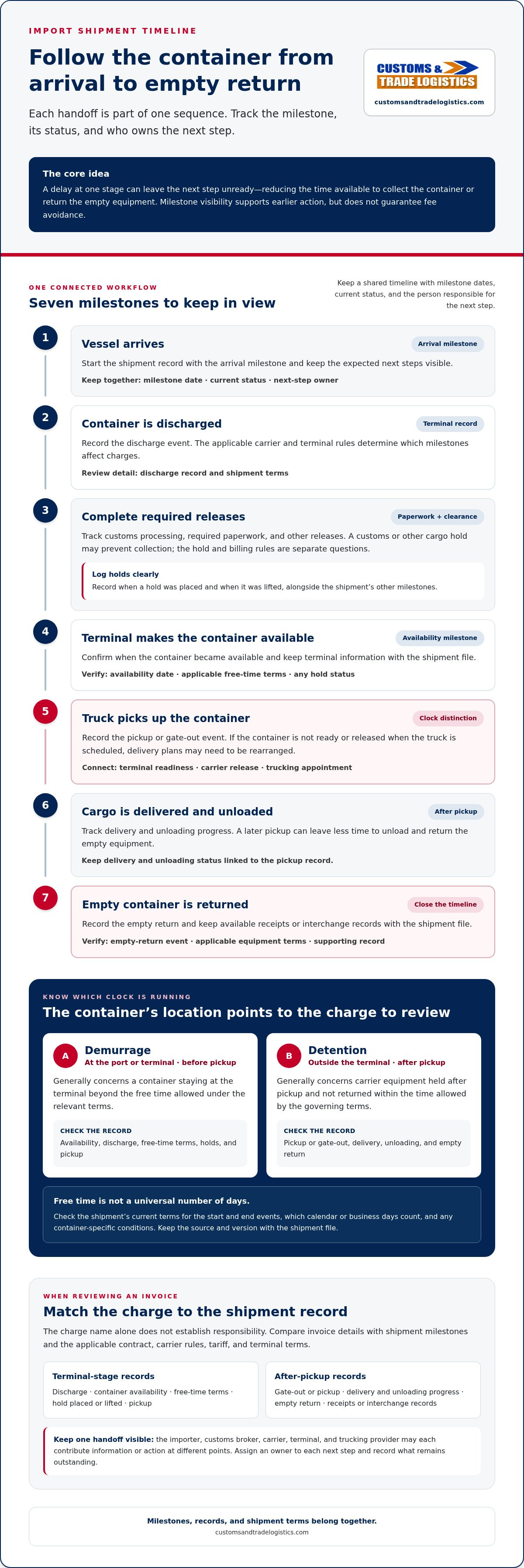
Map the full journey: the vessel arrives, the container is discharged, required releases are completed, the terminal makes the container available, a truck picks it up, the cargo is delivered and unloaded, and the empty container is returned as required. Which milestones affect charges depends on the applicable carrier and terminal rules and the shipment’s terms. For broader context, Demurrage on Wikipedia describes the term’s use across shipping and other forms of transport.
Milestone visibility supports earlier action, not guaranteed fee avoidance. Knowing who owns each handoff and when it is expected helps your team respond to delays and understand what happened if a charge needs review.
Where port charges fit in an import shipment
The importer, customs broker, carrier, terminal, and trucking provider each contribute information or action at different points. Paperwork may be progressing while a pickup appointment is still unconfirmed. If the container isn’t ready or released when the truck is scheduled, the importer may need to rearrange delivery plans. A later pickup can also leave less time to unload and return the empty equipment. Keep a shared timeline with milestone dates, current status, and the person responsible for the next step. This makes handoffs easier to follow and sets up the distinction between demurrage and detention.
Why small importers can feel the impact quickly
For a small importer, one container may hold inventory needed for a planned delivery or replenishment cycle. A delay can push back receiving, create a gap on the shelf, or force changes to customer commitments. Pressure builds when updates sit in separate inboxes, a document issue surfaces late, or the parties aren’t working from the same pickup plan. Some delays are outside an importer’s control, so don’t assume every charge is preventable. Identify what is known, what remains outstanding, and who can move the next step forward.
Customs readiness is one milestone among several. It needs to connect with carrier release and transport arrangements. Understanding US customs clearance services can help importers plan paperwork and release alongside freight handoffs, rather than treating clearance as a separate task. Customs and Trade Logistics coordinates customs paperwork, freight, and container transport so importers can follow these workstreams together. This coordination does not guarantee that charges will never apply.
Demurrage vs. Detention: Know Which Clock Is Running
To understand a charge, identify where the container was and what stage the shipment had reached. Demurrage generally concerns container time at a port or terminal. Detention generally concerns carrier equipment held outside the terminal. The distinction is useful, but the applicable contract, carrier rules, and terminal terms determine how a particular shipment is treated. When managing port demurrage and detention charges, verify the relevant milestones instead of assuming every container follows the same clock.
| Charge | Where the container is | Shipment stage | Milestone to verify |
|---|---|---|---|
| Demurrage | At the port or terminal | Before pickup | Applicable availability, discharge, free-time, and pickup records |
| Detention | Outside the terminal | After pickup | Pickup, allowed use period, and empty-return records |
This is a practical guide, not a substitute for the shipment’s governing terms. The Federal Regulations on Demurrage and Detention provide a reference for federal billing requirements. Use the current text when reviewing regulatory questions.
What demurrage means during terminal dwell
Demurrage may apply when a container remains at a terminal beyond the free time allowed under the relevant terms. The start point, allowance, and billing treatment can vary, so check the carrier’s applicable tariff or contract and terminal information for the shipment. A customs or other cargo hold may prevent collection, but the hold and billing rules are separate questions. Record when the container became available, when any hold was placed or lifted, and when pickup occurred.
What detention means after container pickup
Demurrage concerns terminal dwell; detention concerns equipment use after pickup, but the shipment’s terms determine how each clock is measured. “Free time” means the defined allowance before a charge may apply, not a universal number of days. Verify which calendar or business days count, the start and end events, and any container-specific conditions in the current terms. Keep the source and version you relied on with the shipment file.
When customs clearance, paperwork, freight coordination, and container transport need to align, connected planning can make milestone ownership clearer. Learn about customs and freight logistics support from Customs and Trade Logistics, a family-owned firm with more than 35 years of industry experience.
What Drives Port Charges, and How Can You Review Them?
A port charge isn’t automatically unavoidable, and it isn’t automatically wrong because a delay occurred. Separate two questions: what happened during the shipment, and what do the applicable terms say about billing? A document delay, customs processing, terminal hold, or missed truck appointment may explain events, but doesn’t by itself establish who is responsible for a charge. Responsibility depends on the shipment terms and the recorded facts.
A sound review compares billed dates with shipment records and the applicable terms. Match each invoiced day or event to the carrier or terminal’s stated calculation method, then check whether the timeline supports it. If a date, milestone, or billed period doesn’t align, identify the discrepancy and preserve the records that show why.
Common delay points to investigate
Check document readiness, customs processing, and recorded cargo or carrier holds. Compare those events with terminal availability, trucking capacity, and appointment details. Delays can overlap: a container might be released while a truck appointment remains unavailable, or a paperwork issue might be resolved after a planned pickup slot has passed. Build the event history from shipment records instead of assuming one handoff explains the whole charge. Customs clearance is one part of the sequence, not a determination of carrier or terminal billing.
Records to gather before challenging a charge
Put the invoice beside the governing contract or tariff and gather documents showing what happened and when. Keep original notices where possible, including timestamps and reference numbers. A concise evidence file makes it easier to describe a discrepancy and follow the billing party’s current review process. Gather:
- The invoice, relevant shipment terms, and any stated calculation details.
- Arrival, discharge, availability, and release notices.
- Customs release information and records of any holds or exceptions.
- Pickup appointment confirmations, changes, and terminal gate-out or interchange records.
- Empty-return receipts or interchange records showing when and where equipment was returned.
- Written correspondence about delays, access problems, appointments, or other exceptions.
Compare the documents in order. If an invoice includes a period when the container was recorded as unavailable, locate the availability notice and relevant terms before deciding what to raise. If pickup or return dates differ between the invoice and gate records, flag those exact entries. Avoid broad claims such as “the delay wasn’t our fault.” A focused review identifies the billed dates that appear inconsistent and points to supporting records.
Submit the review through the billing party’s stated channel and follow its current process and deadlines. Keep a copy of your submission, attachments, and any response with the shipment file. This approach supports managing port demurrage and detention charges by separating operational causes, billing calculations, and contractual responsibility.
A Practical Workflow for Managing Demurrage and Detention
A reliable process gives every shipment milestone an owner, a next action, and a record. Keep one shared event log for the importer’s team and logistics partners instead of relying on separate email threads. Include the container or shipment reference, event time, update source, current status, responsible person, and next step. Mark estimates clearly so nobody treats a projected arrival or availability time as confirmed.
Prepare before the vessel arrives
Before arrival, confirm that shipment documents are progressing, key contacts are known, delivery plans are workable, and the applicable carrier and terminal terms are on file. Track expected arrival and availability updates, noting who issued each update and whether it’s an estimate or a confirmed milestone. No fixed timetable fits every port call, so coordinate customs, trucking, and receiving plans as dates develop.
Use this sequence to carry the plan through empty-equipment return:
- Set ownership. Name one person to maintain the event log and assign an owner to each action, such as document follow-up, customs status, carrier release, truck arrangements, receiving, and empty return. Partners should know whom to update and where the latest status is recorded.
- Check readiness. Before arrival, review paperwork status, delivery instructions, contact details, shipment terms, and receiving capacity. Record open items with a responsible person and due date. Don’t treat a projected vessel or availability date as final.
- Update the timeline. Add arrival, discharge, availability, hold, release, and appointment updates as they’re received. Note the source and timestamp, and replace estimates with confirmed events only when supported by a notice or record.
- Verify release and pickup. Before arranging container movement, confirm the shipment’s release status and pickup plan. Record appointment details and changes in the shared log so the receiving team and transportation partners work from the same information.
- Coordinate delivery and unloading. Align the truck arrival with the receiving site’s capacity and unloading plan. If an appointment changes or receiving is delayed, update the log promptly and identify the next available action. Return timing depends on the applicable terms and operational circumstances, so keep the plan flexible.
- Document empty return. Save the equipment return receipt or interchange record and enter the return date in the event log. When the final invoice arrives, compare its billed dates with documented pickup and return milestones and retain the supporting records with the shipment file.
This workflow won’t make every delay preventable, but it can expose missing handoffs sooner and preserve a clearer shipment history. Customs and Trade Logistics coordinates customs paperwork, freight, container transport, and delivery planning for importers. Coordinate your import shipment with its team, which brings more than 35 years of industry experience to import logistics.
How Customs and Trade Logistics Supports Better Shipment Coordination
Port-charge exposure can depend on how well separate shipment tasks connect. Customs paperwork, carrier updates, terminal release, container transport, and delivery planning each affect what the next person can do. Customs and Trade Logistics brings these workstreams together for small and medium-sized importers, helping keep shipment information and responsibilities clearer as a container moves from origin toward delivery.
Connect customs paperwork with freight milestones
Paperwork readiness and customs processing belong on the same planning timeline as shipping and inland transport. If a document question arises, the team can identify the shipment status and coordinate next steps with freight and container arrangements. This doesn’t determine carrier or terminal billing, and it can’t guarantee charges won’t apply. It helps the importer understand what’s outstanding and keep updates connected instead of scattered across separate conversations.
For a shipment moving from a supplier in China to a U.S. destination, early coordination can link supplier-side information with import paperwork, expected shipping milestones, and delivery requirements. Organize cargo details, supplier contacts, document status, timing expectations, and final delivery needs. A clear picture of these basics makes it easier to understand how the shipment’s separate steps fit together.
Plan the next shipment with experienced support
Customs and Trade Logistics is a family-owned customs brokerage and logistics consulting firm with more than 35 years of industry experience. It supports importers with customs clearance, paperwork handling, international freight coordination, container transport, and delivery redistribution. For a small business managing international shipments alongside everyday operations, considering these details together can make it easier to organize information and identify follow-up needs as the shipment progresses.
Before discussing an upcoming import, gather a few practical details:
- Cargo: What’s shipping, and what shipment or container references are available?
- Timing: What arrival estimates or confirmed milestones have been shared?
- Paperwork: Which documents are ready, and are any items still outstanding?
- Delivery: Where does the shipment need to go, and what receiving arrangements should be considered?
These details give the conversation a useful starting point. Customs and freight coordination can help make shipment requirements and handoffs easier to follow, while recognizing that delays and charges still depend on circumstances and applicable terms. A connected view won’t prevent every fee, but it can support clearer communication and better-organized records when managing port demurrage and detention charges.
Planning an import or reviewing coordination needs for an upcoming shipment? Discuss your customs and logistics needs with Customs and Trade Logistics.
Make Your Next Import Easier to Coordinate
Turn what you’ve learned into a routine your team can use for every container. Decide who maintains shipment updates, where records are kept, and how changes are shared when plans shift. A consistent approach gives people a clear starting point when a new shipment is booked, rather than leaving them to piece together events after a delay or invoice appears.
Managing port demurrage and detention charges is an ongoing coordination task, not a promise that every fee can be prevented. Shipment conditions and applicable terms still matter. A deliberate plan can help your team respond with better information and keep responsibilities visible from one handoff to the next.
Customs and Trade Logistics can help coordinate an upcoming import, from customs paperwork to freight and container movement. Plan your import shipment with Customs and Trade Logistics to take the next step with a clearer path forward.
Frequently Asked Questions
How are port demurrage and detention charges calculated?
They’re generally calculated using the applicable terms, the time counted, and the container or shipment category. Check the invoice against the stated free-time allowance, start and end milestones, day-counting method, and any rate tiers. For example, an invoice might use a different start date than the terminal availability notice. Comparing those records can reveal a discrepancy. Rates and calculation details vary, so use the shipment-specific tariff or contract when managing port demurrage and detention charges.
Can demurrage and detention apply to the same container?
Yes. A container may incur demurrage while it remains at the terminal and detention after pickup if the equipment isn’t returned within the applicable allowance. These charges relate to different stages, so review the dates to see whether the billed periods are sequential or appear to overlap. Compare the terminal gate-out record with the invoice’s stated end date for terminal time, then check the empty-return receipt against the detention period.
Who is responsible for paying demurrage and detention charges?
The party billed and the party ultimately responsible depend on the shipment’s contract, carrier or terminal terms, and arrangements among the importer and other parties. Don’t assume that the importer, customs broker, or trucking provider automatically owes a charge simply because its step appears in the timeline. Review the bill-to details and shipment agreements, then compare them with documented events. If responsibility is unclear, identify the relevant contract language before assigning it.
Can a customs hold lead to demurrage or detention?
A customs hold can delay a container’s release or movement and may coincide with time counted under applicable carrier or terminal terms. The hold itself doesn’t establish whether a charge applies, pauses, or is billable to a particular party. Keep the hold notice and release confirmation, including their dates, and compare them with the invoice period and shipment terms. A hold after terminal pickup may affect delivery plans too, but its specific treatment depends on the agreements governing the shipment.
How can I dispute a demurrage or detention invoice?
Submit a focused review through the billing party’s stated process, following its current instructions and deadlines. Point to the specific invoice entry you question and attach supporting records, such as an availability notice, release confirmation, appointment change, gate record, or empty-return receipt. If the billed return date differs from the receipt, identify both dates and include the document showing the return. Keep copies of your submission and any response with the shipment file.
Is terminal storage the same as demurrage?
Not necessarily. Terminal storage may describe a charge for space or time at a facility, while demurrage is a carrier or terminal charge defined by applicable shipment terms. Labels, calculations, and whether charges are separate can vary by tariff, contract, and terminal. If an invoice lists both, don’t assume they’re duplicates or automatically separate charges. Compare the descriptions, billing periods, and terms, then use the billing party’s process to request clarification on any unclear line item.