

What if the right compliance checklist for one children’s product is the wrong one for another? The requirements for importing children's products depend on age range, product category, materials, and intended use. That can make it difficult to identify the relevant safety rules, tests, and documents. Incomplete records can disrupt a shipment or delay a product launch.
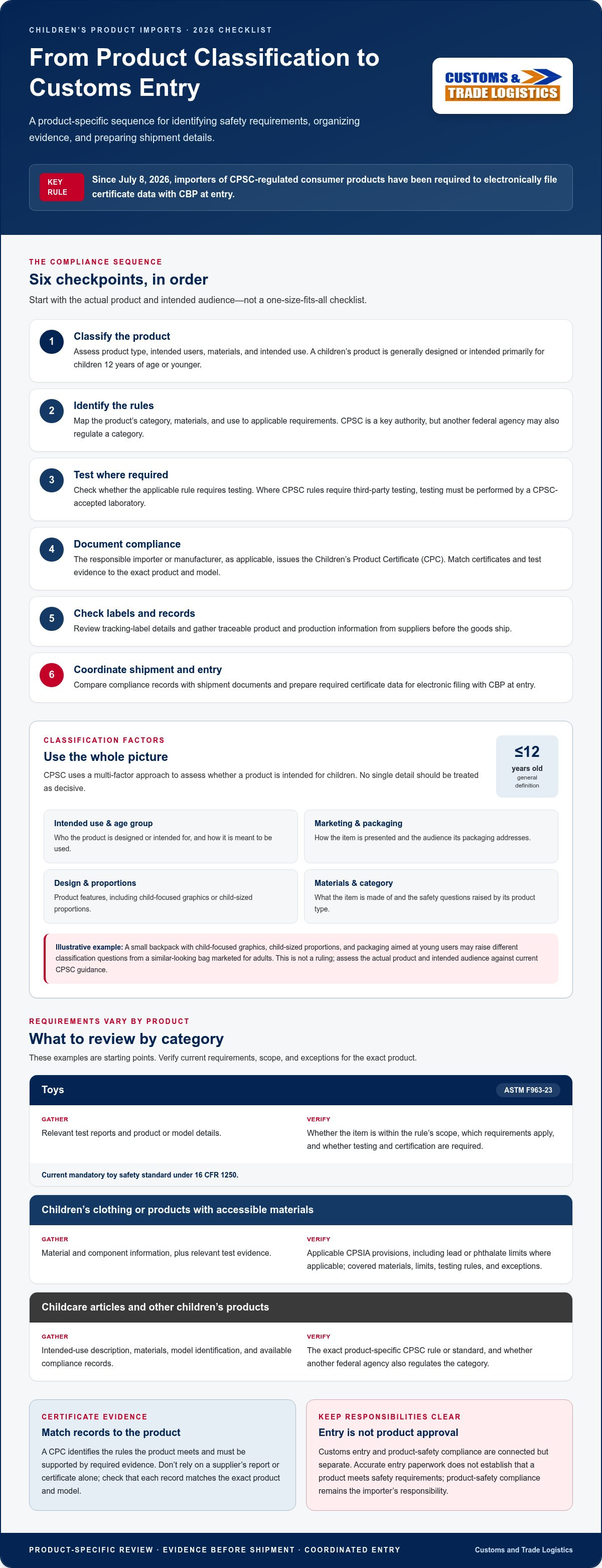
For most entries, an additional step now applies: since July 8, 2026, importers of CPSC-regulated consumer products have been required to electronically file certificate data with U.S. Customs and Border Protection at entry. Compliance records are now part of shipment preparation, not paperwork to leave until the goods arrive.
Use this practical 2026 checklist to identify relevant product-safety rules and testing, organize certificate and tracking-label records, and prepare customs documents before shipment. You’ll also learn how to coordinate supplier, freight, and customs steps. Customs clearance and logistics support can help keep shipment details and paperwork aligned, while product-safety compliance remains a separate responsibility.
Key Takeaways
- The requirements for importing children's products depend on intended users, product type, materials, and applicable safety rules. Classify the product before planning compliance.
- Review each product to identify the relevant standards, testing, and certificates instead of assuming one set of rules fits every category.
- Keep product-safety evidence separate from commercial and transport paperwork, and check tracking-label details before the goods ship.
- Gather traceable product and production information from suppliers, then compare it with compliance records and shipment documents.
- Customs and freight coordination can help align paperwork and entry preparation, while product-safety compliance remains the importer’s responsibility.
Requirements for Importing Children’s Products: Start With Product Classification
The requirements for importing children's products depend on the product type, intended users, materials, and applicable safety rules. Start by classifying the product, then identify the evidence, labels, and shipment information needed for that specific item. Customs entry and product-safety compliance are connected but separate parts of the import process. Accurate entry paperwork does not establish that a product meets safety requirements.
Use this sequence to organize your review: classify, identify rules, test, document, label, and coordinate shipment. The Consumer Product Safety Commission (CPSC) is a key U.S. product-safety authority, but some product categories may also fall under other agencies. Classification is the first step in finding out which requirements apply.
How to identify whether a product is a children’s product
A children’s product is generally one designed or intended primarily for children 12 years of age or younger. Classification depends on context, not just on what a supplier calls an item. Consider its intended use, marketing, design, packaging, and intended age group. CPSC uses a multi-factor approach to assess whether a product is intended for children, so no single detail should be treated as decisive.
Illustrative example: A small backpack with child-focused graphics, child-sized proportions, and packaging aimed at young users may raise different classification questions from a similar-looking bag marketed for adults. This example is not a ruling. Assess the actual product and intended audience against current CPSC guidance before deciding which requirements apply.
Why requirements differ across product categories
A toy, children’s clothing, and a childcare article can raise different safety questions because their uses, materials, and potential hazards differ. A toy may need review against toy-specific requirements; clothing and other children’s products may raise questions about material limits or other applicable rules. The Toy safety regulations overview offers general background, but use current official sources to verify the rules for a particular product.
Some categories may also fall under requirements administered by another federal agency. Don’t assume the CPSC is the only authority involved; verify the product’s full regulatory scope before shipment. For toys, note that ASTM F963-23 is the current mandatory toy safety standard under 16 CFR 1250. Toy rules can apply more broadly than the children’s-product definition, so check the product’s intended age group and the standard’s scope carefully.
Which Children’s Product Safety Rules, Tests, and Certificates May Apply?
After classifying the product, map its materials and intended use to the rules that cover it. The requirements for importing children's products vary by category: a toy, a garment, and a childcare article can raise different compliance questions. Use the examples below as a starting point, then verify current requirements and any exceptions for the exact product.
| Product category | Possible rule or standard and evidence to gather | What to verify |
|---|---|---|
| Toys | ASTM F963-23 may apply under the federal toy safety rule. Gather relevant test reports and product or model details. | Confirm the item is within the rule’s scope, the applicable requirements, and whether testing and certification are required. |
| Children’s clothing or products with accessible materials | CPSIA provisions may include lead or phthalate limits where applicable. Gather material and component information and relevant test evidence. | Check which materials and components are covered, applicable limits, testing rules, and any exceptions. |
| Childcare articles and other children’s products | Product-specific CPSC rules or standards may apply. Gather the intended-use description, materials, model identification, and available compliance records. | Identify the exact rule and check whether another federal agency also regulates the product category. |
CPSIA, CPSC rules, and applicable product standards
The Consumer Product Safety Improvement Act (CPSIA) establishes requirements that can apply to children’s products, but not every product faces the same tests or limits. Lead and phthalate provisions, for example, depend on the product, materials, and applicable scope. ASTM F963-23 is the current mandatory toy safety standard, incorporated under 16 CFR 1250. Verify that the product is covered and determine which provisions apply rather than assuming every children’s item is a toy.
Testing, Children’s Product Certificates, and supporting evidence
Where a CPSC rule requires third-party testing, the test must be performed by a CPSC-accepted laboratory. The responsible importer or manufacturer, as applicable, issues a Children’s Product Certificate (CPC). The certificate must identify the rules the product meets and be supported by the required evidence. Review the Children’s Product Certificate (CPC) requirements for certificate details. For covered CPSC-regulated imports, certificate data must also be electronically filed with CBP at entry under the 2026 eFiling requirement.
Don’t rely on a supplier’s report or certificate alone. Match each record to the exact product and model, materials, applicable rule, and production details. A report for a similar item may not support the product you’re importing. Customs and freight coordination can help keep entry data aligned with shipment paperwork. Customs clearance and freight coordination supports that process but does not replace product-safety testing or certification.
Labels and Records: What to Prepare Before Children’s Products Ship
Keep product-safety evidence distinct from documents used to describe and move the shipment. Both matter, but they serve different purposes. A test report records test results, a certificate declares compliance with applicable rules, and a customs document supports shipment entry and clearance.
| Product-safety evidence | Commercial and transport documents |
|---|---|
| Applicable test reports, product specifications, materials or bill of materials, certificates such as a required CPC, and records supporting the product’s age grading and tracking label. | Commercial invoice, packing details, shipment description, quantities, and supplier information used to prepare and coordinate the customs entry and transport. |
Product labels, tracking information, and age grading
Children’s products and their packaging must have a permanent tracking label. Under current CPSC requirements, it identifies the manufacturer or importer, production date and location, and a batch or run number. Check the exact information and placement against current official guidance, especially if the item’s size or design affects where a label can go.
Review age grading carefully, too. It helps determine which safety rules apply, while packaging language may simply be marketing. Don’t rely on a supplier’s suggested age or a label alone to settle classification. Compare the product’s design, intended use, and audience with the applicable rules.
Build a document file before booking freight
Gather the records that apply to the product before finalizing shipment plans. Depending on the item, this file may include product specifications, a bill of materials, test reports, certificates, commercial invoices, and packing details. The FDA import program information is also useful when assessing whether a product may fall under FDA oversight. Verify any additional agency requirements for the specific item.
- Match product and model names across test reports, certificates, invoices, and supplier records.
- Compare shipment quantities and descriptions with the commercial invoice and packing details.
- Check that supplier, manufacturing, testing, and production information is consistent across applicable records.
- For covered CPSC-regulated products, prepare required certificate data for electronic filing with CBP at entry.
These checks can reveal mismatches before the cargo moves. Customs paperwork is only one part of the file, but clear, consistent shipment details support coordination between suppliers, freight planning, and customs entry preparation.
Pre-Import Checklist: Coordinate Compliance, Supplier Details, and Customs Entry
A clear pre-shipment workflow helps keep product-safety review and customs preparation on track. The requirements for importing children's products depend on the product and applicable rules, so work through each step with the actual model and shipment in view.
- Classify the product. Record its intended users, purpose, materials, design, and model identifiers. Don’t rely on a supplier’s product description alone to determine its regulatory category.
- Map the applicable rules. Identify the relevant CPSC requirements and any product-specific standards or other federal-agency rules. Note which requirements call for testing or certification.
- Gather supporting evidence. Collect applicable test reports, certificates, product specifications, and material details. Match each record to the model and goods being ordered.
- Review labels. Compare the product and packaging against applicable tracking-label and age-grading requirements. Resolve missing or inconsistent information before shipment.
- Prepare entry data. Align the customs description, quantities, values, origin details, and shipping documents with supplier records and the goods being shipped.
For CPSC-regulated products, treat eFiling as a current-year check. As of October 2026, CPSC certificate eFiling with U.S. Customs and Border Protection (CBP) is required at entry for most merchandise from July 8, 2026; goods entering from a Foreign Trade Zone have a January 8, 2027 compliance date. The requirement also applies to low-value shipments. Verify the latest official scope and implementation details for the product and entry type before filing.
Questions to resolve with the supplier before production or shipment
Request consistent model identifiers, material and component details, intended age range, production information, and applicable test documentation. Compare those records with the purchase order and the goods being made. A report for a similar product or an earlier sample may not support the version you’re importing if its materials or design differ.
Keep a written list of unresolved compliance questions and identify who is responsible for answering each one. Resolve gaps before authorizing the shipment, not after the cargo is moving.
Customs entry and freight details to align
Safety approval and customs entry are related, but they are not interchangeable. A customs broker can coordinate entry preparation using accurate shipment details, but customs clearance does not establish product-safety compliance or replace a required certificate. Keep product-rule evidence distinct from commercial descriptions, tariff classification, and entry-filing information, then reconcile all records before the cargo moves.
For help coordinating import shipment details and customs paperwork, coordinate your import shipment and customs paperwork.
How Customs and Logistics Support Fits Into Children’s Product Imports
Importing a children’s product involves two connected workstreams: establishing that the product meets applicable safety requirements and preparing the shipment for transport and customs entry. A customs broker and logistics partner can help coordinate shipment details, paperwork, freight planning, and entry preparation. They don’t replace required product testing or certification, or the importer’s responsibility to meet applicable rules.
Keep compliance responsibility distinct from customs clearance
Think of product-safety records and customs-entry details as separate files that need to agree. A product certificate or test report supports the safety-compliance process. Commercial descriptions, quantities, origin details, and transport documents support shipment planning and entry preparation. Consistent product identifiers and supplier information help connect the records without confusing their purpose.
Resolve product-specific questions about applicable rules, tests, or certificates using current guidance from the relevant government agency. Customs clearance can coordinate entry-related information, but it doesn’t determine whether a product meets safety standards or certify compliance. Clear roles and document handoffs help first-time importers manage the process one stage at a time.
Plan an end-to-end shipment with experienced import support
Customs and Trade Logistics coordinates customs clearance, international freight logistics, import consulting, paperwork, and delivery redistribution for small and medium-sized businesses. With more than 35 years of industry experience, the family-owned firm helps bring supplier, freight, and customs information together as an import moves from preparation toward delivery.
For imports from China, begin supplier coordination early. Share consistent product and production details with the people preparing compliance records and shipment documents, then reconcile those details before the cargo moves. The same staged approach applies regardless of origin: organize the information, identify who handles each handoff, and keep the product-safety review distinct from logistics planning.
Once supplier records and shipment details are organized, logistics planning can proceed with fewer avoidable information gaps. Talk with Customs and Trade Logistics about your import plans to discuss customs clearance and freight coordination for your shipment.
Prepare Your Import Plan With Confidence
The requirements for importing children's products start with classifying the product and identifying the rules that apply to its category, materials, and intended users. Gather supporting test reports and certificates where required, check product and package labels, and make sure supplier, compliance, and shipment records describe the same goods.
Keep product-safety obligations distinct from customs entry and freight planning. Organized records can help align these connected steps, but customs clearance doesn’t replace testing, certification, or other applicable product-safety responsibilities. Reviewing each handoff before the cargo moves can make a complex process easier to manage.
For support coordinating customs clearance and freight across U.S. Customs ports, work with Customs and Trade Logistics, a family-owned customs brokerage and logistics consulting firm with more than 35 years of industry experience. Discuss your children’s product import and shipment plan and take the next step with a clearer path forward.
Frequently Asked Questions
Is every product made for children subject to the same U.S. testing requirements?
No. Testing requirements depend on the product’s intended use, age grading, materials, and applicable safety rules. Some products require testing by a CPSC-accepted third-party laboratory, while others may have different requirements or exceptions. Identify the exact product and the rules that cover it before relying on a supplier’s report. The requirements for importing children's products are product-specific, so verify current official guidance before shipment.
Does every imported children’s product need a Children’s Product Certificate?
No. A Children’s Product Certificate (CPC) is required when applicable children’s product safety rules require one; it isn’t a universal certificate for every product. The CPC identifies the applicable rules and must be supported by required evidence, including test results where the rules call for testing. Confirm the product classification, certificate requirements, content, and responsible certifier before the goods ship.
Can I use a supplier’s test report when importing children’s products?
Possibly, but a supplier report alone doesn’t establish that every applicable requirement is met. Check that it identifies the exact product or model, materials, production details, test scope, and relevant U.S. rules. If a rule requires third-party testing, verify that the laboratory is CPSC-accepted and that the report covers the required tests. Keep matching records organized with the product’s compliance documents.
What labels are required on imported children’s products?
Children’s products and their packaging must have a permanent tracking label identifying the manufacturer or importer, production date and location, and a batch or run number. Other label details, including age grading and warnings, depend on the product and applicable rules. Verify current official guidance for required information and placement. Make sure product identifiers on labels match the compliance records and shipment documents.
What happens if children’s products arrive without the required documents?
Missing or inconsistent records can raise compliance questions, delay shipment handling, or complicate the product’s path to sale. The specific outcome depends on the product, the missing information, and the applicable rules. Before shipping, organize safety evidence separately from customs-entry paperwork, compare model and shipment details across records, and resolve outstanding questions with the responsible parties.
Does customs clearance mean my children’s product is compliant with U.S. safety rules?
No. Customs clearance and product-safety compliance are separate parts of importing. A customs entry supports the import transaction, while applicable safety rules may require testing, certificates, tracking labels, or other evidence. A customs broker can help coordinate entry paperwork and shipment details, but that work doesn’t replace product testing or certification and doesn’t establish that all safety requirements have been met.
Does CPSC eFiling apply to every children’s product import in 2026?
It applies to CPSC-regulated consumer products, not automatically to every item marketed to children. As of October 2026, most covered merchandise must have certificate data electronically filed with CBP at entry; low-value shipments are included. Products entering from a Foreign Trade Zone have a January 8, 2027 compliance date. Check current CPSC guidance for the product and entry type before filing.