

What if the biggest impact of Golden Week on China shipping happens before the holiday even begins? China’s 2026 National Day break ran from October 1 to 7, but the compressed calendar left just three working days, September 28-30, after the Mid-Autumn Festival. That squeeze can affect factory output, cargo handoffs, and available freight capacity, even though shipping doesn’t simply stop everywhere.
If you’re concerned that a supplier may go quiet or cargo could miss its planned departure, the key is to confirm what is happening at each stage. Golden Week can affect production, freight capacity, and schedules, so shipment readiness depends on more than the holiday dates alone. This guide explains how to plan production, freight bookings, documents, and US import steps around the holiday.
You’ll find a checklist for coordinating suppliers and logistics partners, plus guidance on connecting freight and customs planning. Customs and Trade Logistics is a family-owned firm with over 35 years of experience, supporting China imports with international freight logistics and customs clearance. Small and medium-sized businesses can use its free consultation to discuss import planning with a compliance-first approach.
Key Takeaways
- Understand how the impact of Golden Week on China shipping can reach beyond factory closures to cargo handoffs and scheduled departures.
- Compare ocean and air freight planning factors, and identify which schedule and cargo details matter for your shipment.
- Use a step-by-step checklist to align supplier closure dates, cargo readiness, carrier schedules, and document review.
- Prepare for possible cargo rollovers or blank sailings instead of assuming every transport operation stops.
- See how freight coordination and customs planning can connect your China shipment’s departure with its US import steps.
What Is China’s Golden Week, and When Does It Affect Shipping in 2026?
China’s Golden Week is the National Day holiday period, a scheduled break that can affect factory output, supplier communication, and freight handoffs. Importers pay attention because a pause or reduced staffing at one point in the chain can change when goods are ready to move, even if transport services continue operating.
The national holiday dates are a planning reference, not a shipment schedule. To understand the impact of Golden Week on China shipping, distinguish the official calendar from the operating plans of the supplier, carrier, and logistics providers handling your cargo. Background on China’s Golden Week holiday explains its connection to National Day and the broader holiday period.
The 2026 Golden Week window for China shipments
The State Council’s official 2026 holiday schedule sets the National Day Golden Week period from October 1 through October 7, 2026. Those dates identify the public holiday, but they don’t establish a universal factory closure or cargo cutoff. A supplier may close on different dates, reduce staffing around the holiday, or resume work on a schedule specific to its business and location.
Use the calendar to frame your planning, then confirm the dates that apply to your order. A public holiday date does not guarantee that cargo must be handed over or loaded by a particular day.
Which parts of the supply chain may change
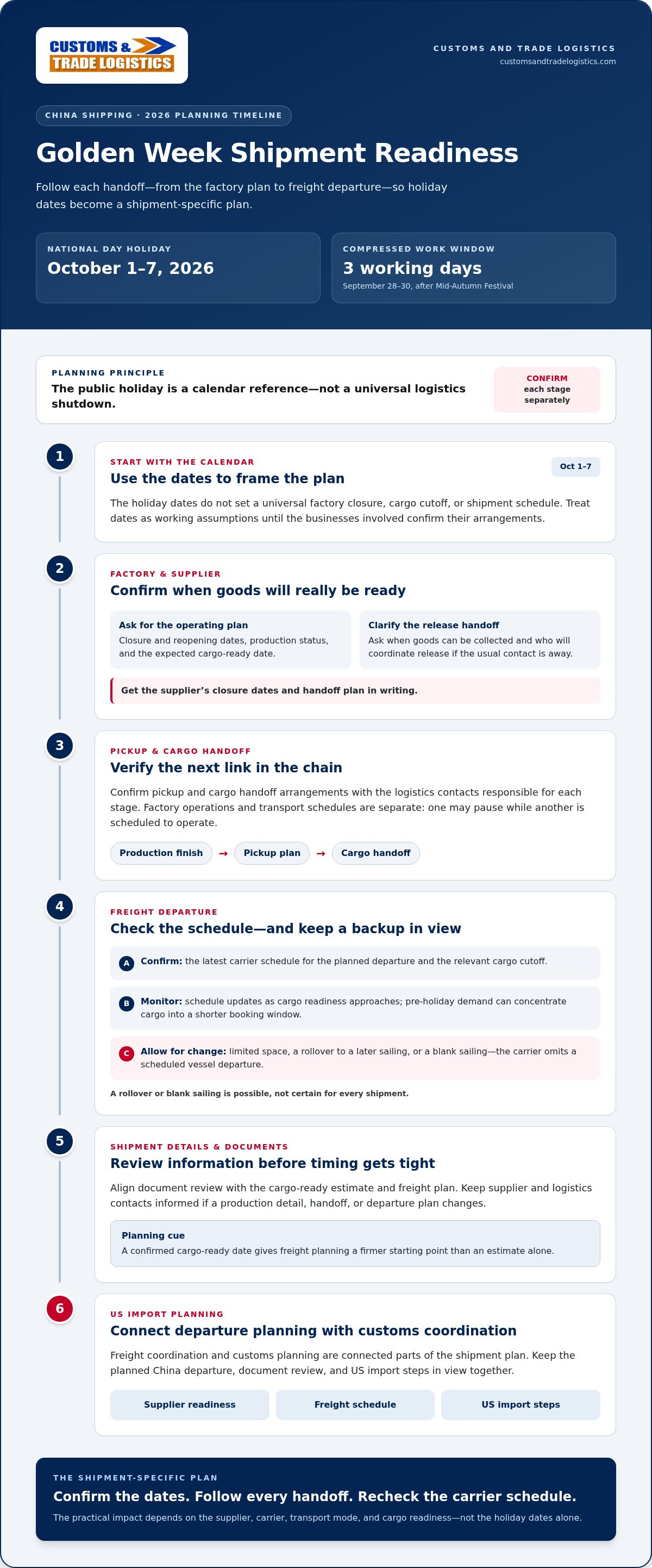
Start with production and communication. A factory’s holiday plan can affect the production finish date, packing, or the speed of responses to questions. Confirm both the closure period and the date your goods are expected to be ready.
Transport is a separate consideration. Carriers and logistics providers may adjust operating schedules, but those changes don’t necessarily match a supplier’s dates. Verify pickup, handoff, and departure arrangements with the contacts responsible for each stage, then revisit schedules as the holiday approaches.
A scheduled public holiday is not a universal logistics shutdown. The practical effect depends on which businesses in your shipment’s route pause, reduce service, or revise their schedules. A factory might be closed while a transport service is scheduled to operate, or cargo may be ready while a later handoff needs rescheduling.
Before relying on a planned timeline, confirm the moving parts directly:
- Ask your supplier for its closure and reopening dates, production status, and cargo-ready estimate.
- Confirm pickup and cargo handoff arrangements with the relevant logistics contacts.
- Check the latest carrier schedule for the planned departure and keep communication open for updates.
These checks turn the national calendar into a shipment-specific plan. Treat dates as working assumptions until the businesses involved confirm their arrangements.
How Golden Week Can Affect China Shipping from Factory to Freight Departure
A shipment can be affected before it reaches a port. If a factory finishes production later than planned, there may be less time to arrange pickup, complete the cargo handoff, and meet the intended vessel departure. Around a major holiday, several businesses may also be working to move goods before closures, putting pressure on available capacity. These are possible knock-on effects, not automatic outcomes for every shipment.
The effects depend on the supplier, carrier, transport mode, and cargo readiness. Following each handoff helps you identify where a schedule may need adjustment rather than treating “shipping” as one single operation.
Factory schedules, cargo readiness, and supplier communication
Reduced staffing or a factory closure may affect when goods are completed, packed, or released for pickup. It may also take longer to get a response about a production issue or missing shipment detail. An estimated completion date is useful, but a confirmed cargo-ready date gives freight planning a firmer starting point.
Get the supplier’s closure dates and handoff plan in writing. Ask when production is expected to finish, when the goods can be collected, and who will coordinate release if the usual contact is away. This gives the next parties in the chain a clear reference and makes it easier to spot a timing gap early.
Capacity, blank sailings, and shipment rollovers
Pre-holiday demand can concentrate cargo into a shorter booking window. When many shippers aim for departures before a break, space may be limited. A shipment that misses a cutoff or cannot be loaded as planned may move to a later sailing. A blank sailing means a carrier omits a scheduled vessel departure from its service. If that happens, cargo booked for that sailing may need a revised plan.
Neither a rollover nor a blank sailing is certain for a particular shipment. Keep the planned departure and a possible alternative in view, and check carrier schedule updates as cargo readiness approaches. The goal is to spot a change early enough to coordinate with the supplier and freight contacts, not to assume a delay or rate increase.
Port and customs operations are not identical to factory operations
Factory schedules, port activity, and customs processing are separate parts of the chain. Some port or customs activity may continue during the holiday period, while staffing, service availability, or specific operating schedules vary. A factory closure therefore doesn’t automatically mean every port or customs function stops. Continued port activity also doesn’t mean a factory can release cargo.
Confirm origin-side pickup and handoff arrangements, then plan the destination-side steps for the US import. The U.S. Customs and Border Protection import guidelines provide official information to support import preparation. For help aligning freight coordination and customs planning, China import logistics support can help connect the stages into one shipment plan.
Ocean or Air Freight: Compare Golden Week Risks Before Choosing a Plan
Does the holiday mean every shipment stops? No. Golden Week doesn’t halt every transport operation, but factory closures, changing carrier schedules, and concentrated demand can affect cargo readiness and which departures are practical. The right mode depends on shipment readiness, urgency, cargo characteristics, and the schedules available for your route. One option is not always safer than the other.
Use this comparison to identify what needs confirming. It’s a planning tool, not a promise of space or an arrival date.
| Planning factor | Ocean freight | Air freight |
|---|---|---|
| Readiness and handoff | Is the cargo ready in time for pickup, origin handling, and the planned vessel cutoff? | Can the supplier prepare and hand off the shipment in time for the available flight schedule? |
| Possible holiday pressure | Concentrated bookings may affect space; a blank sailing or rollover may change the plan. | Schedules and capacity can also come under pressure, particularly when urgent shipments seek alternatives. |
| Shipment priorities | Does the shipment’s timing and cargo profile suit the ocean plan? | Does the shipment’s urgency and cargo suitability support considering air service? |
| Key schedule check | Is the sailing still scheduled, and are handoff arrangements aligned? | Is a suitable flight available, and can cargo meet its handling requirements? |
How to assess ocean freight around Golden Week
Ocean planning needs to connect factory readiness with pickup, origin handoff, and the vessel schedule. A booking or planned sailing is not the same as a confirmed departure: schedules may change, and a blank sailing can remove a scheduled vessel from the plan. Check the current schedule and ask what happens if cargo misses its intended sailing. For more detail on the ocean leg, see this China-to-USA shipping logistics guide. The broader Import From China logistics guide can help place that ocean leg in the full import process.
When air freight may fit the shipment’s needs
Air freight may be worth considering when timing priorities differ from those of an ocean shipment or the cargo is suitable for air transport. First establish when the goods will actually be ready, then compare that date with available flight schedules and the shipment’s requirements. Air isn’t immune to holiday-related capacity pressure, so don’t treat it as an automatic way around schedule uncertainty.
Choose based on shipment facts, not holiday assumptions
Start with the supplier’s cargo-ready update, then compare it with the latest information from the freight provider. A preference for a particular mode doesn’t reserve space or guarantee arrival timing. If the readiness date or schedule changes, revisit the plan using the updated information. This shipment-specific approach makes the impact of Golden Week on China shipping easier to assess without assuming every route or mode will be affected in the same way.
A Golden Week Shipping Checklist for US Importers
A reliable holiday plan connects supplier readiness, freight arrangements, and US import preparation. Work through these steps in order, and keep a written record of confirmed dates and changes. If the impact of Golden Week on China shipping affects one stage, you can respond using current information instead of assumptions.
Confirm the shipment plan before the holiday period
- Confirm supplier timing. Get the factory’s closure and reopening dates, current production status, estimated cargo-ready date, and handoff arrangements in writing. Ask who will provide updates if the usual contact is unavailable.
- Align cargo readiness with the freight plan. Confirm the intended transport mode, current carrier schedule, relevant pickup and cargo cutoffs, and who is responsible for sharing schedule changes. Treat dates as subject to updates, not as a guarantee that cargo will depart or arrive on a specific day.
- Discuss a contingency. Agree how the parties will communicate if production runs late, the planned departure changes, or cargo misses a handoff. This prepares everyone to reassess options without assuming a particular alternative will be available.
Prepare documents and meet the ISF filing requirement
- Gather shipment documents. Organize the commercial invoice, packing list, and transport document, such as the bill of lading for ocean freight or air waybill for air freight. Review these for consistent shipment details, including the goods and quantities.
- Identify goods-specific paperwork. Determine whether permits or certificates apply to the goods being imported, and include relevant documents in the shipment file. Requirements can depend on the goods, so don’t rely on a document set from an unrelated shipment.
- Plan the ocean ISF filing. For ocean cargo, the Importer Security Filing (ISF) must be filed 72 hours before vessel departure. Work backward from the departure schedule and provide the required shipment information in time for filing. If the schedule changes, revisit filing coordination rather than relying on an outdated departure date.
Accurate, complete documents help reduce avoidable processing issues. They also give the people coordinating freight and customs entry a consistent basis for preparing the import file.
Coordinate updates through departure and US entry
- Assign update ownership. Decide who will collect supplier production updates, relay freight schedule changes, and keep customs documents current. Share changes promptly with the relevant parties.
- Review the final transport documents after departure. Compare the issued bill of lading or air waybill with the shipment details and retain the final records for US entry coordination. If shipment information or schedules have changed, communicate the revision instead of assuming earlier details still apply.
Need help bringing freight coordination and customs preparation together? Request a free consultation for your China import plan with Customs and Trade Logistics.
How Customs and Trade Logistics Helps Manage China Import Planning
Golden Week planning involves more than choosing a departure date. Supplier readiness, freight coordination, import paperwork, and US customs entry all need to fit together. Customs and Trade Logistics helps small and medium-sized businesses importing from China organize these connected steps, so shipment decisions are based on clear information rather than assumptions about holiday schedules.
Coordinate freight and customs preparation in one import plan
As a family-owned customs brokerage and logistics consulting firm, Customs and Trade Logistics supports importers with international freight coordination, import documentation, and customs clearance. Bringing these parts into one plan helps keep cargo details consistent as they move from supplier updates to freight arrangements and customs entry preparation.
Accurate paperwork matters. Import document details should align with the shipment and the information used to prepare the customs entry. A compliance-first approach keeps attention on complete, consistent records and the steps required for the import. If Golden Week affects production timing or a planned departure changes, updated shipment information helps keep the import plan aligned with the cargo’s actual status.
Customs and Trade Logistics is a Licensed U.S. Customs Broker providing nationwide customs clearance at all U.S. ports, with over 35 years of experience. Many shipments are cleared within 24 hours. This is not a promise that every shipment will clear within that timeframe; clearance depends on the shipment and its circumstances.
For importers assessing the impact of Golden Week on China shipping, coordinated freight and customs preparation can clarify what needs attention next: a revised cargo-ready date, an updated transport schedule, or a document detail to address before US entry.
Get guidance for your next China shipment
Use a free consultation to discuss your shipment’s cargo readiness, import documentation, freight coordination, and US entry preparation. Sharing the details of your plan can bring the different stages into focus and identify where schedule changes may require updated coordination. It’s a practical starting point for businesses seeking experienced guidance on their import plan.
With Customs and Trade Logistics, importers can work with a professional team that understands freight movement and customs preparation. Leave Logistics to a Professional Team.
Turn Your Import Plan Into the Next Clear Step
The best time to resolve uncertainty is before it becomes a missed handoff. Use your supplier’s latest production update and the current freight schedule to set a practical next milestone, then keep the plan flexible enough to respond if either changes. This turns the impact of Golden Week on China shipping from a broad concern into specific decisions for your shipment.
If you’d like a professional perspective on cargo readiness, paperwork, or US entry planning, Customs and Trade Logistics offers a free consultation for prospective clients. Its nationwide customs clearance support and experience as a Licensed U.S. Customs Broker can help you plan the next steps with a compliance-first focus.
Schedule a free consultation about your China import plan to move forward with a clearer plan for your shipment.
Frequently Asked Questions
When is China’s Golden Week in 2026?
China’s 2026 National Day holiday period ran from October 1-7, 2026. The calendar marks the public holiday, not the working timetable for your specific order. For example, a supplier may stop production before October 1 or resume after October 7. Ask your supplier and freight contacts to provide their closure dates, cargo cutoffs, and operating schedules in writing.
Do all factories and shipping services in China close during Golden Week?
No. There isn’t one schedule for every factory, carrier, port, customs function, or logistics provider. A supplier might pause production while a transport service continues, or a provider may adjust its hours without matching the factory’s calendar. Map your shipment’s handoffs and confirm who is operating at each stage. This is more useful than treating a national holiday as a complete shutdown of the shipping chain.
Can my shipment leave China during Golden Week?
It may, depending on whether the cargo is ready, the supplier and warehouse can release it, and the relevant carrier has an operating departure with available capacity. For example, packed cargo awaiting supplier release may not be ready for pickup even if a vessel is scheduled. Confirm the release arrangements and current transport schedule. A scheduled departure is a plan, not a guarantee that the shipment will sail as expected.
Does Golden Week affect air freight from China?
Yes, it can. Air freight still depends on supplier production, cargo handoff, staffing, and available schedules, so a different transport mode doesn’t remove holiday-related uncertainty. If goods are time-sensitive, compare their confirmed ready date with current air-service options and cargo requirements. Keep a backup discussion open in case production or capacity changes. Air freight may suit some priorities, but it doesn’t guarantee a particular departure or arrival date.
Does China’s Golden Week delay US customs clearance?
Not automatically. Golden Week can affect shipment timing on the China side, while US import processing depends on the shipment’s arrival, entry preparation, and document accuracy. If the departure changes, check that the information used for customs entry still matches the shipment. For example, review updated transport documents against the commercial invoice and packing list, then share corrections promptly with the parties coordinating the entry.
What is a blank sailing during Golden Week?
A blank sailing occurs when a carrier removes a scheduled vessel departure from its service. If your cargo was planned for that departure, the change may require coordination around another schedule and related handoff arrangements. For example, check whether the cargo is still at origin or has already been delivered for loading, since the next steps may differ. Blank sailings are a possibility, not a certainty for every route.
When should an importer file ISF for ocean cargo from China?
For ocean cargo, the Importer Security Filing, or ISF, must be filed 72 hours before vessel departure. Build the filing into the shipment timeline using current departure information, and provide complete, accurate details in time. If the vessel schedule or shipment data changes, coordinate an update rather than assuming the original filing information remains suitable. Assigning one person to gather supplier and transport updates can help prevent missed communications.