

Red flags when choosing a logistics provider become deal-breakers when they could seriously disrupt your supply chain and are difficult to fix. A correctable invoicing mistake, for example, is different from repeated billing problems or a provider that won’t take responsibility. Focus first on the potential impact of each issue and whether the provider can resolve it with clear, measurable steps.
Look beyond an attractive quote: unclear charges, weak communication, unreliable service, limited flexibility, financial instability, and inadequate insurance can all create problems after you sign. This guide explains how to assess those warning signs, distinguish a fixable concern from a reason to walk away, and identify the details that deserve attention before you commit. It also covers how to compare pricing and service expectations, set communication and performance standards, and assess whether a provider can adapt as your business changes.
Key Takeaways
- Separate fixable concerns from deal-breakers by weighing each issue’s potential impact and how difficult it would be to resolve.
- Compare written quotes against the services and activity you expect, and clarify how additional charges, invoice disputes, and corrections will be handled.
- Set measurable service standards and communication routines so you can spot recurring failures and know who will respond when disruptions arise.
- Assess whether the provider can adapt its processes as your products, volumes, or delivery needs change.
- Review financial stability, liability terms, and current proof of insurance before entrusting a provider with your shipments.
1. Integrity, communication, and pricing transparency
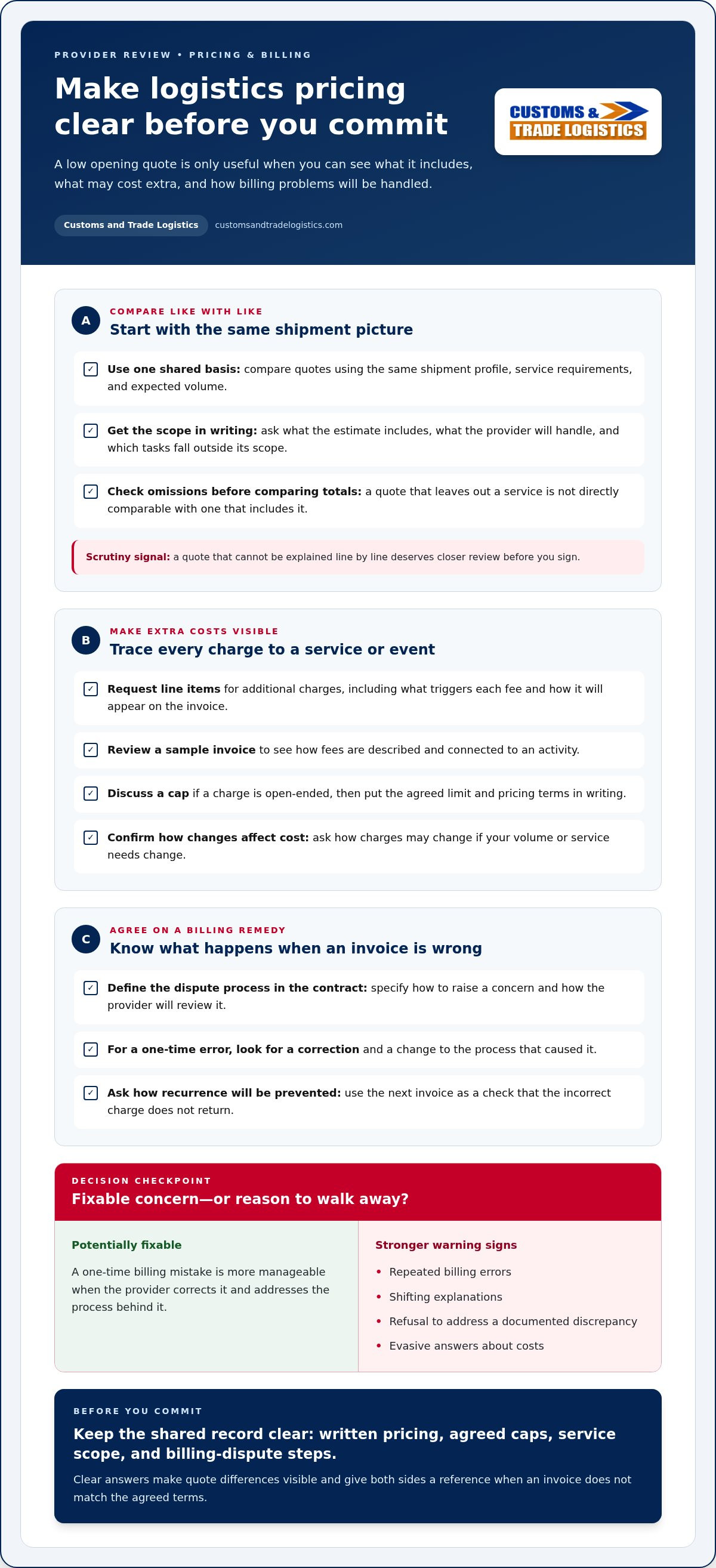
A low opening quote can look attractive while leaving important services out of the estimate. Ask the provider to price the services you need against your expected activity, then request a written explanation of what the estimate includes. Compare quotes using the same shipment profile, service requirements, and expected volume. If one quote omits a service that another includes, the headline totals are not a fair comparison. Clear pricing makes the differences visible before you commit.
Look for transparency about pricing and capabilities. A provider should explain what it will handle, which tasks are outside its scope, and how those limits affect charges. Ask for line items covering additional charges, the events that trigger them, and how they will appear on an invoice. If a charge is open-ended, discuss a cap and put the agreed terms in writing. Vague descriptions or verbal assurances leave room for misunderstandings.
Pay particular attention to charges beyond the base service. Request a sample invoice to see how each fee is described and linked to an activity. Then establish a billing dispute process in the contract, including how to raise a concern and how the provider will review it. A defined cap can limit exposure to open-ended charges. These steps give both sides a shared reference when an invoice does not match the agreed terms.
How a provider responds to a billing error matters, too. A one-time mistake may be fixable if the provider corrects it and changes the process that caused it. For example, ask how the team will prevent the same incorrect charge from appearing on the next invoice. Repeated errors, shifting explanations, or refusal to address a documented discrepancy are stronger warning signs. Evasive answers about costs are a red flag when choosing a logistics provider.
Prioritize clear answers over a low initial estimate. Ask the provider to explain how its quote reflects your requested services and expected activity, then compare the written details side by side. Confirm how changes in volume or service needs affect charges, and record agreed pricing terms, caps, and dispute steps. A provider that explains its pricing and services upfront gives you a sounder basis for budgeting. A quote that cannot be explained line by line deserves closer scrutiny before you sign.
2. Customer service and quality standards
Technology should help you see shipment status, inventory information, and disruptions through a dependable process. Ask what reporting the provider supplies, how it gathers tracking data, and how it handles gaps or inaccurate updates. A warehouse management system can support inventory accuracy and forecasting. If the provider relies on outdated systems or cannot provide timely shipment information, that weakness can cause delays and operational problems.
Fit matters as much as technology. Ask the provider about its experience with your industry, products, and fulfillment requirements. A company handling fragile goods, for example, needs processes suited to careful handling, not a generic description of service. Map the provider’s coverage against your shipping routes and customer locations, then confirm which transportation modes it manages. A mismatch in product knowledge, route coverage, or delivery capability can undermine otherwise strong service.
Watch for repeated recommendations that add cost without a clear operational reason. Ask the provider to connect each proposed service to a specific need, such as a delivery requirement or product-handling step. Then compare the proposal with the service scope and shipment profile you actually need. Expensive options are not automatically poor choices, but unexplained upgrades or repeated recommendations that do not address your requirements are warning signs. You should be able to assess the rationale.
Use past performance to test service claims. Request records for core measures such as on-time shipping and inventory accuracy, then agree on key performance indicators and review them regularly. A provider that cannot demonstrate past performance on essential measures presents a serious concern. Set measurable acceptance criteria for a defined pilot so your team can assess actual shipments before expanding the relationship. In the contract, define service levels and consider service credits for missed commitments, such as late shipments or incorrect orders.
Build a remedy for repeated failures into the contract. Specify corrective action plans, measurable milestones, and consequences for missed improvements. For recurring problems, define shortened cure periods and conditions that allow early termination without penalty. Regular operational or financial audits can also reveal whether agreed standards are being met. These terms turn service expectations into practical protections instead of informal assurances. If import shipments need coordinated handling, freight coordination can be part of the service scope you assess against your routes, products, and delivery requirements.
3. Communication protocols and regular check-ins
Communication failures can turn a manageable shipment delay into a planning problem. Before signing, agree how the provider will share shipment status, inventory changes, and possible disruptions. For example, decide whether updates will arrive through a shared dashboard, email, or a named contact. The method matters less than having a clear, consistent route for information that affects purchasing, customer commitments, or delivery plans.
Set a check-in schedule that matches your shipment volume and operational needs. A business with frequent inbound loads may need regular status reviews, while a less frequent shipping schedule may call for updates at key milestones. Define what each meeting covers: upcoming shipments, delayed freight, unresolved issues, and decisions needed from your team. Record owners and next steps after each discussion. Without regular reviews, small recurring problems can remain hidden until they disrupt orders.
Disruptions need a separate process from routine updates. Agree which events require immediate notice, such as a missed departure, a customs hold, or a delivery appointment change. The provider should explain how it identifies the issue, who contacts your team, and what each update includes. A useful notice states what happened, which shipments are affected, what action is underway, and when the next update will arrive. This gives your operations team something concrete to act on.
Before signing, identify a senior-level escalation contact and document communication service-level agreements. The agreement should describe response expectations, escalation steps, communication channels, and responsibility for notifying affected teams. For example, if an operational contact cannot resolve a delayed shipment, the documented process should identify who takes ownership next. A provider that cannot explain its escalation route leaves your team without a clear path when routine support stalls.
Test the process with a realistic scenario before work begins. Ask the provider to walk through a shipment delay from detection to resolution, including the messages your team would receive. Check that the example identifies responsible roles and explains how unresolved decisions reach management. Then review the protocol when routes, shipment patterns, or internal contacts change. Clear communication standards help prevent confusion, but repeated missed updates or unowned issues signal a deeper service concern.
Keep the agreed protocol accessible to everyone involved in shipping, receiving, and customer updates. A simple contact map can show who sends routine status reports, who manages disruptions, and who handles escalation. Review it during operational check-ins, especially after a contact or process changes. If the provider repeatedly misses documented communication commitments, track the missed updates and their effects on shipments. Specific records help distinguish an isolated oversight from a pattern that needs corrective action.
4. Supplier flexibility and customizable solutions
A supply chain changes as product lines, demand, and delivery needs shift. A provider that applies one warehouse plan to every business may struggle when your requirements change. Ask how it adapts storage, distribution, and staffing to your products and growth plans. For example, a seasonal increase in orders calls for a documented temporary labor plan and hiring pipeline, not a last-minute promise to find staff.
Location affects how quickly shipments reach customers and how efficiently inventory moves. Map the provider’s warehouse options against your customer locations, delivery routes, and expected demand. A warehouse closer to your customers may support shorter delivery times, while access to multiple regions can help adjust distribution as demand shifts. CKE Restaurant Holding considers distribution centers within about 250 miles of its internal customers ideal for restaurant deliveries. That example illustrates why location should reflect the needs of the operation, not a standard formula.
Ask how a provider would tailor its approach before accepting a proposed solution. It should understand your goals, product requirements, and distribution network before recommending warehouse options. A limited track record can be a concern if your business needs specialized storage or complex distribution. Arrange a warehouse tour to see whether the facility and processes match your needs. A long delay in arranging a tour may raise questions about access and readiness.
Test the customer-facing process before moving all your volume. A defined pilot can show how orders move from receipt through packing, dispatch, and delivery. Set acceptance criteria that reflect your needs, such as accurate order handling and reliable delivery performance. Review results with the provider and document specific improvements, owners, and milestones. A pilot turns broad claims about flexibility into observable performance without making your whole supply chain dependent on an untested process.
Customer retention and references offer another view of how a provider handles change over time. Ask for references from businesses with comparable products, shipping patterns, or seasonal needs. Discuss how the provider responded when a client changed volumes, routes, or fulfillment requirements. Frequent client turnover, weak explanations for lost relationships, or references that cannot describe problem-solving deserve closer attention. One reference may not tell the full story, so compare feedback across similar operating needs.
Finally, assess whether the provider can scale with your plans. A warehouse network or process suited to current demand may not support expansion into new regions or a more complex distribution model. Ask for a plan showing how capacity, locations, and operations would adjust as needs evolve. If the provider resists reasonable changes or offers no practical path to scale, its flexibility may be limited. Treat that mismatch as a warning sign before relying on the provider for long-term growth.
5. Financial stability and insurance coverage
A provider’s financial strain can affect the people, systems, and equipment handling your freight and inventory. Look for practical warning signs, such as sudden service reductions, repeated payment-related disruptions, or unexplained ownership changes. Ask how the provider maintains operations during financial pressure and whether it has a continuity plan. These questions help you assess whether service can remain dependable throughout your contract.
How can you verify a logistics provider’s licenses, insurance, and safety record? Match its documented operating credentials to the services and routes it will handle, then review current insurance evidence and safety records. Active safety citations, customs penalties, or license suspensions that affect operations are deal-breaker warning signs.
Request proof of insurance each year and compare it with the risks in your shipping plan. Review the named insured, covered activities, policy period, and any exclusions that could affect your goods or routes. Check whether the coverage fits the cargo and service involved, rather than relying on a general statement that the provider is insured. If your contract requires additional-insured status, confirm that the policy documents address it.
What security, cargo loss, damage, and claims risks should you check? Review how the provider protects freight, records custody, reports loss or damage, and handles claims. Check that the contract’s liability terms and insurance provisions explain responsibility, documentation, and the process for resolving a claim.
Ask for clear liability limits and indemnification language before signing. A provider’s refusal to accept reasonable liability limits or explain its indemnification terms is a serious warning sign. Read the contract alongside the insurance documents, because a coverage statement alone does not explain who bears a loss. For example, clarify what happens if damaged goods are discovered after delivery or shipment records show a gap in custody.
Review claims handling in practical terms. Ask which records support a claim, who receives the notice, and how the provider tracks an open case. Confirm how shipment documents, condition reports, and delivery records are retained. If responsibility is unclear between the provider and another party, resolving a loss may become harder. A defined claims process gives your team a clear sequence to follow when freight arrives damaged or inventory is missing.
Use these checks to assess whether coverage and financial safeguards fit your freight movements. For coordinated international freight, discuss international freight logistics as part of your shipment planning.
Customs and Trade Logistics: Customs Clearance Services
Customs and Trade Logistics supports businesses that need help coordinating customs clearance as part of an international shipment. Its Customs Clearance Services help manage this part of the import process, while International Freight Logistics supports the movement of goods. Businesses importing from China can also use Import From China Consulting, and Delivery and Redistribution Services can support the next stage after goods arrive.
These services are useful when your team needs guidance across import steps, from freight movement to customs clearance and onward delivery. Clear communication about your shipment’s requirements helps define the scope and support needed. Contact Customs and Trade Logistics to discuss your import or freight needs.
Turn Your Logistics Review Into a Clear Next Step
Before committing to a logistics relationship, turn your evaluation into a practical plan: identify the support your business needs, the responsibilities that must be clear, and the standards you’ll use to assess the partnership. Use red flags when choosing a logistics provider as prompts for decisions, not just items to check off. This approach can help you build a logistics setup that fits your business as it moves forward.
For import shipments, Customs and Trade Logistics offers Customs Clearance Services and International Freight Logistics. Businesses sourcing from China can also use Import From China Consulting to support their import planning. These services can help when you need support with customs clearance, freight movement, or import decisions.
Contact Customs and Trade Logistics to discuss your logistics needs and decide on a sensible next step. A thoughtful review today can help you move ahead with greater clarity and confidence.
Frequently Asked Questions
3PL Red Flags vs Deal-Breakers: Which Issues Require Immediate Action?
Deal-breakers are serious risks that are difficult to correct, while some red flags can be addressed through a documented fix. Pause a decision if a provider’s practices could threaten shipment continuity, leave responsibility for losses unclear, or prevent you from ending the relationship after repeated failures. For a remediable issue, agree on an accountable owner, a measurable correction, and a deadline before moving forward.
What are the biggest red flags when choosing a logistics provider?
The strongest warning signs are repeated service failures, evasive answers about responsibilities, and a lack of evidence for important claims. Red flags when choosing a logistics provider become more serious when the same problem affects multiple shipments or the provider dismisses documented concerns. Look for patterns, not one isolated mistake: ask what changed after an error and whether later performance shows the improvement.
What financial warning signs indicate a logistics company may be unstable?
Look for operational signs that financial pressure is affecting service, such as sudden reductions in capacity, disrupted handoffs, or frequent changes to the people managing your account. Ask how the provider maintains essential operations and handles continuity if a key subcontractor or facility becomes unavailable. Compare the answers with actual service delivery. A pattern of disruptions paired with vague explanations deserves careful review before extending the relationship.
What should a logistics provider’s service-level agreement and performance metrics include?
A useful agreement defines each metric, how it is calculated, which shipments count, and how often results are reported. Specify the service being measured, such as order accuracy or delivery performance, and explain how exceptions are recorded. Include a process for reviewing missed targets, assigning corrective actions, and checking whether those actions worked. Clear definitions prevent both sides from interpreting the same performance report differently.
How can I spot hidden fees or misleading pricing in logistics quotes?
Check whether each quote uses the same shipment details, route assumptions, service scope, and delivery conditions. Look for charges triggered by events such as a failed delivery attempt, additional handling, or a change in shipment details. Ask how each trigger is documented and reflected in billing. A quote that leaves important assumptions unstated can be difficult to compare, even if its initial total appears straightforward.
How should I evaluate a provider’s capacity, coverage, and on-time delivery performance?
Ask how the provider handles your specific routes, shipment types, and peak-demand periods. Request performance records grouped by route or service type, rather than relying only on an overall average. Discuss the capacity available during busy periods and how the provider manages handoffs across its network. Compare those details with your own shipping pattern to identify gaps that broad coverage claims might conceal.
What contract terms, liability limits, and termination clauses are red flags?
Review terms that make responsibility unclear or leave you without a practical remedy. Pay close attention to broad liability exclusions, caps that do not reflect the exposure you are accepting, unilateral changes to service terms, and termination language that prevents an exit after recurring failures. Check how the contract handles claims, notice, and open shipments at termination. Have qualified counsel review unclear or high-impact terms before signing.
How do I check customer reviews, references, and complaint records for a logistics provider?
Look for repeated themes across review platforms and company references, especially complaints about missed handoffs, damaged freight, or unresolved billing concerns. Ask for references whose shipment patterns resemble yours, then ask how the provider responded to a specific service problem. Review how the complaint was resolved, not just whether it received a reply. Consistent accounts of corrective action offer more insight than broad endorsements.