

The typical transit time from China to US ports is 14 to 20 days for West Coast routes and 25 to 35 days for East Coast routes, port to port. Door-to-door ocean shipping commonly takes roughly 4 to 6 weeks once pickup, port handling, customs clearance, and inland delivery are included. Direct sailings can be faster than routes involving transshipment, but the shortest sea journey doesn’t always mean the quickest delivery to your door.
A vessel’s estimated sailing time can look straightforward, but congestion, transfers between ships, and inland transport can all affect when goods arrive. This guide explains how route choice and direct service versus transshipment shape ocean freight timing, then covers the additional steps that influence door-to-door delivery. The best route depends on where your cargo starts and where it needs to go, not just how quickly a vessel crosses the ocean.
Key Takeaways
- Compare FCL and LCL timelines, since consolidation and deconsolidation can add handling time for shared-container cargo.
- Include inland rail or trucking in your plan; the destination beyond the port can change which route makes sense.
- Allow for schedule disruption from port congestion, vessel queues, and delays moving cargo out of the terminal.
- Check whether a route is direct or uses transshipment, because changing vessels can extend the journey.
- Build your delivery estimate around the full journey, from factory pickup through customs clearance to final delivery.
How Long Does Ocean Freight Take from China to the US?
Standard ocean freight from China to U.S. West Coast ports typically takes 14 to 20 days port to port. East Coast port-to-port transit typically takes 25 to 35 days, with the port pair and route shaping the estimate.
West Coast Port-to-Port Estimates
West Coast port-to-port transit is the sea journey from a Chinese departure port to a U.S. West Coast port, excluding final inland delivery. For planning, the typical range is 14 to 20 days, though route-specific estimates vary. Shanghai to Los Angeles or Long Beach often takes 14 to 18 days under normal conditions, while Shanghai to Seattle or Oakland may take 12 to 16 days.
Departure port matters, too. From Shenzhen’s Yantian port to Los Angeles or Long Beach, ocean transit typically takes 14 to 17 days. Guangzhou’s Nansha port to those same destinations takes 15 to 18 days, while Xiamen to Los Angeles or Long Beach takes 14 to 18 days. These examples show why the typical transit time from China to US ports is a useful starting range, not a route-specific schedule.
Container type also affects the estimate. Full-container-load (FCL) freight from Shanghai or Ningbo to Los Angeles or Long Beach typically takes 14 to 21 days port to port. Less-than-container-load (LCL) freight requires consolidation with other cargo and later deconsolidation, which can extend the overall timeline beyond the vessel’s sailing time.
East Coast Routes and Transit Estimates
East Coast routes carry cargo from Chinese ports to destinations such as New York or Savannah, often through the Panama Canal or by transshipment. The longer sea journey makes the estimate important for inventory planning, especially when delivery timing matters more than reaching a nearby West Coast port.
Standard ocean freight to U.S. East Coast ports typically takes 25 to 35 days port to port. Shanghai to New York takes approximately four to five weeks by sea, while FCL shipments from Shanghai or Ningbo to New York or New Jersey via the Panama Canal typically take 28 to 38 days. A route involving transshipment may add time as cargo waits for a connecting vessel.
Gulf Coast destinations have their own timelines. Ocean freight from Guangzhou to Houston can take 38 to 45 days by sea; FCL from Shanghai or Ningbo to Houston via the Panama Canal typically takes 30 to 40 days. The difference reflects the departure port, service, and route. Before vessel departure, filing also matters: the Importer Security Filing must be submitted at least 24 hours before cargo is loaded at the Asian origin port.
Port congestion
How much extra time should you allow for U.S. customs clearance and port processing? Routine U.S. customs clearance takes 1 to 3 business days when documentation is complete; standard clearance typically takes 1 to 5 days. Port processing and congestion can extend the wait beyond customs clearance.
A port-to-port estimate includes more than sailing. It can cover origin and destination port operations, plus waiting caused by congestion or vessel schedules. At Los Angeles and Long Beach, current port dwell time is 2 to 4 days. Severe congestion at either port can add 5 to 15 days, so a west coast port’s sailing advantage may shrink after arrival.
Peak-season pressure adds another variable. From July through October, congestion at U.S. ports can add 5 to 10 days to China-U.S. ocean freight delivery windows. In 2021, extreme congestion left vessels waiting at anchor near Los Angeles and Long Beach for 1 to 2 weeks. That period shows how queues can stretch a planned arrival before a container reaches the terminal.
Holiday timing matters at origin, too. Chinese New Year can shut factories for 2 to 3 weeks and create port backlogs before and after the holiday. National Day Golden Week closures last 7 to 15 days around October 1 to 7. If cargo misses a sailing during a closure or backlog, it may wait for another scheduled departure.
Customs is a separate stage from port congestion. Complete documentation supports routine clearance in 1 to 3 business days, while an intensive U.S. Customs examination can add 3 to 10 days. Plan filing and document preparation before the vessel arrives, since a customs hold can keep a container from moving onward even after discharge.
Weather can disrupt vessel schedules and port operations, with effects varying by route and conditions. A delay at the origin port may cause a missed departure, while disruption near the destination can affect arrival and unloading. Plan around the full route rather than treating the advertised sailing time as the delivery window.
When comparing Chinese origin ports, consider departure frequency as well as sailing duration. Services may depart weekly or multiple times per week, but the right fit depends on cargo readiness and destination. Compare the planned vessel, any transshipment, and port congestion together. A shorter sailing to a busy West Coast port, for example, may not be faster overall if the container waits after arrival.
To factor customs and port handling into an import plan, include customs clearance in the delivery timeline. This helps distinguish ocean transit from the time cargo spends awaiting release and onward movement.
Ocean freight transit-time range from China to the United States
Ocean freight from China to the United States typically takes 20 to 40 days, depending on route and shipment type. Air freight generally takes around 8 to 10 days, so it can suit urgent cargo, while ocean freight carries a longer journey.
Transit estimates cover different parts of a shipment’s journey. Compare the transport method, handling stages, and final destination to establish a more useful delivery window.
Standard and Expedited Ocean Shipping
Standard ocean shipping follows the scheduled service for the origin and destination ports. Expedited ocean options prioritize faster vessel transit, which may help when inventory timing is tight and air freight is not the preferred mode.
For example, a premium ocean service from Shanghai to Los Angeles may take 10 days port to port. That is faster than standard ocean estimates, but it still covers the port-to-port leg, not the full delivery. A forwarder can compare available routes and schedules against cargo readiness and the required arrival date.
Expedited service does not eliminate every stage. Origin handling, destination processing, congestion, and inland transport can still affect the total. Check what the stated transit estimate covers before using it to plan stock availability.
What Ocean Transit Time Includes
Ocean transit time generally describes movement between ports, including the sea voyage and port operations at origin and destination. Depending on how the estimate is presented, it may also include waiting for vessel schedules or due to congestion.
It usually does not include every step before loading or after unloading. Factory pickup, export handling, customs clearance, and delivery beyond the port can add time. LCL cargo also needs consolidation before sailing and deconsolidation after arrival; those handling stages can add 5 to 7 days to door-to-door transit.
Documentation affects how smoothly cargo moves through the process. Preparing or filing shipment documents late can hold up loading or customs clearance, even when the vessel journey follows its schedule.
Ocean and Door-to-Door Timing
Door-to-door timing covers the shipment from pickup in China through delivery at its U.S. destination. Ocean transit measures only the port-to-port portion, so the two estimates are not interchangeable.
Door-to-door ocean freight commonly takes roughly 4 to 6 weeks when all stages are included. Inland transport after arrival typically takes 3 to 14 days, depending on distance and the delivery method. A container discharged in Los Angeles may need further rail or trucking before reaching an inland destination.
Customs clearance adds another stage after arrival. Routine U.S. clearance typically takes 1 to 3 business days when documentation is complete. For inventory planning, compare the port arrival estimate with the time needed for release and final delivery, rather than treating vessel arrival as the delivery date.
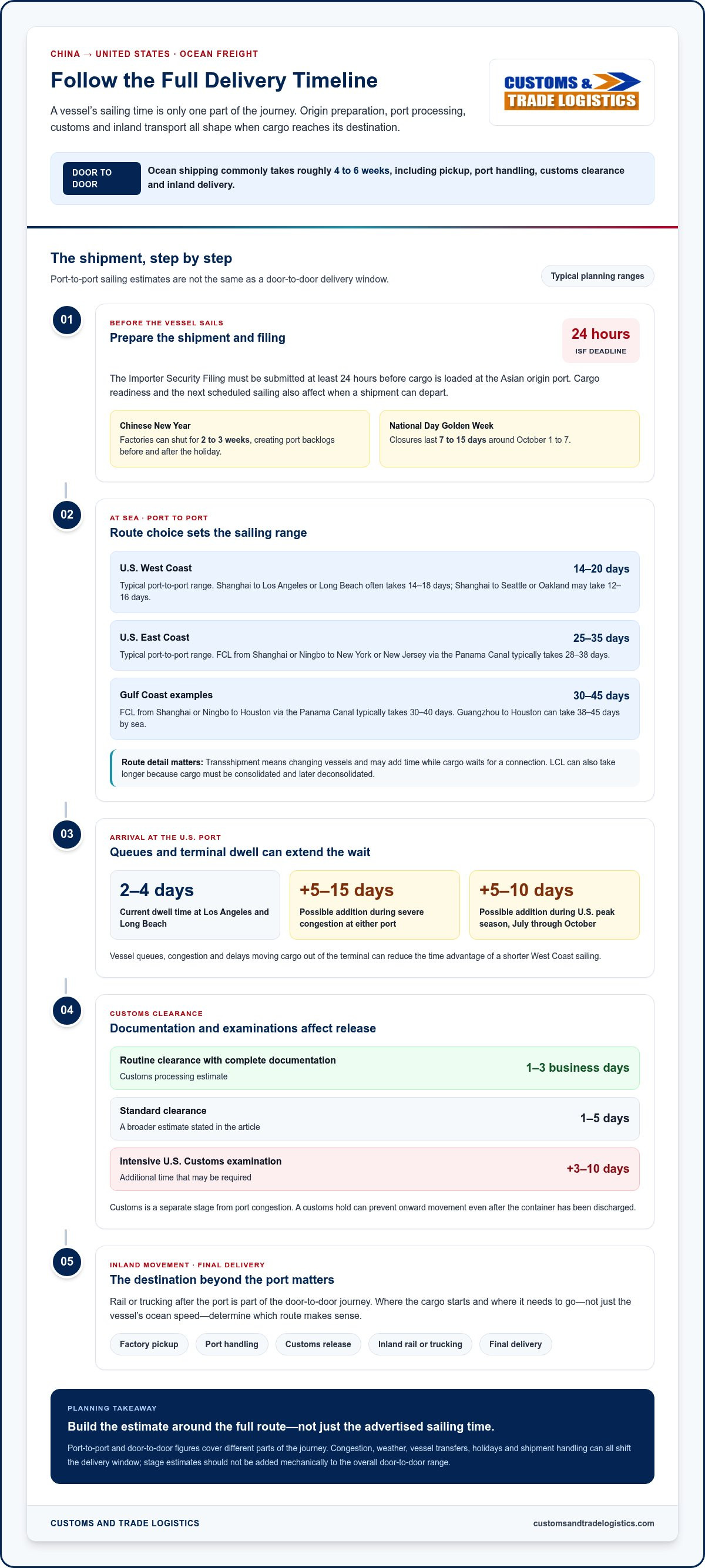
Door-to-door shipping timelines
Door-to-door ocean shipping from China to the United States commonly takes roughly 4 to 6 weeks. The full timeline runs from pickup at origin through ocean transport, customs clearance, and delivery to the final address. A port arrival date is only one milestone, not the date cargo reaches its destination.
For a broad route comparison, door-to-door shipping to the U.S. West Coast typically takes 20 to 30 days, while delivery to the East Coast typically takes 30 to 45 days. Estimates vary with the selected ports and inland leg. For example, cargo bound for a Midwest address needs more than a port-to-port estimate, even if it arrives at Los Angeles.
Origin handling starts the clock before the vessel sails. Factory pickup, container loading, and port loading in China typically take 3 to 7 days. If cargo from multiple Guangdong factories must be combined into one FCL container, consolidation can add 4 to 6 days for packing and loading. That time belongs in the actual timeline, not only the sailing estimate.
The destination determines how long inland transportation takes after arrival. Local U.S. trucking typically takes 1 to 3 days, while intermodal rail from a port to Midwest hubs such as Chicago or Dallas typically adds 7 to 14 days. A container moving from Los Angeles to Chicago may spend another 7 to 10 days on rail, before final delivery arrangements.
Route examples make the difference visible. FCL shipping from Shanghai to Los Angeles takes 18 to 22 days door to door. FCL from Ningbo to Savannah via the Panama Canal takes 34 to 44 days door to door. Both figures include more than the sea leg, so comparing them with port-to-port estimates would give an incomplete picture.
LCL shipments add handling at both ends. Consolidation before departure and deconsolidation after arrival can add 5 to 10 days. The final timeline also depends on where cargo is collected, when the shipment is ready to load, and how far the destination sits from the arrival port. A delivery address near Los Angeles differs from one requiring inland rail.
Season affects planning, too. Peak-season congestion at U.S. ports can add 5 to 10 days to China-U.S. delivery windows. Treat the expected arrival as a planning point, then account for clearance and inland movement before setting a stock-arrival date. That approach gives teams a more useful timeline than relying on vessel arrival alone.
Direct service versus transshipment
A direct service sails from the Chinese origin port to the U.S. destination without transferring the container between vessels. Transshipment moves cargo through an intermediate port, where it changes ships before continuing. That extra connection can add 5 to 10 days, making the route choice a meaningful part of the delivery timeline.
A direct route is not automatically faster for every shipment. A direct vessel may have a longer wait for its next departure, while a connecting service may leave sooner. Compare the complete schedule, including departure timing and connection waits, rather than counting vessel legs alone. For inventory planning, the expected arrival date matters more than the route label.
East Coast shipments illustrate why routes differ. Cargo from China may travel through the Panama or Suez Canal, or transfer at an intermediate port. A connection adds a handoff: the first vessel must arrive, the container must be transferred, and the onward vessel must depart. If schedules do not align, the cargo waits at the transshipment port, extending the journey beyond sailing time.
Carrier schedules and port congestion can change which route is faster. A direct vessel may face a queue at Los Angeles or Long Beach, while a transshipment route may encounter delays at its connecting port. A missed connection can also erase the benefit of an earlier departure. Compare the full sequence of ports and planned arrival times, not just the fastest segment in a logistics schedule.
Shipment type also affects the route. FCL cargo travels in a full container, while LCL cargo is consolidated with other shipments and separated later. This handling can add time regardless of whether the vessel route is direct. For LCL cargo, compare both sailing plans and consolidation steps before assuming a direct option is faster overall.
Use the final delivery location to make your comparison. A direct sailing to a West Coast port may suit nearby destinations, but cargo going farther inland still needs onward transport. An East Coast route through the Panama Canal may take longer at sea yet bring cargo closer to an eastern delivery point. Compare port arrival and inland transport together.
For a route decision, weigh the scheduled departure, transfers, congestion exposure, cargo type, and final destination. Plan your China-to-U.S. freight route around the full shipment journey, not sailing time alone.
Customs and Trade Logistics: Customs Clearance Services
Customs and Trade Logistics helps importers coordinate the steps from shipment arrival through release for delivery. Customs Clearance Services support businesses with U.S. import clearance, while International Freight Logistics helps coordinate transport planning with the selected route and destination.
When arranging imports from China, turn to the team for help connecting freight timing, customs clearance, and onward delivery. Import From China Consulting helps clarify the import process, while Delivery and Redistribution Services support the movement of goods after arrival.
Contact Customs and Trade Logistics for help planning your China-to-U.S. shipment.
Make Your Next Shipment Easier to Plan
Use the typical transit time from China to US ports as a starting point, then build your delivery plan around the cargo’s destination and business priorities. Align the shipping route, customs process, and onward movement before the shipment is underway. This gives your team a clearer basis for coordinating inventory and communicating delivery expectations.
Customs and Trade Logistics supports importers with Customs Clearance Services, International Freight Logistics, and Import From China Consulting. These services can help when you’re arranging an import from China and need support coordinating freight planning, clearance, and the next stage of delivery.
Ready to discuss your shipment and its route? Contact Customs and Trade Logistics to talk through your import needs and plan your next steps with confidence.
Frequently Asked Questions
How long does FCL shipping from China to the US take compared to LCL?
FCL often moves through ports faster because the container does not need to be combined with other shipments. LCL requires consolidation before departure and deconsolidation after arrival, and can take one or two weeks longer than FCL. For a smaller shipment, consider whether the extra time for shared-cargo handling fits your inventory schedule. If stock is needed for a launch or seasonal demand, for example, compare FCL even if the cargo will not fill a container.
How long will it take to ship from China to the US?
Plan on roughly 4 to 6 weeks for door-to-door ocean shipping, including the stages beyond the voyage. The actual timeline depends on when the goods are ready, the origin and destination, and whether cargo needs consolidation or inland transport. For example, a shipment destined for an inland address needs time after its U.S. port arrival. Keep the delivery date, not just the vessel arrival, in your inventory plan.
How long is port-to-port transit to the US West Coast?
Port-to-port ocean transit to U.S. West Coast ports typically takes 14 to 20 days. The specific port pair matters: Shanghai to Seattle or Oakland may take 12 to 16 days, while Shanghai to Los Angeles or Long Beach often takes 14 to 18 days under normal conditions. Use the estimate for your actual departure and arrival ports, since a broad coast-wide range won’t reflect every vessel schedule.
Need to Know Your Timeline?
Build your shipment calendar backward from the date the goods need to be available, allowing for pickup, vessel departure, arrival, clearance, and delivery. Cargo ready after a scheduled sailing may have to wait for the next departure, shifting the whole plan. If stock is needed for a launch or seasonal demand, coordinate cargo readiness with the sailing schedule and include inland transport to the final address.
Transit Time: How Long Does Sea Freight Take?
Ocean freight from China to the United States typically takes 20 to 40 days, depending on the route and whether cargo ships FCL or LCL. This is a broad range, not a door-to-door estimate. The typical transit time from China to US ports depends on the departure and arrival ports, vessel itinerary, and handling along the route. Add pickup, customs clearance, and final delivery when estimating when goods will be usable.
West Coast vs East Coast: Which Route Is Right for You?
Choose based on the final delivery point, not simply which coast has the shorter voyage. West Coast ports are closer to China, while an East Coast arrival may reduce inland transport for some eastern or central destinations. For cargo headed inland, compare the full route, including rail or trucking after arrival. A longer ocean leg may still make sense overall if the destination is closer to an East Coast port.
What Can Cause Delays?
Port congestion, missed vessel connections, customs examinations, weather, and holiday shutdowns can all disrupt schedules. An intensive U.S. Customs examination can add 3 to 10 days, while Chinese New Year factory closures can last 2 to 3 weeks and create backlogs. Peak-season port congestion may also lengthen delivery windows. Check whether your cargo is ready before the planned sailing, since missing a departure can delay the shipment before it reaches the ocean.
How long does ocean freight take from China to the U.S. West Coast?
Most standard port-to-port journeys to the West Coast take 14 to 20 days. Route examples vary: Shenzhen’s Yantian port to Los Angeles or Long Beach typically takes 14 to 17 days, while Guangzhou’s Nansha port to those destinations takes 15 to 18 days. These estimates cover ocean movement between ports. Cargo going beyond the arrival port needs additional time for clearance and inland delivery.