

A full container isn’t automatically the more expensive choice. With LCL vs FCL shipping for a small business, LCL means sharing container space and paying for the space your cargo occupies, while FCL reserves a container for one shipper at a flat rate. The usual volume point for considering a switch from LCL to FCL is around 13-15 CBM, but timing, cargo handling and inventory needs also matter.
If you’re shipping a smaller order, it’s natural to assume that paying for only part of a container will cost less. It often does overall, but as shipment volume grows, LCL charges and handling can change the comparison. The right option depends on your shipment and business needs, not simply on how full a container looks.
This guide explains how LCL works, how shipment volume affects the decision, and how costs and cargo handling compare with FCL. It also offers a practical way to weigh shipment size, delivery timing, and how much inventory you want to bring in at once.
Key Takeaways
- LCL lets you share container space and pay for the space your shipment uses; FCL reserves a container exclusively for your goods.
- Use shipment volume as a starting point: around 13-15 CBM is a common range for comparing a switch to FCL.
- Compare the full cost, including LCL consolidation and deconsolidation, rather than looking only at the freight rate.
- Consider handling as well as price: LCL cargo has additional consolidation and deconsolidation points, while FCL generally has fewer.
- Match the shipping method to your order pattern, delivery timing and inventory needs, then use the decision guide to weigh the trade-offs.
Cargo handling and damage risk
LCL generally takes longer in transit because cargo must be consolidated with other shipments and deconsolidated at destination. This process can add a week or more, depending on the port and consolidation schedule. FCL avoids those shared-container steps, so it generally moves faster. That difference matters when a small business has a delivery deadline or limited stock.
With LCL, cargo passes through several handling stages: it is grouped with other shipments, loaded into a shared container, separated during deconsolidation, and prepared for onward delivery. Each transfer creates another opportunity for freight to be moved, stacked, or repositioned. The shipment may also be delayed if another load in the same container encounters a problem during deconsolidation or customs clearance.
FCL reserves the entire container for one shipper’s goods, even if it is not full. The container may be loaded at the factory and then transported for unloading at the importer’s warehouse. This avoids the additional consolidation and deconsolidation stops associated with LCL. Fewer handling points can reduce exposure to damage, making FCL useful for fragile goods or time-sensitive cargo.
Shared container space makes careful packing especially important. For example, if a carton of liquid products leaks in transit, nearby cargo could be affected. Secure outer packaging, stable palletization, and clear handling instructions help protect goods in either mode. With LCL, consider how your shipment will sit alongside other cargo. With FCL, plan the load so goods stay secure during transport.
Neither option removes every risk. FCL generally offers better cargo safety and a lower risk of damage than LCL because it involves fewer handling points. However, fragile cartons can still shift if they are poorly secured, and LCL cargo can be affected by damage elsewhere in the container. Match packaging and loading plans to the goods, not just the shipping method.
| Option | Handling points | Transit effect | Risk considerations |
|---|---|---|---|
| LCL | Consolidation and deconsolidation | Can add a week or more | More transfers; shared cargo environment |
| FCL | Fewer shared-container stops | Generally faster | Fewer handling points; load still needs securing |
Choose based on cargo fragility, delivery schedule, and handling needs. For delicate or urgent goods, fewer transfers may justify FCL; for less sensitive freight, LCL may suit a more flexible schedule. International freight logistics can help coordinate the shipment’s movement and handling at each stage.
Shipment volume thresholds
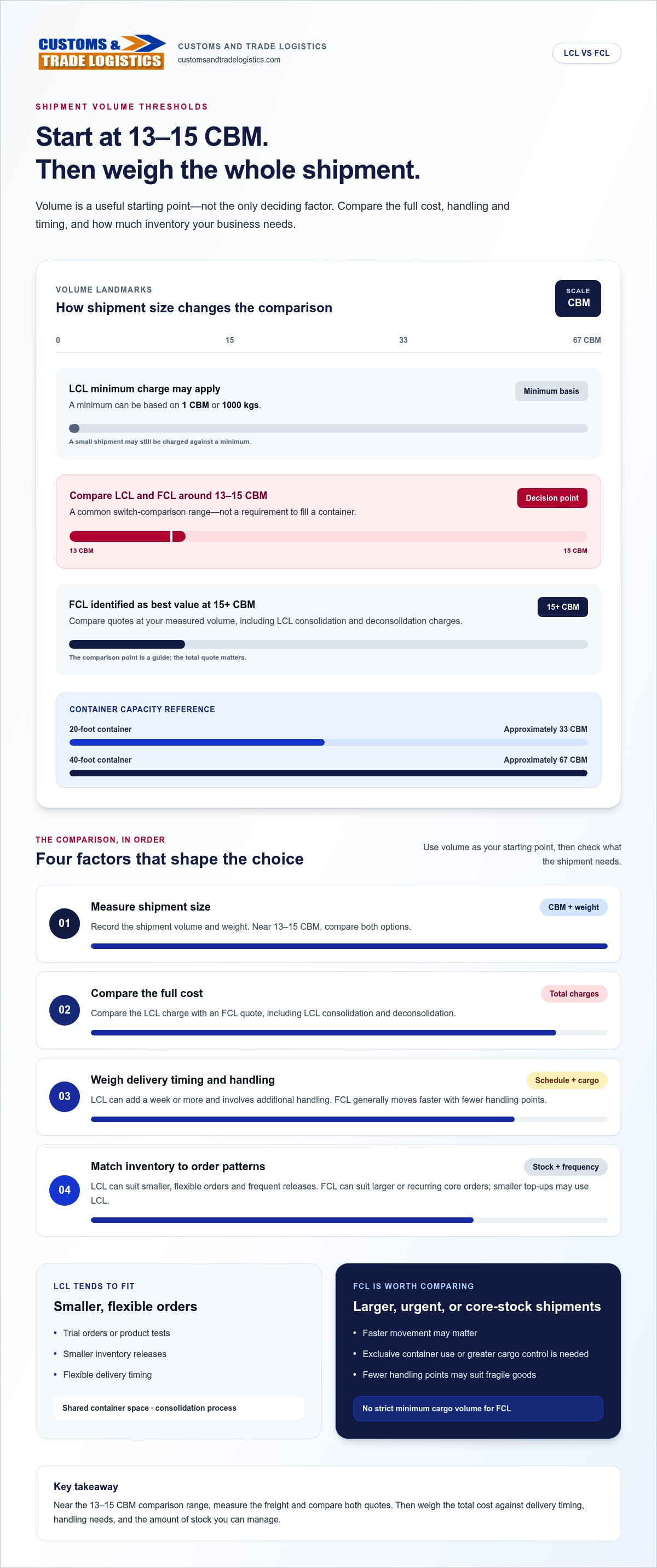
Compare LCL and FCL around 13-15 CBM, a common range for switching from shared space to a full container. Choose LCL for smaller, flexible orders; consider FCL for larger volumes or when speed and exclusive container use matter more.
LCL is the shared-container option: your freight travels with other shippers’ goods. Volume helps estimate the cost, but shipment frequency, delivery timing, and inventory needs also shape the decision.
Small Shipments and High-Volume Freight
LCL suits smaller shipments, including trial orders and product tests that don’t justify booking an entire container. A business can bring in less stock at a time and order more frequently, aligning inventory with demand. The trade-off is shared container space and the consolidation process.
As freight volume grows, FCL becomes more relevant. A 20-foot container holds approximately 33 CBM, while a 40-foot container holds approximately 67 CBM. Businesses with recurring core orders can compare these capacities against their typical shipment volume, rather than treating each order as a separate, isolated decision.
Shipment Volume and Pricing Thresholds
LCL charges are based on the space cargo occupies, commonly measured in cubic metres (CBM), or on weight or measure. A minimum charge can apply at 1 CBM or 1000 kgs. That means a very small shipment can still be charged against a minimum, while larger loads accumulate costs as their measured volume increases.
A usual comparison point for moving from LCL to FCL is 13-15 CBM; FCL is identified as best value at 15+ CBM. These are useful decision points, not container-fill requirements. Compare both quotes at your measured volume, including LCL consolidation and deconsolidation charges, to see how the total changes.
Choosing Between LCL, FCL, and Shared Space
For a small, non-urgent order, LCL shares container space and avoids booking capacity your goods won’t use. Choose it when flexible timing and smaller inventory releases matter more than exclusive use of a container. It can also suit an initial product order when demand is still being tested.
For larger or urgent shipments, compare FCL even if the container won’t be full. There is no strict minimum cargo volume for FCL, so a business can reserve a container when faster movement or greater cargo control outweighs the need to fill it. A growing importer might use FCL for regular core stock and LCL for smaller top-up orders.
To decide, measure the shipment in CBM, note its weight, and compare the resulting LCL charge with an FCL quote. Then weigh the cost against delivery timing and the amount of stock you can manage. Near the 13-15 CBM threshold, comparing both options gives a clearer basis for choosing than volume alone.
What is LCL (Less-than-Container Load) shipping?
LCL combines shipments from multiple businesses in one container, with each shipper paying for the space their cargo occupies. FCL, or Full Container Load, reserves the entire container exclusively for one shipper’s goods.
Shared Container Space for LCL
With LCL, a business books part of a container rather than a full container load. A freight consolidator groups separate shipments before transport, then separates them during deconsolidation at destination. This shared arrangement suits cargo that doesn’t fill a container, but adds handling stages compared with exclusive FCL use.
For example, a small importer shipping several cartons can share container space with other businesses’ pallets. The shipment travels internationally as part of the combined load, and charges reflect the space it occupies. Since the goods share a container, strong cartons, secure wrapping, and clear labels help protect them during loading and transfers.
FCL works differently: one shipper reserves a container, even if the cargo doesn’t fill it. The booking is charged at a flat container rate rather than according to each shipper’s measured share. Exclusive space gives the shipper control over the container’s cargo mix, while LCL shares space and consolidation among several shipments.
Container Capacity and Palletization
Container capacity helps put the choice in context. A 20-foot FCL container holds approximately 33 CBM, while a 40-foot container holds approximately 67 CBM. A 40-foot high-cube container can hold up to 76 CBM. These capacities are planning estimates; pallets, packaging, and cargo shape affect how much usable space remains.
Palletization matters in both methods because a pallet’s dimensions and stackability affect the space it occupies. LCL freight charges typically depend on the number of pallets and the cargo’s measured volume. Awkwardly shaped cartons may use more container space than their count suggests, so record pallet dimensions as well as total CBM.
LCL is commonly priced by cubic metre, including when goods occupy less than 1 CBM. FCL instead applies a flat rate for exclusive use of the container. Compare the chargeable LCL volume with the container rate, then consider whether unused FCL space is acceptable for your order.
For a growing importer, the practical steps are straightforward: measure each pallet, calculate the shipment’s total CBM, and compare it with container capacity. LCL shares space and charges by measured cargo; FCL reserves the full container. Packaging dimensions and the amount of cargo you can use help determine which structure fits the shipment.
FCL and LCL definitions
FCL means Full Container Load: one shipper reserves a container for its goods. LCL means Less-than-Container Load: multiple shippers’ cargo shares container space. For a small business, this distinction affects how freight is grouped, documented, and moved from origin to destination.
Full Container Load: one shipper’s cargo
With FCL, the shipper has exclusive use of the container, even if the goods don’t fill it. The container is assigned to one shipper’s cargo rather than combined with unrelated shipments. The rate applies to the container, not just the cubic metres occupied.
For example, an importer sending a large order can arrange for its goods to be loaded together and moved as a single container shipment. An FCL bill of lading includes the container number and seal. These identifiers connect the shipping document with the specific container moving between origin and destination.
Less-than-Container Load: shared freight
LCL groups cargo from multiple shippers inside one container. Each business pays for the space its shipment occupies instead of reserving the entire container. Cargo is consolidated before ocean freight and separated through deconsolidation at destination. This shared process lets a small importer ship a smaller order without booking an entire container.
LCL documentation reflects the shared arrangement. An LCL shipment has a House Bill of Lading under a Master Bill of Lading for the whole container. The House Bill identifies an individual shipment within the larger load; the Master Bill relates to the container carrying the combined freight.
These definitions also explain how consolidation can bring together goods from multiple suppliers. Shipments collected from different suppliers can be consolidated into one container for receipt at destination. The importer coordinates separate shipments at origin toward a combined arrival, rather than treating each supplier’s cargo as a separate destination delivery.
Another arrangement reverses the flow: an FCL/LCL shipment travels as a container, then is divided at destination for delivery to multiple final destinations in the same region. This can suit a business distributing goods to several locations. The key distinction is where consolidation happens: before shipment for a shared load, or after container transport for onward distribution.
Keep customs separate from the shipping method. LCL and FCL describe how cargo uses container space; they don’t, by themselves, cover every customs step or determine whether a shipment clears without delay. If another shipment in an LCL container encounters a problem during customs clearance or deconsolidation, the shared load may also be delayed.
To classify an upcoming shipment, determine whether one shipper will use the container exclusively or whether cargo will be shared. Then match the booking and bill of lading to that arrangement. This distinction clarifies the shipping costs, handling stages, and documents involved in the freight journey.
Cost Comparison: Which Option is More Economical?
LCL and FCL use different pricing structures, so compare the full shipment cost rather than just one rate. LCL is typically quoted per cubic metre, while FCL uses a flat rate for exclusive container use. The better fit depends on measured cargo, handling charges, shipment weight, and inventory needs.
LCL Costs by Cubic Metre
LCL charges are usually calculated by cubic metre, or by weight or measure, and include consolidation and deconsolidation fees. The charge reflects the shipment’s occupied space, so pallet dimensions and packaging affect the amount used in the calculation. LCL shipments exceeding 1 metric ton (2,000 lbs) typically attract higher pricing.
There is no single per-CBM amount that can be compared directly with every FCL booking. For LCL, the rate applies to measured cargo; for FCL, the container rate applies regardless of how much space the goods use. Request the total shipment quote and identify which handling charges it includes.
FCL and LCL Cost Structures
LCL spreads container costs across multiple shippers, with each paying for their share of the space. This can suit a small order when paying for an entire container would leave substantial capacity unused. However, consolidation and deconsolidation add cost components beyond the ocean freight charge.
FCL applies a flat rate for the container, reserved exclusively for one shipper’s cargo. As shipment volume increases, the cost per unit decreases because more goods use the same container rate. Compare the total FCL charge with the combined LCL rate and related fees for the same shipment volume, not just the headline freight amount.
Factors Affecting Shipping Costs
Shipment volume is a key comparison point. LCL can become a more expensive per-unit option when cargo exceeds 13 CBM. A usual threshold for considering a switch to FCL is 13-15 CBM, while FCL is identified as best value at 15+ CBM. These ranges help frame the comparison, but the actual shipment’s dimensions still matter.
Weight also affects LCL charges, especially once freight exceeds 1 metric ton (2,000 lbs). Other practical factors include pallet count, cargo dimensions, consolidation and deconsolidation, and how much container space remains unused under FCL. For sensitive goods, compare handling requirements alongside the rate. Frequent smaller shipments may support inventory planning, while a larger shipment can make better use of a sealed, dedicated container.
For a useful supply-chain comparison, list the shipment’s CBM, weight, and pallet count, then compare LCL and FCL totals on the same basis. Include the costs of consolidation and deconsolidation in the LCL figure. Compare freight options for your shipment to make the cost structure easier to assess.
Customs and Trade Logistics: Customs Clearance Services
Customs and Trade Logistics helps small businesses coordinate the next steps with Customs Clearance Services and International Freight Logistics. If you’ve chosen LCL or FCL but need help managing the import process, customs clearance supports the shipment through the required customs stage. Freight logistics helps coordinate its movement from origin toward delivery.
For example, an importer bringing goods from China can use Import From China Consulting to plan the import process, then arrange Delivery and Redistribution Services for onward movement. Choose support based on where the shipment needs help: clearance, freight coordination, import planning, or delivery after arrival.
Contact Customs and Trade Logistics to discuss your import shipment and the support you need.
Turn Your Shipping Choice Into a Clear Import Plan
A sound decision about LCL vs FCL shipping for a small business should support more than one shipment. Consider the orders you expect next, the stock you can manage, and how goods need to reach their final destination. This gives you a practical starting point for planning future imports rather than treating every booking as a separate decision.
Customs and Trade Logistics can support your next steps with Customs Clearance Services, International Freight Logistics, and Import From China Consulting. These services connect your shipping choice with the wider import process, from freight planning through customs clearance. Bring your shipment details and business priorities into the conversation so the plan reflects how your operation works.
Ready to discuss your import plans? Contact Customs and Trade Logistics to explore the support that fits your next shipment. A considered plan can help you move forward with greater clarity as your business grows.
Frequently Asked Questions
FCL vs LCL - What’s the Difference?
FCL reserves a container for one shipper, while LCL combines cargo from several shippers. For a practical comparison, picture a business importing a large seasonal order versus one bringing in a few pallets for a product launch. The first may value exclusive container use; the second may prefer paying for its share. Compare measured volume, schedule, and handling needs before choosing.
Can I Combine LCL and FCL in the Same Shipment Plan?
Yes. A business can use FCL for regular core stock and LCL for smaller test or top-up orders. These methods apply to separate shipments, not simultaneously to the same cargo on the same container journey. For example, goods from multiple suppliers can be consolidated into one container, while a later, smaller order travels as LCL. Planning this mix can align freight choices with changing order sizes.
Do Freight Forwarders Recommend FCL or LCL for Small Businesses?
No single method suits every small business. A useful recommendation weighs shipment volume, delivery urgency, cargo sensitivity, and the cost of holding inventory. A business testing a new product may prioritize a smaller LCL order; one replenishing fast-selling stock may consider FCL. Share accurate carton or pallet dimensions and the required delivery window so the comparison reflects the actual shipment, not a broad rule.
FCL or LCL for SMEs?
SMEs can use either method, depending on the order and operating plan. Choosing LCL vs FCL shipping for small business imports means considering storage capacity, demand certainty, and shipment urgency. An SME with limited storage may prefer smaller LCL orders, while stable, larger orders may make FCL worth comparing. Review each product’s sales pace and reorder pattern instead of using one method for every import.
How Are FCL and LCL Shipping Costs Calculated?
LCL charges are generally based on cargo volume in cubic metres, or on weight or measure, and include consolidation and deconsolidation fees. FCL applies a flat rate for exclusive container use. To compare them, record shipment dimensions, weight, and pallet count, then assess the complete freight charges for each option. LCL cargo exceeding 1 metric ton (2,000 lbs) typically attracts higher pricing.
How Does LCL Shipping Work?
An LCL shipment begins with cargo measurements and a booking for the space required. The goods are grouped with other shippers’ freight, loaded into a shared container, transported by ocean freight, and separated at destination. The shipment has a House Bill of Lading under a Master Bill of Lading for the full container. Accurate labels and packing details help identify your cartons during consolidation and deconsolidation.
Is LCL Always Cheaper Than FCL?
No. LCL often costs less overall for a small shipment, but charges rise with measured cargo and related handling. LCL can become more expensive per unit when cargo exceeds 13 CBM. Around 13-15 CBM is a usual range for comparing a switch to FCL, and FCL is identified as best value at 15+ CBM. Compare complete quotes at your shipment’s actual volume.
LCL vs FCL Shipping: Which Option Saves You More Money and Time?
Neither option always saves both time and money. LCL can reduce the total freight outlay for a small order, while FCL generally moves faster because it avoids LCL consolidation and deconsolidation. For LCL vs FCL shipping for small business, choose according to your priority: compare full costs when budget matters most, or assess the shorter handling path when timing is critical. A business can also use each method for different orders.