

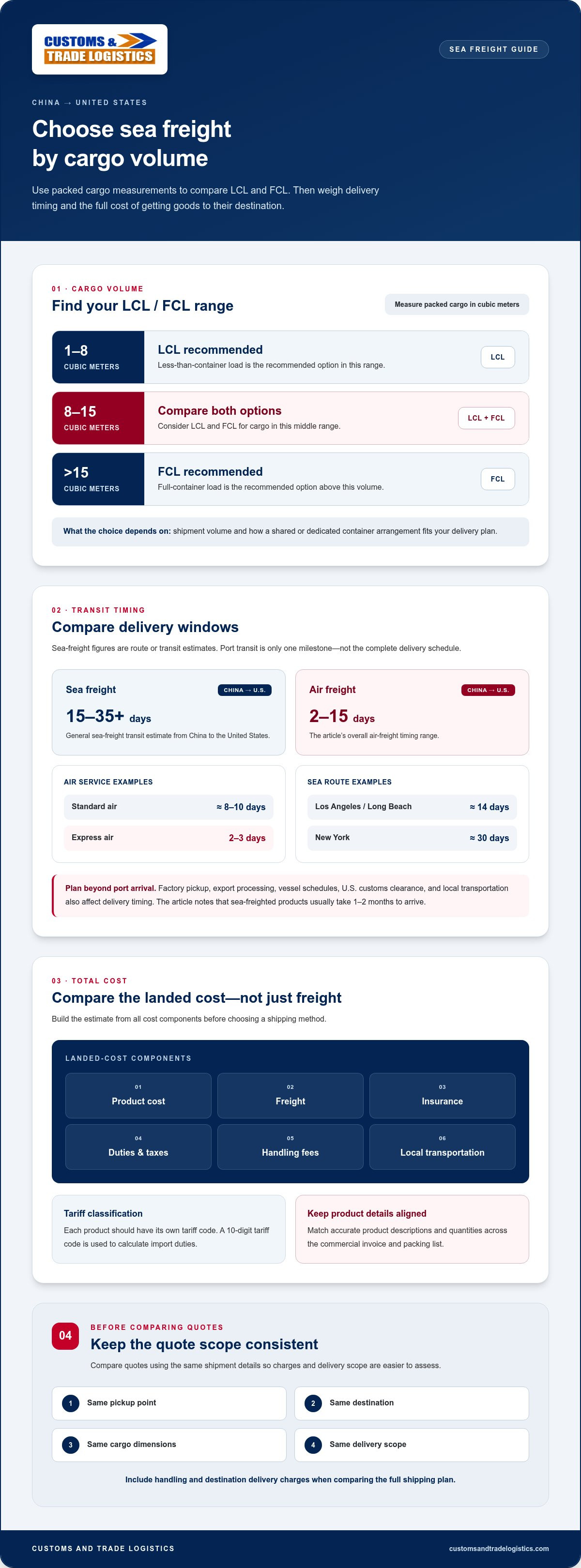
A full container isn’t automatically the right sea-freight choice. To learn how to arrange shipping from a China factory, compare your cargo volume with LCL and FCL: LCL is recommended for shipments measuring 1 to 8 cubic meters, while FCL is recommended for shipments exceeding 15 cubic meters. For cargo between 8 and 15 cubic meters, consider both options; sea freight from China to the United States can take 15-35+ days.
Choosing a shipping method is only the first step. You’ll also need to coordinate pickup and booking, prepare shipment details and paperwork, and plan for U.S. customs clearance and delivery. A clear sequence helps you understand how to arrange shipping from a China factory and who is responsible at each stage.
This guide covers how to compare sea-freight options, share cargo details, coordinate each stage with a forwarder, and follow the shipment through arrival. You’ll also learn what to prepare for customs clearance and how to assess the full landed cost, so you can make informed decisions and move your goods toward their destination.
Key Takeaways
- Match the shipping arrangement to your cargo’s volume, delivery deadline, and final destination.
- Give your freight forwarder clear shipment details so pickup, booking, and delivery can be coordinated smoothly.
- Prepare customs paperwork around the goods and destination, and plan who will handle clearance on arrival.
- Assess the full landed cost, including freight, duties, handling, and local transportation, before finalizing your plan.
- Use shipment milestones to follow progress and prepare for the next step before the cargo arrives.
How long does sea freight shipping take?
- Use the route to set an arrival window. Sea freight from China to the United States can take 15-35+ days. Listed route estimates are approximately 14 days to Los Angeles or Long Beach and approximately 30 days to New York. Ocean freight estimates can also span 25-40+ days, depending on route and destination. Treat port transit as one milestone, not the complete delivery schedule.
- Plan for each stage after the vessel departs. Factory pickup, export processing, vessel schedules, U.S. customs clearance, and local transportation all affect when goods reach their final address. Sea freight from China usually takes 1-2 months for products to arrive. Share your destination address and required delivery timing before booking, so the schedule accounts for port handling and onward movement.
- Identify the U.S. importer and goods before preparing entry. The U.S. importer acts as the Importer of Record and is responsible for identifying each product’s Harmonized System code, arranging freight, and completing customs clearance. Many import rules apply to businesses bringing in goods for commercial use. Product descriptions and intended use help determine the information needed for entry and duty calculations.
- Classify every product for duty calculation. Each product shipped to the United States should have its own tariff code. A 10-digit tariff code is used to calculate import duties. Keep the classification aligned with the commercial invoice and packing list. Accurate descriptions matter because differences between declared goods and shipment contents can prompt questions during customs review.
- Prepare export and import paperwork before dispatch. China export paperwork may include a customs entry document, customs declaration, commercial invoice, packing list, and export licence. Required documents must be submitted before the shipment leaves China. The U.S. destination also affects labeling, addressing, import forms, and applicable customs requirements. Hazardous goods may require material safety data sheets, while agricultural goods may require sanitary and phytosanitary certificates.
- Include U.S. bonds and fees in the landed-cost plan. Without a continuous transaction bond, an entry bond and an ISF bond are required. Allow for applicable customs processing and harbor maintenance fees when estimating landed cost. Landed cost also includes product, freight, insurance, duties and taxes, handling, and local transportation.
What Are Your Shipping Options From China?
Compare shipping methods based on shipment volume, delivery timing, and destination. Before booking, calculate the full cost, including duties and local delivery.
-
Compare Sea Freight Options
Measure the packed cargo in cubic meters, then compare less-than-container load (LCL) and full-container load (FCL). LCL is recommended for shipments measuring 1 to 8 cubic meters; for 8 to 15 cubic meters, consider both LCL and FCL. FCL is recommended above 15 cubic meters. The right choice depends on shipment volume and how the shared or dedicated container arrangement fits your delivery plan.
Sea freight can suit large shipments and has virtually no limit on product size. Transit from China to the United States can take 15-35+ days. Compare quotes using the same pickup point, destination, cargo dimensions, and delivery scope. This makes charges easier to compare and helps avoid choosing an option that excludes costs needed to get goods to your address.
-
Assess Tariff Classification and Landed Costs
Identify the tariff code for every product before estimating import costs. Each product shipped to the United States should have its own code, and a 10-digit tariff code is used to calculate duties. Give accurate product descriptions to the person preparing the classification, since the goods’ characteristics inform the code and duty calculation.
Estimate landed cost by adding product cost, freight, insurance, duties and taxes, handling fees, and local transportation. Compare methods using these combined costs, not just the ocean-freight quote. Match the invoice and packing-list descriptions to the products and quantities to help prevent avoidable delays. Keep the destination address consistent across booking and import documents.
-
Compare Air Freight Costs and Transit Times
Use air freight when delivery timing outweighs the value of slower ocean transport. Air freight from China to the United States can take 2-15 days; standard air freight is listed at approximately 8-10 days, while express air shipping can take 2-3 days. Compare the service timing with your actual deadline and the shipment’s cargo details.
Air freight costs depend on shipment size and weight, so provide both measurements when comparing options. Dimensional weight uses package length, width, and height in centimeters, multiplied together and divided by 6,000 to calculate volume weight in kilograms. Clear measurements help prevent quote changes and delays caused by inaccurate cargo information.
-
Review Sea Freight Costs and Transit Times
Request comparable sea-freight quotes for the same cargo volume, pickup location, and final destination. The route affects timing: sea freight from China to Los Angeles or Long Beach is listed at approximately 14 days, compared with approximately 30 days to New York. These are port-route estimates, so include customs processing and onward transportation in your delivery schedule.
Ask the forwarder to separate freight, handling, and destination delivery charges in the quote. This helps reveal which costs are included and supports a more useful landed-cost comparison. For help weighing route and service options, explore freight logistics planning for your shipment.
Shipment tracking and customs clearance
Track the shipment at each handoff, and prepare its U.S. clearance documents before arrival. These steps help you respond promptly when a carrier, customs official, or delivery team requests information.
- Set up a shipment record. Keep the booking confirmation, bill of lading, carrier reference, factory contact, and destination address together. Use the carrier reference to follow available milestones, such as pickup, export departure, vessel movement, port arrival, and final delivery. Recording milestones helps you see where progress pauses and determine who is responsible for the next handoff.
Ask your freight coordinator for updates at key handoffs. Compare each reported status with the bill of lading and planned destination, and note changes with their dates. Tracking updates show movement, but they don’t replace customs clearance or confirm that goods are ready for delivery.
- Match customs forms to the actual shipment. Prepare the commercial invoice and packing list with consistent descriptions, quantities, and consignee details. Product type, load size, and weight help determine the required forms and clearance process. If a product description differs between documents, resolve the mismatch before submission to reduce avoidable questions during import.
Some cargo requires additional paperwork. Hazardous materials may need a material safety data sheet, while agricultural products may require sanitary and phytosanitary certificates. Requirements depend on the goods and destination. Keep copies of the final documents with the shipment record so the importer and customs representative work from consistent information.
- Plan for U.S. customs clearance. Every shipment arriving in the United States must go through customs clearance. The importer should coordinate the entry process and ensure that product descriptions, tariff classifications, and shipment records match. Customs may request supporting documents to review the goods, so keep the invoice, packing list, and transport details readily available.
For air freight, the importer is responsible for customs clearance. Global couriers such as DHL, UPS, and FedEx handle clearance for their own shipments. For sea freight, clarify who is coordinating the entry and responding to document requests. This helps prevent confusion among the carrier, importer, and customs representative when a shipment reaches port.
- Arrange the applicable bonds and fees. When importing without a continuous transaction bond, an entry bond and an ISF bond are required. The listed U.S. customs duties and processing fees must be paid to ensure timely release. Include applicable charges in your import budget.
Keep payment records and bond details with the entry paperwork. A customs fee or missing bond can interrupt release, even after the vessel arrives. Make sure the party coordinating entry has the documents and information needed to proceed, then follow the shipment through clearance and local delivery.
Shipping workflow and freight forwarder coordination
Calculate packed dimensions and gross weight before requesting transportation quotes. Shipment size comes from length × width × height; air chargeable weight uses dimensions in centimeters multiplied together, then divided by 6,000.
-
Coordinate Freight Forwarding and Shipping Management
Give your freight forwarder the supplier’s pickup address, cargo-ready date, packed dimensions, gross weight, goods description, and final destination. These details help coordinate pickup, booking, export movement, and delivery planning. Ask for a clear sequence of handoffs so you know when the supplier, carrier, and destination team each take responsibility.
Keep the booking reference, contacts, packing details, and transport documents in one shipment record. Update it if cargo dimensions or readiness change. A missed factory pickup or inaccurate measurement can disrupt the booking, so align the supplier and forwarder before the cargo is packed and released.
-
Prepare Freight Under Incoterms
Review the Incoterm in your purchase agreement and map out responsibilities before booking transportation. Confirm which party arranges pickup, export handling, main freight, and delivery at the destination. Share this division of responsibilities with your supplier and forwarder so neither assumes the other has arranged a required step.
Prepare the commercial invoice and packing list using the final cargo details. Check that the goods description, package count, and weights match the shipment. If the supplier changes the packing or cargo-ready date, promptly update your freight forwarder. Consistent information helps coordinate export preparation and prevent avoidable booking changes.
-
Choose Air or Sea Freight
Compare the delivery deadline with cargo size, weight, and total transportation needs. Air freight from China to the United States can take 2-15 days; sea freight can take 15-35+ days. Air often fits urgent cargo, while sea can suit larger shipments. Include pickup and destination delivery in the comparison, not only the main transport leg.
For container planning, a standard 20-foot container has a listed maximum capacity of 28 cubic meters; a 40-foot container has 58 cubic meters. Compare your packed cargo volume with those capacities, leaving room for actual loading needs. Do not estimate from product dimensions alone; cartons, pallets, and packing affect the shipment’s total size.
-
Review Air Freight Thresholds and Transit Times
Compare air service with courier options when cargo is time-sensitive. Air freight can take 2-15 days, while express air shipping is listed at 2-3 days. Air freight may become more practical than courier service at about 300 pounds. Use your delivery timing to determine which flight suits the shipment, and provide accurate package measurements.
For each package, multiply length, width, and height in centimeters, then divide by 6,000 to calculate volume weight in kilograms. Compare that result with actual weight when assessing chargeable weight. Major shipping companies in China can deliver a 10-kilogram shipment in less than 15 days, but your route and selected service affect the plan.
Comparing shipping methods from China
Compare the full shipping plan, not just its main transport leg. Cargo volume, delivery deadline, destination, and final delivery needs all affect which option fits best.
- Match ocean freight to cargo volume. For goods from China, LCL is recommended for shipments measuring 1 to 8 cubic meters, while FCL is recommended above 15 cubic meters. Between 8 and 15 cubic meters, compare both arrangements. Sea freight is cost-effective for large shipments and can accommodate products with virtually no size limit. Compare quotes using the same cargo contents and delivery destination.
- Compare complete costs rather than headline freight charges. Ask what each quote covers, including pickup, handling, main transportation, customs-related charges, and local delivery. Sea freight transit to the United States can take 15-35+ days, so include the cost of timing in your decision. A lower freight quote may not represent the lower total landed cost if other services are excluded.
- Use air or express for tighter deadlines. Air freight from China to the United States can take 2-15 days, while express courier shipping takes about 3-7 days. Global courier shipments can arrive in 2-5 days; FedEx or DHL courier shipments are listed at approximately 3-5 days. Compare the actual service window with your required arrival date and the shipment’s size and weight.
- Consider rail, postal, or small-package services where routes fit. China-to-Europe rail freight takes approximately 15 to 19 days, depending on origin and destination; listed examples are 17 days to Poland and 18 days to London. China Post typically takes 2-5 weeks. Small-package lines such as 4PX or Yunexpress have an example delivery time of 7 to 14 days. These options differ by destination, so match the route and timing to your delivery need.
- Choose by shipment purpose, not habit. A sample or small parcel may suit courier service, while a large replenishment order may suit LCL or FCL shipping. If you’re facing a stockout, weigh air freight against the cost and impact of waiting for ocean freight. For routine inventory, allow time for the full journey, including destination handling and delivery. Ask your Chinese supplier for the final packed dimensions and weight before comparing methods.
- Make the decision using one comparison sheet. Record each method’s transit estimate, included services, cargo limits, destination charges, and delivery scope. This makes trade-offs visible across the entire shipment, rather than only the overseas leg. To weigh route and transport options for goods from China, discuss your import shipping plan.
Customs and Trade Logistics: Customs Clearance Services
Customs and Trade Logistics can help with U.S. entry paperwork, freight coordination, and delivery planning. Customs Clearance Services support the customs process, while International Freight Logistics helps coordinate transportation. Import From China Consulting provides guidance through the import process, and Delivery and Redistribution Services can help move goods onward after arrival.
Consider professional support when product details, shipment documents, and clearance responsibilities need to align before the cargo reaches the United States. Coordinating these elements can make it easier to manage the handoff from factory dispatch through customs and delivery.
Contact Customs and Trade Logistics to discuss support for your import shipment.
Turn Your Shipping Plan Into a Repeatable Process
Use this shipment to build a practical template for future orders. Knowing how to arrange shipping from a China factory helps your team record who handles each handoff, what product details are needed, and how shipment updates reach the people receiving the goods. That preparation gives your next order a more organized starting point.
Customs and Trade Logistics offers Customs Clearance Services, International Freight Logistics, and Import From China Consulting. If you’re deciding how to arrange shipping from a China factory, these services can support customs entry, transportation coordination, and guidance through the import process. Bring your shipment details and destination goals together to identify where professional support can help.
Take the next step by contacting Customs and Trade Logistics about your shipment. With a practical plan and the right support, you can move forward with confidence and focus on growing your business.
Frequently Asked Questions
How long does it take to ship from China to the USA?
Sea freight from China to the United States can take 15-35+ days, while air freight can take 2-15 days. The sea route matters: the listed estimate is approximately 14 days to Los Angeles or Long Beach and approximately 30 days to New York. These estimates describe transit, so build your schedule around the shipment’s route and destination handoffs, too.
What information do I need from a China factory to arrange shipping to the US?
Gather the factory pickup address, cargo-ready date, goods description, package count, dimensions, and gross weight. Request the commercial invoice and packing list, then compare them with the final packed shipment. For example, if the factory changes the carton count, update the packing list and booking details before dispatch. Provide the U.S. delivery address and the recipient’s contact information, too.
How do I choose between air freight, sea freight, express courier, and rail shipping from China?
Choose by shipment size, delivery deadline, destination, and total landed cost. Sea freight suits larger cargo; air or express can fit urgent or smaller shipments. Rail transit examples of 15 to 19 days apply to China-to-Europe routes, not U.S. delivery. Compare the complete route and service scope for your destination, rather than treating a transit estimate for another country as a U.S. arrival estimate.
How much does shipping from China to the US cost by air, sea, and courier?
Shipping costs depend on the shipment and are provided after a quote request. Factors include transport method, origin and destination, package dimensions, gross weight, cargo type, handling, insurance, duties and taxes, and local delivery. Compare quotes using the same cargo details and delivery scope. A low main-freight charge may exclude destination handling or final transportation, which changes the total landed cost.
How long does shipping from China to the US take by each method?
Air freight can take 2-15 days, sea freight 15-35+ days, and global courier shipments can arrive in 2-5 days. Express air shipping is listed at 2-3 days. Rail examples of 15 to 19 days cover China-to-Europe transit, so they don’t establish a U.S. delivery time. Include origin handling, customs clearance, and onward delivery in your planning.
How do I find and hire a freight forwarder in China?
Start by defining the factory location, cargo details, destination, delivery deadline, and required transport mode. A freight-forwarding partner needs this information to coordinate pickup, booking, transportation, and handoffs. Keep the agreed scope and shipment references in one record, and align the supplier’s cargo-ready date with the booking plan. International Freight Logistics can help coordinate transportation and related logistics steps.
Which Incoterms should I use when arranging shipping with a China factory?
Choose an Incoterm that clearly matches the responsibilities agreed with your supplier, rather than defaulting to the same term for every purchase. Map out who arranges factory pickup, export handling, main transportation, insurance, import clearance, and final delivery. Ensure the purchase agreement, booking instructions, and invoice reflect that allocation. Clear responsibilities help prevent missed handoffs and unexpected tasks.
What insurance, packaging, and cargo protections should I arrange for shipping from China?
Consider cargo insurance in light of the goods’ value, route, and handling exposure. Understand the covered risks and exclusions before shipping. Ask the factory to pack goods for the full journey, including loading, transfers, and container or aircraft handling. Use accurate package labels and keep photos of packed cargo and any visible damage. Record the shipment’s condition at handoffs to support any claim with relevant evidence.