

What if a document you need for a CBP question is buried in an old email thread, while the rest of the entry file is scattered across accounting and logistics systems? The record keeping requirements for US importers call for more than saving a customs entry. Importers generally need to retain supporting records for five years, and responsibility doesn’t shift to a broker simply because the broker helped prepare the paperwork.
It’s easy to be unsure which documents belong together or whether your broker’s files are enough. A reliable approach is to treat each import as a traceable transaction file: collect records as the order develops, connect them to the entry, and make sure your team can retrieve them.
This 2026 guide explains which records may support an import entry, how long to retain them, and what to consider when setting up an electronic or paper filing process. You’ll also learn how to coordinate document handoffs with a customs broker while maintaining appropriate oversight, so records are easier to retrieve for CBP requests, audits, and internal reviews.
Key Takeaways
- Use a shipment-by-shipment checklist to connect invoices, transport documents, payment evidence, and other records to the details they support.
- Understand the record keeping requirements for US importers, including how retention periods and start dates can depend on the record or activity.
- Assign an internal owner to collect documents, use consistent file names, and check that each shipment file is complete.
- Choose a paper or electronic filing approach that lets your team retrieve records promptly for CBP requests and internal reviews.
- Coordinate document handoffs with your customs broker, while maintaining an importer-side process for oversight and retention.
What Are the Record Keeping Requirements for US Importers?
Importer recordkeeping means collecting and maintaining documents and data related to import transactions and other customs activities, then being able to produce applicable records when required. These files support customs entry information and help a business check costs, trace shipment details, and answer questions about a transaction.
The CBP recordkeeping regulations in 19 CFR Part 163 set out requirements for records connected to customs business. The rules don’t prescribe one identical document checklist for every importer or shipment. Which records matter can depend on the transaction, activity, and parties involved. In practice, build a connected file that explains what was imported and supports the information reported. Avoid saving documents without a clear link to the relevant entry or activity.
Who Must Keep Import Records?
The importer of record is generally the owner or purchaser of the imported goods, or a licensed customs broker designated by the owner or purchaser to make entry. Under customs law, the importer of record has responsibilities that include using reasonable care in entry-related matters. The role of a customs duties payer helps explain why accurate transaction records matter, though Wikipedia provides general background, not a statement of CBP requirements.
A customs broker may handle delegated tasks, such as filing an entry or coordinating customs documentation. That assistance doesn’t mean the importer should assume the broker’s files are its complete recordkeeping system. Regulations can apply to different parties based on their roles and activities, and a service agreement doesn’t automatically settle every party’s regulatory responsibility. Confirm what the broker retains, what records are shared with you, and who maintains the rest of the transaction file.
Why Do CBP Recordkeeping Rules Matter?
Organized records help connect an entry to its supporting details when CBP asks questions, conducts an audit, or reviews an import activity after release. They also make internal reviews more useful. Your team can compare documents, investigate a discrepancy, or locate information for routine business decisions without searching across disconnected systems. A document request is a reason to retrieve and review the relevant file, not by itself proof of wrongdoing.
Importer recordkeeping is the organized maintenance of records related to customs transactions and activities, as required by 19 CFR Part 163, so applicable records can be produced when required.
For a workable start, assign an internal owner to coordinate records with your broker and other teams. The record keeping requirements for US importers are easier to manage when responsibilities are clear and each shipment’s documents can be traced to its transaction.
Which Documents Should a US Importer Keep for Each Shipment?
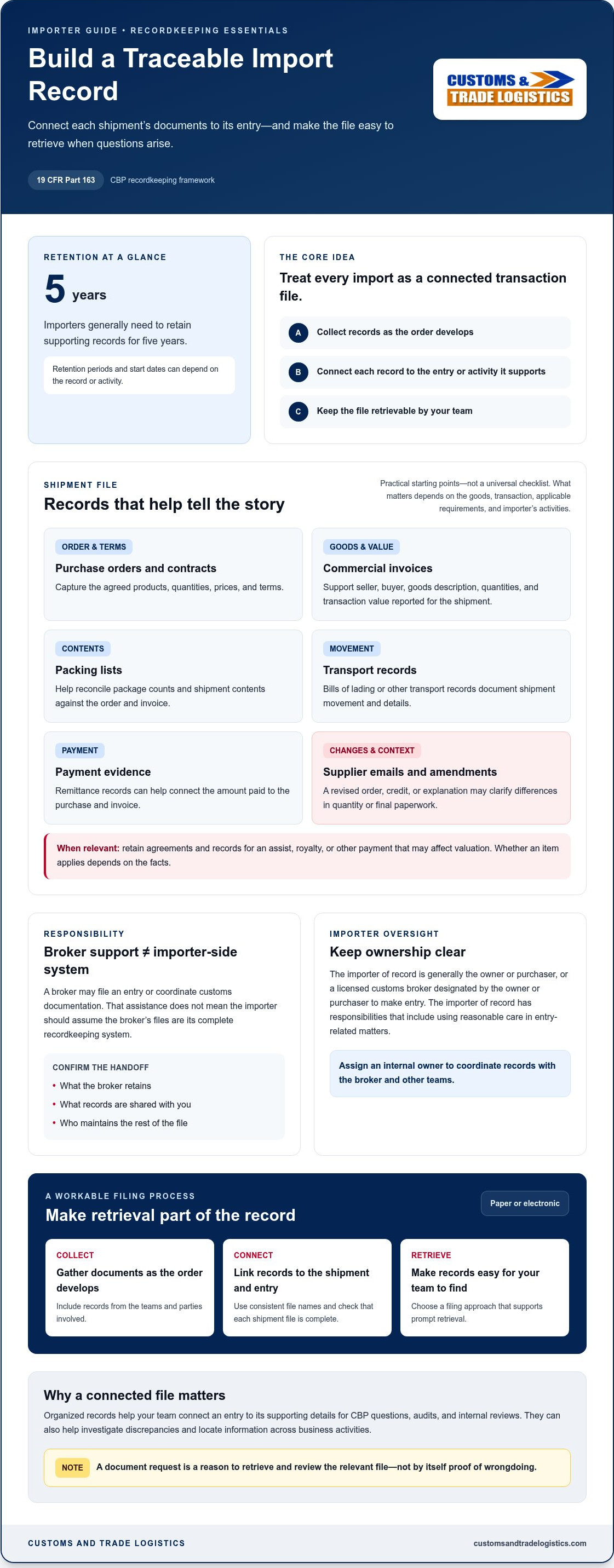
There isn’t one universal document packet for every import. The records that matter depend on the goods, transaction, applicable agency requirements, and the importer’s activities. Use these examples as a practical starting point, not a complete statement of every legal requirement. CBP’s Record Keeping Informed Compliance publication explains the agency’s recordkeeping framework, including records that may need to be maintained and produced.
Commercial and Shipping Records
Keep documents that show what your business ordered, what the supplier shipped, and what your business paid. Read together, they can help explain differences in price, quantity, product description, or routing.
- Purchase orders and contracts: Capture the agreed products, quantities, prices, and terms.
- Commercial invoices: Support the seller, buyer, goods description, quantities, and transaction value reported for the shipment.
- Packing lists: Help reconcile package counts and shipment contents against the order and invoice.
- Bills of lading or other transport records: Document shipment movement and transport details.
- Payment evidence: Remittance records, for example, can help connect the amount paid to the purchase and invoice.
Keep relevant supplier emails and amendments, too. A revised order, credit, or explanation for a changed quantity can clarify why the final shipment differs from the original paperwork. If valuation may be affected by an assist, royalty, or other payment, retain relevant agreements and records so the transaction can be reviewed. Whether a particular item applies depends on the facts.
Customs Entry and Supporting Records
Save entry documents, including the entry summary and information used to prepare or review the filing. Classification support can show how the product was identified. Valuation records can explain how the declared value was determined, and origin documents can support the stated country of origin. Depending on the goods, keep relevant permits, certificates, or other government-agency records related to admissibility or specific product requirements.
Retain broker communications and document versions that explain corrections, questions, or decisions made during entry preparation. A broker can help coordinate customs documentation, but the importer should be able to access and understand the records supporting its transactions. For background on the clearance process, see Customs Clearance Services in the US: The Complete Importer’s Guide for 2026.
Make retrieval straightforward by using a consistent purchase order, shipment, or entry reference across folders and filenames. Link related files to the same reference, so staff can locate an invoice, transport record, and entry documents from one identifier. This practical step helps turn the record keeping requirements for US importers into a usable transaction file. If you need help coordinating import documentation with customs clearance and shipment arrangements, explore customs clearance and logistics support.
How Long Must US Importers Keep Records, and In What Format?
For customs records covered by the general rule, the retention period is five years. Under 19 CFR Part 163 and 19 U.S.C. §§ 1508-1509, the clock generally starts on the date of entry or the date of the activity that created the record. The trigger depends on the record, so don’t assume every file’s five-year period starts on the same day. The record keeping requirements for US importers can also differ where a specific rule or another agency’s requirements apply.
Retention Periods and Trigger Dates
Use this table as a planning guide, not a substitute for checking the rule that applies to your goods and activity. Confirm the record category and trigger against current requirements before setting a destruction date.
| Record category | Likely retention period and trigger | What to verify |
|---|---|---|
| General customs records | Generally five years from the date of entry or the activity that created the record | Identify the applicable trigger for each record under 19 CFR Part 163 |
| Drawback claim records | Three years from the date of payment | Confirm the record relates to the drawback claim and check any other applicable rules |
| Certain informal entries or duty-free articles | Some specified cases have a two-year period | Verify the entry type and the conditions for the exception |
| Packing lists | A special period may apply, including a 60-day period in specified circumstances | Check the current rule and whether the list is covered by the special treatment |
| Goods subject to antidumping or countervailing duty proceedings | Retention may need to continue while the relevant case remains open | Confirm case status and any applicable agency requirements |
Other agencies, entry types, or transaction circumstances may require a different or longer retention period. If a file supports more than one obligation, use the longest applicable period and document why you selected that end date.
Electronic Records, Backups, and Retrieval
Electronic filing can make records easier to search and retrieve, provided files remain complete, readable, and accessible. CBP’s electronic recordkeeping provisions may include specific conditions, such as advance written notice before adopting an electronic system and retaining originals for a defined period. Confirm the current requirements that apply to your system before discarding paper originals or converting records.
Build reliability into the process. Restrict access to authorized staff, maintain dependable backups, and test whether someone who didn’t create a file can find it using an entry, shipment, or purchase order reference. Keep a written retrieval procedure and assign someone to review retention dates. A digital archive is only useful if your team can produce the right file promptly.
How Can Importers Build a Recordkeeping Process That Works?
A reliable process starts with one clear owner and follows each purchase through delivery and retention review. The goal isn’t to create extra paperwork. It’s to keep shipment records connected, capture changes, and make sure someone can locate the file when questions arise. These workflow steps are practical business controls, not a replacement for checking the specific legal requirements that apply to your imports.
A Shipment-by-Shipment Filing Workflow
Assign an internal owner to collect, name, and check records. That person can coordinate with purchasing, finance, logistics, and your customs broker, while keeping importer-side oversight clear.
- Set up the file at supplier onboarding. Choose a consistent folder or record structure. Identify the supplier, purchase order, shipment, and entry references you’ll use to connect documents.
- Collect records as the order develops. Save relevant purchase documents and supplier communications before shipment. Keep revised invoices, packing lists, and order terms with their dates rather than replacing earlier versions without a trace.
- Reconcile before and during entry filing. Compare the details in commercial documents with the information prepared for the entry. Resolve differences in descriptions, quantities, values, or origin with the supplier or broker, and preserve the explanation or corrected document.
- Close the file after delivery. Add final shipping and entry records, note shipment changes, and confirm that the file is complete and searchable under its reference numbers.
- Review retention periodically. Track relevant retention triggers and check whether a separate requirement applies before authorizing disposal.
Preparing for a CBP Records Request
A request is easier to manage when the retrieval steps are familiar. First, identify the transaction or activity the request covers and record any instructions or response date provided. Assign one person to coordinate the search, gather potentially responsive records from internal teams and the broker, and check that the documents are complete and consistent. Verify the applicable deadline and any extension process directly from the request or current CBP guidance. Don’t assume a general timeframe applies to every request.
A short self-audit can help reveal gaps before a request arrives:
- Can staff find a file using its purchase order, shipment, or entry reference?
- Are revised documents dated and linked to the final transaction details?
- Can the internal owner identify what the broker retains and what the importer keeps?
- Are access, backup, and retrieval steps documented and periodically tested?
If document handoffs across your team and broker are difficult to manage, learn about import documentation support as part of customs clearance and shipment coordination.
When Should an Importer Get Help Managing Customs Records?
Self-managed filing may work when shipment volume is manageable, staff understand the documents involved, and the business has a consistent way to collect and retrieve them. Broker-assisted coordination can be useful when shipments are frequent, supplier information arrives in different formats, or product and transaction details require more internal coordination. Choose support that addresses a real gap without losing sight of importer oversight.
What a Customs Broker Can Help Coordinate
Depending on the agreed scope, a customs broker can help prepare and coordinate customs documentation, support entry filing, and communicate about information needed for the entry. This can clarify document handoffs, especially when a business manages suppliers, freight, and internal records across different teams. The importer should still assign someone to collect source documents, review submitted information, and retain the records it needs. Broker involvement doesn’t automatically make the broker the importer’s recordkeeper.
Choosing Support That Fits Your Import Operation
Before deciding, consider how often you import, how much supplier follow-up each shipment requires, whether product details are straightforward, and whether your team can keep transaction files complete. Then ask a prospective provider practical questions:
- Which documents should your team provide, and how should you send them?
- How will you receive entry documents and supporting records after filing?
- How are corrections or updated supplier documents communicated and saved?
- Who should your team contact to retrieve records or clarify what the broker retains?
Clear answers help you compare self-managed filing with broker-assisted coordination based on workload and capability, not assumptions. They also give your internal owner a defined process for checking that shipment records remain accessible. The record keeping requirements for US importers still call for the importer to understand and oversee its responsibilities, even when a broker handles delegated tasks.
Customs and Trade Logistics brings more than 35 years of industry experience supporting customs brokerage and logistics for US businesses, including small and medium-sized businesses and importers working with China. Its services include customs documentation and international shipment coordination. You can discuss import support with Customs and Trade Logistics if your team needs help coordinating documents and shipment arrangements.
Make Your Import Records Easier to Manage
The record keeping requirements for US importers are easier to manage when each shipment has a connected, retrievable file. Keep records that support the transaction, confirm the retention period and start date that apply to each record, and assign someone to oversee document collection and retrieval. A broker can help coordinate customs documentation, but importer oversight remains part of a dependable process.
You don’t need to solve every filing challenge at once. Start by reviewing how your team and broker exchange documents, where final records are stored, and whether staff can locate them using a shipment or entry reference. Small, consistent improvements can make internal reviews and responses to CBP questions more manageable.
Customs and Trade Logistics is a family-owned firm serving importers nationally, with more than 35 years of customs brokerage and logistics experience. Its support includes customs documentation and international shipment coordination. To discuss how that support could fit your import process, talk with Customs and Trade Logistics about your import process.
Frequently Asked Questions
How long do US importers have to keep customs records?
US importers generally must retain covered customs records for five years, but the applicable trigger and any exception depend on the record and activity. Under 19 CFR Part 163, the period may run from the date of entry or the date of the activity that created the record. The record keeping requirements for US importers aren’t identical for every file, so verify current provisions and other applicable requirements. This is general information, not a determination for a specific transaction.
What records should an importer of record keep?
An importer of record should keep records that substantiate the information reported for each import. Examples include purchase orders, commercial invoices, packing lists, transport documents, entry records, payment evidence, and communications that explain declared details or shipment changes. This is a practical starting point, not a complete legal checklist. The records needed depend on the goods, transaction, and applicable rules, so keep relevant supporting documents and confirm any requirements specific to your importing activities.
Is a customs broker responsible for keeping an importer’s records?
A customs broker may prepare entries and handle documents under the parties’ engagement, but importers shouldn’t assume the broker alone satisfies every importer obligation. Responsibility can depend on the applicable rules, each party’s role, and their arrangements. Confirm which records the broker retains, how your team can retrieve them, and what remains under your control. Agreeing on a clear handoff process helps prevent gaps between broker files and the importer’s own transaction records.
Can US import records be stored electronically?
Electronic systems can make import records easier to organize and retrieve, provided the files remain complete, legible, secure, and accessible as required. No storage method automatically guarantees compliance. Before replacing paper records or choosing a system, verify current CBP requirements for the record type and your circumstances. Maintain tested backups, limit access appropriately, and document how staff can locate and produce a shipment file if records are requested.
What happens if an importer cannot produce requested customs records?
Failure to maintain or produce required records can lead to compliance and enforcement consequences, depending on the facts and applicable law. A missing file doesn’t determine the outcome by itself. If you receive a request, identify its scope, preserve related records and communications, and confirm the deadline and response procedures. If records are incomplete or unavailable, consider consulting qualified customs or legal professionals promptly rather than making assumptions about the consequences.
Do small businesses have the same US import recordkeeping requirements?
Business size alone shouldn’t be treated as an exemption from applicable customs recordkeeping rules. Small importers can make the process manageable with a shipment-based filing system, one clearly assigned record owner, consistent file names, and a reliable retrieval method. Check the requirements that apply to your specific goods and activities. Other government agencies may regulate certain products, so customs records may not be the only documents your business needs to retain.
Do importers need to keep records from suppliers and freight providers?
Relevant supplier and logistics records can help substantiate transaction details such as price, quantity, origin, shipment movement, and changes to an order. Keep useful communications and document versions with the related shipment file so the final details can be understood. The exact records required depend on the transaction and applicable rules. Treat examples as a starting point, not an exhaustive checklist, and verify special requirements for your goods and activities.