

If you’re asking what is a CBP Form 28 request for information, it’s a formal inquiry from U.S. Customs and Border Protection (CBP) seeking details about an import entry. CBP may ask about classification, value, country of origin, or other entry information. The wording can make it hard to know which records to send, but a Form 28 is not itself a penalty.
It does require prompt, careful attention. Importers typically have 30 days from the form’s issue date to respond, but follow the deadline stated on your specific request. An incomplete answer or missed deadline can complicate the entry review. Avoid guessing what CBP wants or sending documents without explaining how they address the questions.
This guide explains why CBP may send Form 28 and how to prepare a clear, evidence-based response, question by question. You’ll learn how to organize entry and supporting records, check the response deadline, and recognize when a customs broker or attorney may be helpful. Customs and Trade Logistics brings more than 35 years of customs and logistics experience to helping importers manage documentation with greater confidence.
Key Takeaways
- Understand what is a CBP Form 28 request for information and how it differs from a notice of action or a final decision.
- Identify the entry details CBP is asking about, such as product information, transaction records, country of origin, or declared value.
- Build a response that addresses each question directly and connects your explanations to relevant supporting documents.
- Use the instructions on the request to confirm how and when to submit your response, and keep a complete copy of what you send.
- Learn what CBP may do after reviewing your response and when a customs broker or attorney may be appropriate support.
What Is a CBP Form 28 Request for Information, and What Does It Mean?
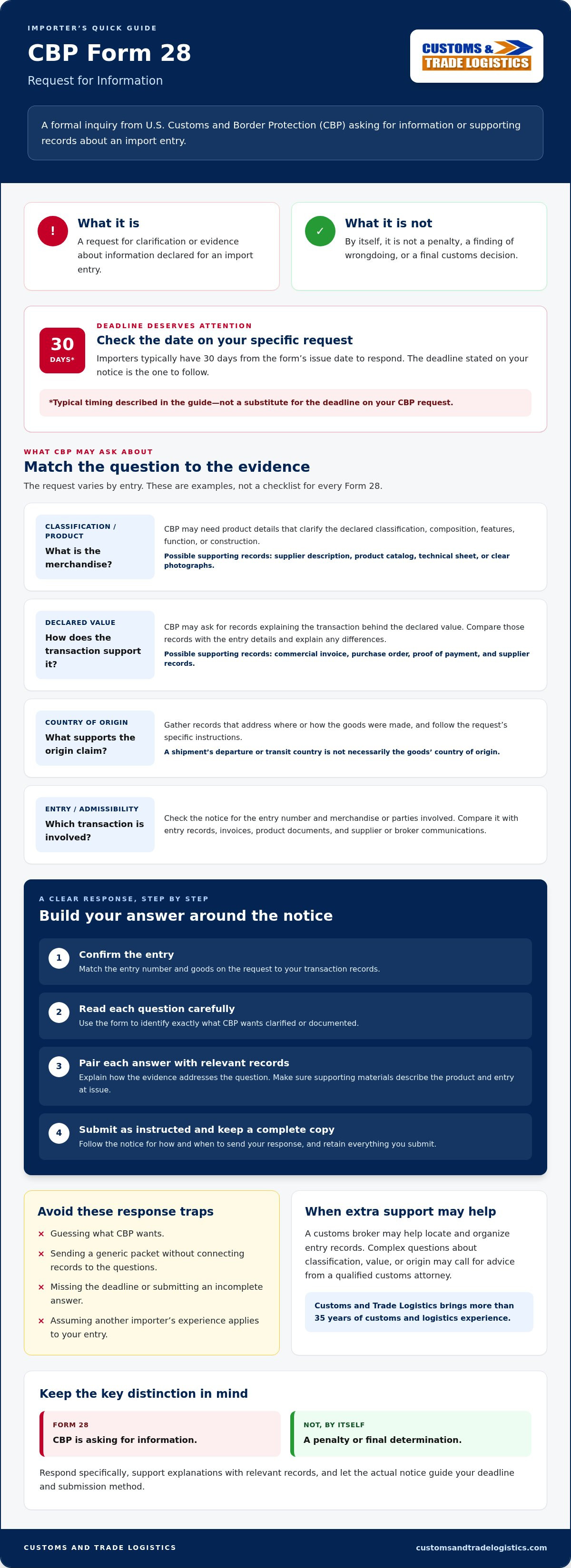
What is a CBP Form 28 request for information? It’s a formal notice CBP uses to ask for information or supporting records about an import entry. The agency may need clarification about details declared for the shipment, and the form specifies what it wants you to address.
Receiving a Form 28 does not, by itself, prove that you did something wrong or mean CBP has made a final decision. Treat it as a request that deserves a careful, specific response, not as a finding of noncompliance. The questions and requested documents vary, so use your notice as the guide rather than assuming another importer’s experience applies to your entry.
A Form 28 asks for information. By itself, it is not a final customs action or determination.
What information can CBP ask an importer to provide?
The request may concern an entry’s tariff classification, declared value, country of origin, or admissibility. For example, CBP might ask for product descriptions or technical details to better understand how merchandise was classified. It could also request transaction records to clarify the declared value, or documents supporting an origin claim. These are examples, not a checklist for every Form 28.
Origin questions can involve how a product qualifies as originating under a trade agreement. If that topic appears on your form, the overview of Rules of Origin can help explain the underlying concept. Your response should still address the exact question CBP asked and include records relevant to the entry. Don’t substitute unrelated material for a direct answer.
Who receives Form 28, and which entry does it concern?
A Form 28 concerns information CBP seeks about an import transaction. Check the notice for the entry number and any description of the merchandise or parties involved. Compare those details with your entry records, invoices, product documents, and communications with the supplier or customs broker. This helps confirm which transaction the request covers before you gather evidence.
Don’t assume the notice applies to every shipment you’ve imported or that every importer follows the same review path. If you’re unsure which entry or goods CBP is asking about, clarify that before preparing your response. A customs broker may help locate and organize entry records. Complex questions about classification, value, or origin may call for advice from a qualified customs attorney.
Why Does CBP Issue Form 28, and What Is It Trying to Verify?
CBP may issue Form 28 when it needs clarification or supporting evidence about information declared for an import entry. Questions may focus on whether the product description supports the declared classification, how transaction details relate to the reported value, or what records substantiate the country of origin. The request means CBP wants more information. It does not establish that the original declaration was incorrect.
The questions on your Form 28 determine which evidence is relevant. Match each response to the request instead of sending a generic packet of documents.
How can product classification or description lead to questions?
A brief or unclear description may not give CBP enough detail to understand what the merchandise is or how it is used. If the request concerns classification, gather materials that clarify the product’s composition, features, function, or construction. Depending on the item and the questions, useful records may include a supplier description, product catalog, technical sheet, or clear photographs.
Check that your supporting materials describe the same product covered by the entry. Don’t guess at a tariff classification based on a similar item. The right analysis can depend on specific product facts, so verify it where needed.
Why might CBP ask about value, origin, or transaction records?
CBP may request records that help explain the transaction behind the declared value. Depending on the questions, relevant documents could include the commercial invoice, purchase order, proof of payment, and supplier records. Compare them with the entry details and identify differences you can explain. Don’t assume that one document alone answers every question.
Origin questions also call for care. The country a shipment departed from or passed through isn’t necessarily the country where the goods originated. If CBP asks about origin, gather records that speak to where or how the merchandise was made, and follow any specific request for supporting details. For a broader perspective on response strategy, see this customs law firm’s discussion of how to respond to a CBP Form 28.
Start by sorting the notice’s questions into separate topics, then match each one with relevant evidence. If the request raises complex classification, value, or origin issues, a customs broker can help organize entry records and coordinate a response. Customs clearance support may also help importers manage entry documentation.
Does a CBP Form 28 Mean a Penalty or Customs Hold Is Certain?
No. A CBP Form 28 is an information request, not an automatic penalty, final finding, or guarantee that a shipment will be held. CBP may use your response to review an entry, but the outcome depends on the facts and any later agency action. If you’re asking what is a CBP Form 28 request for information in relation to a penalty, the key distinction is that the form asks for information. It does not itself decide that a violation occurred.
A Form 28 response also doesn’t guarantee that CBP will take no further action. The agency may accept the entry as filed, make a change, issue another notice, or take other steps depending on its review. Shipment release, duties, or delays may also be affected by separate circumstances and communications, so don’t assume the Form 28 alone explains a hold.
How is Form 28 different from CBP Form 29?
Form 28 requests information. Form 29, titled “Notice of Action,” communicates an action CBP proposes or has taken, and may provide an opportunity to respond. The forms serve different purposes, but the details and instructions on the notice matter. Check the title, entry reference, stated action, and response deadline rather than relying on the form number alone.
| Notice or stage | What it generally means | What to check |
|---|---|---|
| Form 28 | CBP requests information about an entry. | Questions, requested records, deadline, and submission instructions. |
| Form 29 | CBP gives notice of proposed or taken action. | The action described and any opportunity or deadline to respond. |
| Final action or decision | CBP has reached an outcome for the matter or entry. | The decision, its effect, and any stated options or deadlines. |
This is a general guide, not a substitute for reading the notice. If Form 28 and Form 29 arrive together, or the action could affect duties or enforcement exposure, ask a qualified customs professional to review the documents promptly.
What if the request arrives with a shipment delay or another notice?
Keep each communication distinct. A Form 28 doesn’t necessarily explain a separate hold, examination, or notice of action. Record the date received, entry reference, stated deadline, and instructions for every notice. Form 28 requests typically allow 30 days from issuance, but follow the deadline printed on your specific request. If release, additional duties, or possible enforcement action is involved, contact your customs broker or a qualified attorney promptly. A careful response matters, but it cannot guarantee a particular CBP decision or prevent delays or further review.
How Should You Respond to a CBP Form 28 Request for Information?
A clear response starts with the notice, not assumptions about what CBP might want. If you’re asking what is a CBP Form 28 request for information and how to answer it, treat each question as a separate task: identify the point at issue, find records that address it, and explain how the evidence supports your answer.
- Note the deadline and submission method. Check the date, response deadline, and delivery instructions on your specific request. Form 28 requests typically allow 30 days from issuance, but follow the deadline printed on the notice. If you may need more time, verify extension procedures with CBP or a qualified customs professional before the deadline expires.
- Break down each question. Mark the information CBP requests and list the facts or documents that could answer each point.
- Gather relevant evidence. Match records to the questions instead of sending a large, unexplained file.
- Check for consistency. Compare your explanations and documents with the entry data and related communications. Flag gaps or conflicts for review.
- Submit as instructed and keep a copy. Follow the notice’s submission method. Save the response, attachments, proof of submission, and related entry records together.
Which records should you collect before drafting a response?
Use the request to guide your file. An invoice or purchase order may help address transaction details, while payment records may clarify what was paid. Product specifications, supplier statements, photographs, or origin records may be useful when they directly answer a question. Don’t include documents simply because they’re available.
| If CBP asks about | Records to consider, when relevant |
|---|---|
| Transaction or declared value | Commercial invoice, purchase order, proof of payment, supplier records |
| Product details | Product specifications, catalog information, photographs, supplier description |
| Country of origin | Origin-related records or supplier statements that address the specific question |
| Shipping details | Shipping documents that relate to the entry and the point CBP raised |
Before drafting, flag missing, conflicting, or untranslated documents. Don’t fill gaps with guesses or make statements the records can’t support. If you can’t verify a fact, describe the limitation carefully and seek qualified guidance where appropriate.
How can you make the response clear, complete, and consistent?
Answer each numbered question directly, label attachments as exhibits, and refer to them in your explanation. Check that your statements align with the entry data, commercial documents, and prior communications. If the facts are disputed, the request involves complex valuation, classification, or origin questions, or you see possible legal exposure, consult a customs broker or attorney before submitting.
Need help organizing entry records or managing customs documentation? Contact Customs and Trade Logistics about customs clearance support.
What Happens After You Respond, and When Can a Customs Broker Help?
Submitting your response moves the review forward, but it doesn’t determine what CBP will do next. The agency may review your materials, ask follow-up questions, or take further action based on the entry and information available. Receiving a Form 28 alone isn’t enough to predict the result. Keep your records organized so you can respond accurately if CBP contacts you again.
What should you monitor after submitting your response?
Use the submission method stated in the request to check that your response was sent, and retain any available delivery or submission confirmation. Add a dated copy of the form, your response, every attachment, and later communications to the entry file. Keep related entry records together. A clear file makes it easier to confirm what CBP has already received and respond consistently to follow-up.
Watch for new notices, questions, or deadlines. If CBP proposes an action, you don’t understand a follow-up request, or a deadline is unclear, seek appropriate professional guidance promptly. Don’t assume that sending the initial response closes the review.
When should you ask a customs broker or attorney for help?
A customs broker can help locate and organize entry records, compare them with entry details, and coordinate customs documentation. Consider asking for support if invoices, supplier records, or other documents are incomplete or don’t match. A broker can assist with customs processes, but isn’t a substitute for legal counsel.
Consult a qualified attorney if the matter raises potential penalties, disputed legal interpretations, or enforcement concerns. The question “what is a CBP Form 28 request for information” may sound straightforward, but the right support depends on the issues and records involved. Customs and Trade Logistics has more than 35 years of industry experience supporting importers with customs and logistics needs. You can also review a customs clearance services guide to learn more about customs clearance.
If you need help organizing customs documentation or managing clearance needs, keep the Form 28 and your entry file available so you can explain which questions or records need attention.
Move Forward With a Clear Response Plan
Understanding what is a CBP Form 28 request for information helps put the notice in context: it asks for details about an import entry, but it isn’t itself a final finding or penalty. Start by following the questions on your specific form, supporting each answer with relevant records, and keeping a complete copy of everything you submit. If CBP follows up or the request raises complex customs or legal concerns, seek qualified support promptly.
You don’t have to sort through entry documents alone. Customs and Trade Logistics is a family-owned firm with more than 35 years of customs brokerage and logistics experience, supporting small and medium-sized businesses importing through U.S. ports. For help with customs documentation and clearance needs, talk with an experienced customs brokerage team.
A careful, organized response gives you a practical way to address the request and manage the next steps with greater confidence.
Frequently Asked Questions
What is a CBP Form 28 request for information?
A CBP Form 28 is a formal request from U.S. Customs and Border Protection (CBP) for information or supporting records about an import entry. The questions may concern details such as product classification, declared value, or country of origin. Receiving one doesn’t by itself mean CBP has found wrongdoing or made a final decision. Read the specific notice carefully to see which entry and questions it covers.
Why did I receive a CBP Form 28?
CBP may send a Form 28 when it needs clarification or evidence about information declared for an import entry. For example, it may ask for product specifications to understand a description, transaction records to review declared value, or documents supporting an origin claim. The request doesn’t establish that your original declaration was incorrect. Use the questions on your notice to identify what CBP wants verified and which records may address it.
How long do I have to respond to a CBP Form 28?
Importers typically have 30 days from the form’s issue date to respond, but follow the deadline printed on your specific request. Check both the date and submission instructions as soon as you receive it. If you need more time, verify the extension procedure with CBP or a qualified customs professional and request an extension before the stated deadline expires. Don’t assume an extension has been granted unless confirmed.
What documents should I provide with a Form 28 response?
Provide records that directly answer the questions on your notice. Depending on the issue, these might include commercial invoices, purchase orders, proof of payment, shipping documents, product specifications, supplier statements, or origin records. The list isn’t the same for every request. Match each document to a specific question, label attachments clearly, and check for missing or conflicting information before submitting. Avoid unsupported explanations or unrelated paperwork that could obscure your response.
Does a CBP Form 28 mean my shipment is being held?
No, receiving a Form 28 doesn’t automatically mean your shipment is being held. A request for information and a separate shipment hold, examination notice, or other action are distinct communications. Check the notice for what it says about the entry, then review any other messages you’ve received. If the shipment appears delayed or you have a separate notice, record its details and promptly ask your customs broker or another qualified professional what steps apply.
What is the difference between CBP Form 28 and Form 29?
Form 28 requests information about an import entry. Form 29, titled “Notice of Action,” communicates a proposed or taken action and may provide an opportunity to respond. They serve different purposes, but the title, contents, and instructions on the actual notice matter. Review any stated deadlines and entry references carefully. If you receive both forms or the notice could affect duties or raise enforcement concerns, seek prompt review from a qualified customs professional.
Can a customs broker respond to a CBP Form 28 for me?
A customs broker can help organize entry records, compare documents with entry details, and coordinate preparation of a response. Whether the broker can submit it on your behalf depends on applicable authorization and the instructions on the notice, so confirm those details before relying on them to file. You remain responsible for ensuring the response is accurate and timely. For potential penalties, enforcement concerns, or disputed legal questions, consult a qualified attorney.