

What good is a customs entry filed correctly if you’re still unsure who is coordinating the shipment or answering your questions? The questions to ask a potential customs broker should reveal more than filing knowledge. They should show whether the broker can explain responsibilities, communicate clearly, and connect customs clearance with the rest of your import journey.
If you run a small business, you need practical answers that fit your shipment and your team, not vague assurances or confusing jargon. Get clarity on who provides and prepares documents, how shipment issues are handled, and what updates you can expect.
This guide offers questions to help you assess a broker’s customs knowledge, communication, and ability to coordinate import logistics. You’ll also see what specific, useful answers can sound like, so you can judge whether the broker is ready to support your needs from customs paperwork through shipment coordination and delivery planning.
Key Takeaways
- Use questions to ask a potential customs broker to find out how their experience applies to your products, route, and business needs.
- Clarify who prepares and reviews customs entry details, and how product classification decisions are explained.
- Find out how routine updates, missing paperwork, and shipment changes are communicated, and who handles your questions.
- Separate customs clearance, freight coordination, paperwork, and delivery planning to understand who manages each stage.
- Bring product descriptions, supplier details, shipment plans, and available paperwork to make your first conversation more productive.
Questions to Ask a Potential Customs Broker Before You Commit
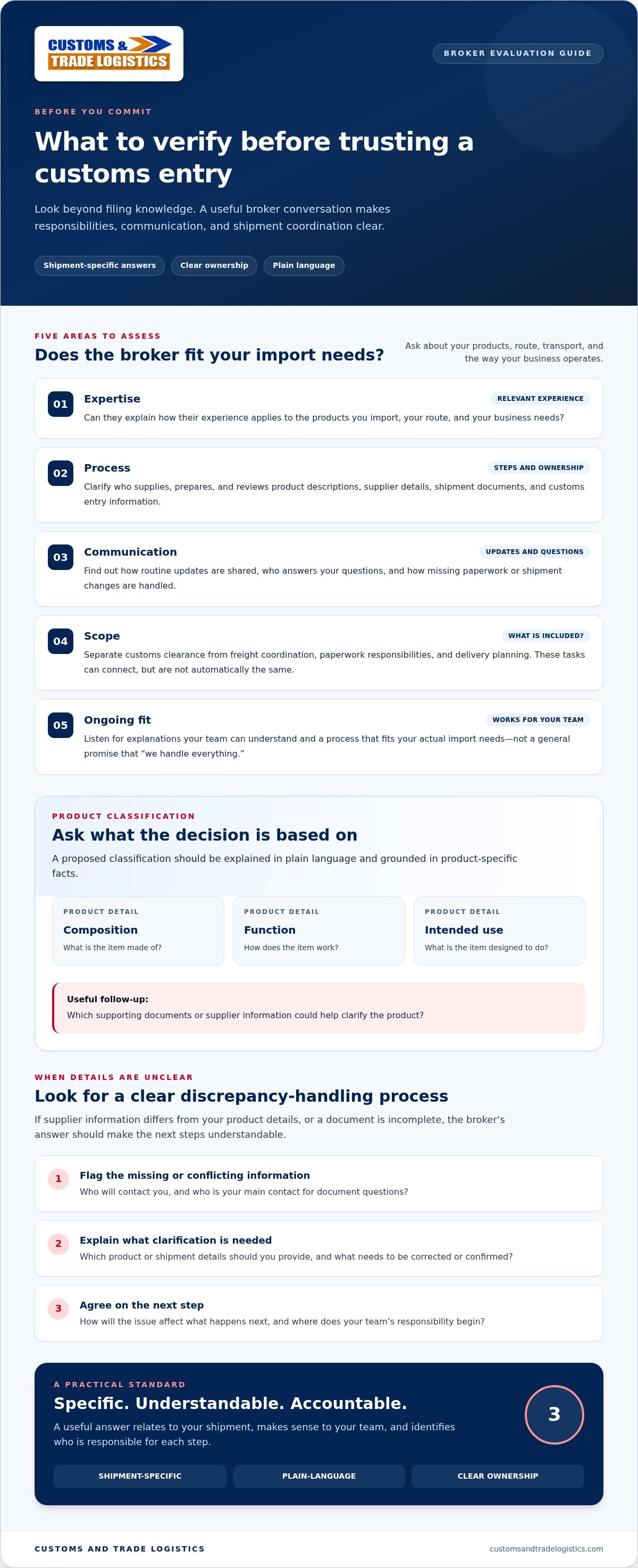
The best questions to ask a potential customs broker relate to your actual imports. Answers should account for the products you’re bringing in, the route and transport involved, and the way your business operates. A small business importing regularly may need a different process from one arranging an occasional shipment.
Use five areas to guide the conversation: expertise, process, communication, scope, and ongoing fit. Ask who is responsible for each step and what information they need from you. A polished promise may sound reassuring, but a clear explanation of responsibilities is more useful. Notice whether the broker can explain the process in plain language and relate it to your shipment rather than relying on general assurances.
What does a customs broker handle in the import process?
A customs broker’s work centers on preparing customs entry information. Moving international freight involves a broader set of transportation and coordination tasks. These responsibilities can connect, but they are not automatically the same. A Customs broker overview can help unfamiliar importers understand the role in international trade.
Ask how product descriptions, supplier details, shipment documents, and other information feed into entry preparation, and who supplies or checks each item. Incomplete or unclear details can complicate the process, so establish how questions will be raised and resolved. Then clarify whether the broker’s role also includes coordinating freight or planning the shipment’s next steps.
How should you judge a broker’s answers?
Listen for plain-language explanations, named responsibilities, and a relevant example of how the process works. If a document is missing or shipment details change, a useful answer explains who will contact you, what information is needed, and how the issue affects the next step. It should also make clear where your team’s responsibilities begin.
If you hear a broad assurance such as “we handle everything,” ask what “everything” includes. A vague answer is a reason to ask for specifics before relying on it.
A useful broker answer is specific to your shipment, understandable to your team, and clear about who is accountable for each step. That standard helps you compare expertise and working style without mistaking confidence for a complete plan.
Ask About Customs Expertise, Classification, and Entry Accuracy
Customs entry information is only as useful as the facts behind it. Ask how the broker gathers, reviews, and uses the details you provide, and where your team remains responsible for supplying accurate information. A clear process explains both the specialist’s role and the importer’s part. Handing over paperwork does not remove your need to answer questions.
These questions to ask a potential customs broker can help you understand how they approach classification, review entry details, and follow up when something is missing. No single answer fits every shipment. Sound decisions depend on the specific product and the information available.
How does the broker approach product classification?
Ask the broker to explain the reasoning behind a proposed classification in language you can understand. What product details inform the analysis? How do composition, function, and intended use factor into the discussion? What supporting documents or supplier information would help clarify the product?
A short label such as “kitchen accessory” may not explain what an item is made of or how it works. Ask which details matter for your product and whether additional documentation could be needed. Classification questions may require review of product-specific facts, so be cautious of a definitive answer offered without first understanding those facts. For background on broker requirements and responsibilities, refer to U.S. Customs and Border Protection’s customs broker FAQ.
Who handles entry information and document follow-up?
Clarify who collects your paperwork, who reviews the details, and who contacts you if something is inconsistent or incomplete. Ask what happens if a supplier’s description differs from your product information, or a document leaves out a key detail. A useful response explains how the discrepancy is raised, what clarification is needed, and how the next step is agreed on, without promising a particular compliance outcome.
- Who is my main contact for document questions?
- Which product and shipment details should I provide?
- How will you flag conflicting or missing information?
- Will you explain what needs to be corrected before proceeding?
Knowing how entry preparation fits into the wider process can make these responsibilities easier to discuss. See the U.S. customs clearance services guide for a broader overview.
Look for a process that makes your role visible, not one that leaves you guessing about what the broker needs. For help connecting customs entry work with freight coordination and delivery planning, explore customs clearance and import logistics support.
Ask How the Broker Communicates and Handles Shipment Problems
A clear communication plan matters most when shipment details change or a problem needs attention. Ask how routine updates are shared, who owns your questions, and how the broker’s customs work connects with freight movement. The U.S. International Trade Administration explains that customs brokers assist importers in meeting federal requirements. Your discussion should also clarify how the broker communicates as the shipment progresses.
What should you ask about updates and points of contact?
Ask which channels the team uses for routine updates and where to direct an urgent shipment question. Find out whether you’ll have a consistent contact who understands your shipment, or whether different people handle different stages. Either arrangement can work if you know who owns each question and how information moves between the customs and freight teams.
Useful questions include:
- How will I receive routine shipment updates?
- Who should I contact with a customs question, and who handles freight coordination?
- If another team member takes over, how will they get the shipment context?
- How should I flag a time-sensitive issue?
Focus on a defined communication process, not an unsupported promise about response times or constant availability.
How are exceptions and delays handled?
Ask the broker to walk you through what happens if a document is missing, shipment details change, or an issue affects the next step. A helpful explanation identifies how the issue is surfaced, who assesses its impact, what information or decision is needed from you, and who communicates with the parties coordinating freight. Clarify which actions the broker can take independently and which require your approval.
A useful shipment update names the issue, the person responsible for it, and the next action. For example, “The supplier’s details don’t match the shipment paperwork; we need your clarification before this step can proceed” gives you something concrete to act on. “There’s a problem” leaves you guessing.
Clear, complete information shared early can help prevent avoidable confusion. For practical preparation ideas, see these strategies for reducing customs clearance delays.
For small businesses managing both paperwork and delivery plans, it helps when customs and freight responsibilities are clearly connected. Explore coordinated customs and import logistics support to bring those parts of the import journey together.
Compare Service Scope, Costs, and Fit for Your Import Business
A proposal is easier to assess when each task has a clear owner. Ask what the service covers, where the broker’s responsibility ends, and who coordinates the next stage. Customs brokerage, international freight coordination, paperwork handling, and delivery planning are related parts of an import journey, but they are distinct responsibilities. Don’t assume one automatically includes the others.
Describe the practical shape of your operation: the products you import, how often you ship, your business scale, and where the goods need to go. Small and medium-sized businesses, including Amazon sellers, can have different workflows and delivery needs. For businesses collaborating with international export specialists such as Global Exclusive Trading (GET) to bridge global and domestic markets, outlining your trade and supplier setup early helps ensure seamless logistics handoffs. Ask for an example of a similar process without requesting confidential information about another importer.
Does the broker understand businesses like yours?
Use the conversation to see whether the broker’s explanation reflects your shipment pattern and operating needs rather than a generic scenario. If you’re importing from China, sourcing inventory via overseas parcel forwarders such as Stork Japan株式會社, or arranging delivery to more than one destination, describe that context and ask how responsibilities would be coordinated. A relevant example should outline the steps and handoffs while protecting other clients’ privacy.
What should a clear service and fee discussion cover?
Ask how the broker explains its service fees and what shipment details could affect the work involved. Keep those fees separate from duties, taxes, freight charges, and other shipment costs so you can understand what each amount represents. Request a clear description of what’s included, what may be separate, and which party is responsible for coordinating each item. For more context, read the custom brokerage service fees guide.
Use this simple comparison to organize the answers you receive:
| Import need | Question to ask | What a clear answer explains |
|---|---|---|
| Customs brokerage | Which entry-related tasks are included, and what information do you need from me? | The work covered and the importer’s role in supplying details. |
| Freight coordination | Who coordinates transportation and communicates changes? | The responsible party and how handoffs are managed. |
| Paperwork | Which documents are handled, reviewed, or requested from my team? | Who provides, checks, and follows up on each item. |
| Delivery planning | Who coordinates delivery after the shipment reaches its destination? | Whether delivery planning is part of the arrangement or a separate task. |
| Fees and other charges | How are service fees distinguished from freight and other shipment costs? | What each charge relates to and what details may affect scope. |
These questions to ask a potential customs broker help you compare actual work and responsibilities, not just a headline description. For support connecting customs clearance with freight coordination and delivery planning, explore import logistics support.
Choose a Customs Broker and Prepare for a Productive First Conversation
Choosing a broker is about more than one confident sales claim. Consider the full picture: does the broker understand your import, explain the process clearly, define who handles each task, and offer a service scope that fits your business? Strong answers make the next steps easier to understand and clarify who is responsible for each part.
A little preparation makes the conversation more useful. Bring what you know, note what you don’t, and use the discussion to clarify how customs brokerage and freight coordination can work together for your shipment.
What information should you prepare before speaking with a broker?
Gather the details that can help the broker understand your shipment and operating needs. You don’t need to have every answer in advance. A clear list of known information and open questions gives the conversation a practical starting point.
- Product descriptions, materials, and intended use
- Supplier details and the country the goods are shipping from
- Expected shipment method and any available shipment plans
- Where the goods need to be delivered and any redistribution needs
- Available paperwork, previous entry issues, current concerns, and relevant deadlines
If you’re importing from China, the China import logistics guide offers additional context for planning the shipment journey.
How does Customs and Trade Logistics support importers?
Customs and Trade Logistics is a family-owned customs brokerage and logistics consulting firm with more than 35 years of industry experience. The firm works with small and medium-sized businesses, including Amazon sellers, and connects customs clearance with international freight logistics. Its services also cover paperwork handling, shipping coordination, and delivery redistribution, helping importers understand how responsibilities relate across different stages.
This connected approach can help when your business needs practical guidance rather than a one-size-fits-all process. Share your product and shipment details to discuss how customs work and logistics coordination can fit your import requirements.
Discuss your import logistics needs with our team and take the next step with a clearer picture of your shipment.
Take the Next Step Toward a Clearer Import Plan
The right broker should be able to explain how customs expertise, communication, and service responsibilities fit your shipment and your business. Use the questions to ask a potential customs broker to compare clear, specific answers rather than broad promises. Before making a decision, understand who handles entry details, how shipment issues are communicated, and how customs work connects with freight coordination and delivery planning.
Customs and Trade Logistics is a family-owned firm with more than 35 years of industry experience, supporting small and medium-sized businesses, including Amazon sellers. The team coordinates customs brokerage and international freight across U.S. Customs ports, helping importers bring connected parts of the journey into one practical conversation.
Ready to talk through your products, supplier, and shipment plans? Talk with our team about your import needs. A clear first conversation can help you move forward with greater confidence.
Frequently Asked Questions
What questions should I ask a potential customs broker?
Ask how they handle your type of product and shipment, who prepares and reviews entry information, and what details they need from you. Clarify how they explain classification decisions, communicate about missing or inconsistent paperwork, and coordinate customs work with freight and delivery planning. Also ask what the proposed service covers and how fees are distinguished from duties, taxes, and transportation charges. Specific answers help you understand responsibilities before you commit.
How do I know if a customs broker is qualified to handle my imports?
Look for relevant experience with products, routes, and shipment patterns like yours, along with a clear explanation of the broker’s process and responsibilities. Ask how they approach product classification and what information informs their work. You can also ask how to verify relevant credentials through official U.S. Customs and Border Protection resources. A useful answer should be understandable and specific, without promising a particular compliance outcome.
Can a customs broker help coordinate international freight?
Some customs brokers also coordinate international freight, but the exact scope depends on the service arrangement. Ask whether the broker handles freight coordination or focuses on customs entry work, and clarify who manages each stage between the supplier, transportation, customs processing, and delivery. Customs and Trade Logistics coordinates customs brokerage and international freight logistics, helping importers connect entry work with shipment movement and delivery planning.
What information should I give a customs broker before an import shipment?
Share clear product descriptions, supplier details, the country the goods ship from, your expected shipment method, and where the goods need to be delivered. Provide available invoices, packing details, or other shipment paperwork, and flag any known discrepancies or previous entry issues. If some information is still missing, say so early. The broker can then explain what details are needed to assess the shipment and discuss the next steps.
How are customs broker fees different from duties and taxes?
Customs broker fees pay for professional services, such as preparing and managing customs entry work. Duties and taxes are separate charges associated with the import, while freight and other shipment costs relate to transportation or logistics. Ask for each category to be identified separately and request an explanation of what the broker’s service includes. The shipment details and agreed scope help clarify which services and charges apply.
What happens if customs paperwork has an error?
If paperwork contains an error, the next step depends on what’s incorrect and where the shipment is in the process. The broker should explain the discrepancy, identify what information or corrected document is needed, and clarify who will provide it. Ask whether any action requires your approval and how the issue may affect the shipment. Prompt, accurate clarification helps the broker determine an appropriate next step, but no specific outcome can be assumed.
Do small businesses need a customs broker to import goods into the United States?
Small businesses can benefit from customs brokerage support, particularly when they need help organizing entry paperwork, understanding product details, or coordinating freight and delivery. Whether a broker is needed for a particular import depends on the shipment and applicable requirements, so avoid assuming every business follows the same process. A small importer can discuss its products, shipping plans, and internal capabilities with a broker to understand the support that fits its operation.