

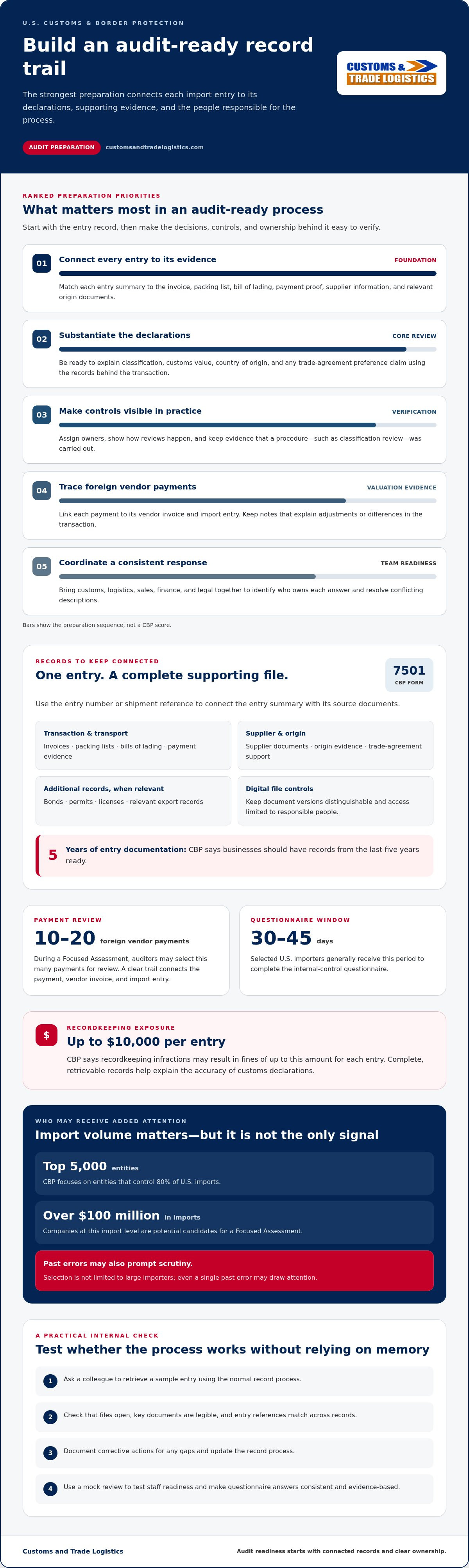
Large-volume importers are more likely to face a U.S. Customs and Border Protection (CBP) Focused Assessment: companies importing over $100 million are potential candidates, and CBP also focuses on the top 5,000 entities that control 80% of imports. Even a single past error may draw scrutiny, so preparing for a customs audit means being ready to explain how entries were classified, valued, and supported.
It’s understandable to worry that an audit could turn into a scramble through years of paperwork. CBP says businesses should have entry documentation from the last five years ready, but preparing for a customs audit involves more than locating records. You’ll learn which importers may receive a Focused Assessment, what entry records and supporting documents auditors may examine, and how internal controls can help identify and address gaps. We’ll also explain how customs, logistics, sales, finance, and legal teams can work together on a clear, consistent response.
Key Takeaways
- Large-volume importers may be more likely to face a Focused Assessment, but even a single past error can attract scrutiny.
- Keep entry records and supporting documents organized so you can explain how each shipment was declared and valued.
- U.S. Customs and Border Protection says recordkeeping infractions may result in fines of up to $10,000 per entry.
- Bring customs, logistics, sales, finance, and legal teams into the preparation process, and use an internal review to uncover gaps.
What Is a Customs Audit?
A U.S. customs audit examines an importer’s operations, records, and internal controls for compliance. Preparing for a customs audit means connecting each import entry to accurate classification, customs valuation, origin claims, and payment records. CBP may check whether declarations match the transaction and its supporting documentation.
Keep records connected, not scattered. Each entry should be traceable to its invoice, packing list, bill of lading, payment evidence, supplier information, and relevant origin documents. U.S. Customs and Border Protection says businesses should have entry documentation from the last five years ready. Clear links between records help explain how an entry was prepared and where its figures came from.
Import volume can influence attention. The top 5,000 entities controlling 80% of U.S. imports are one area of focus for CBP, and companies importing over $100 million are potential candidates for a Focused Assessment. Selection is not limited to large importers: past errors may also prompt scrutiny.
An audit may assess broad operations or focus on a particular compliance issue. Reviews can cover past import activity, including how the importer classified goods, established value, and supported trade agreement claims. Keep relevant export records as well, especially when preference rules affect the treatment claimed on imports or exports.
There is no single customs audit software, consultant, or legal service that every U.S. importer needs. Use a records process that retrieves entry documents and connects them to internal approvals. Seek specialist support when classification, valuation, or legal questions call for deeper analysis.
When should an importer consider prior disclosure to report customs errors to CBP? Act promptly after identifying a possible customs violation, rather than treating it as a routine record correction. Customs counsel can assess the facts, timing, and any existing CBP contact before preparing a disclosure.
CBP can compare tariff classification and country-of-origin claims with entry statements and supporting records. Product descriptions, supplier documents, invoices, and origin evidence help show whether the declared classification and origin match the goods and transaction.
Include relevant bonds, permits, and licenses in the records for affected imports. For preference claims, retain documents supporting the claimed origin and the basis for applying the trade agreement. Together with consistent internal review, these records help explain the decisions behind each declaration.
Entry summaries and supporting records
An audit-ready record set connects each entry summary to the documents behind its declarations. U.S. Customs and Border Protection identifies CBP Form 7501 as an entry summary importers may need to produce.
Customs Record-Keeping
Customs record-keeping means preserving records that explain an import entry and its declared details. Keep invoices, packing lists, bills of lading, payment proofs, and supplier documents together with the matching entry summary. U.S. Customs and Border Protection says importers may face fines of up to $10,000 per entry for recordkeeping infractions. Complete records support compliance and help explain the accuracy of customs declarations under scrutiny.
Organizing Digital Records
Digital organization is a consistent system for naming, storing, and retrieving import files. Use an entry number or shipment reference to connect the Form 7501 with invoices, origin documents, and payment evidence. Keep versions distinguishable when a corrected document replaces an earlier one, and limit access to people responsible for the relevant activities. A focused folder structure makes it easier to locate records and respond accurately to a government request.
Foreign vendor payment records help connect declared customs valuation to the underlying transaction. Match each payment to its vendor invoice and import entry, then retain notes explaining adjustments or differences. During a U.S. Customs Focused Assessment, auditors may select between 10 and 20 foreign vendor payments for review. A clear payment trail helps show how the importer supported valuation claims and where a reviewer can find the evidence.
Before an audit, test whether a colleague can retrieve a sample entry without relying on one person’s memory. Check that each file opens, key documents are legible, and the entry reference matches across records. If gaps appear, document the corrective action and update the record process. For importers who need help coordinating clearance documentation, customs clearance support can help keep import records aligned with shipment activity.
Internal controls and cross-department responsibilities
A reliable internal control program assigns customs tasks, checks decisions, and records how issues are handled. For a Focused Assessment, connected teams can help provide a clear, accurate response.
Selection Notices and Control Questionnaires
A selection notice opens the review process, while an internal-control questionnaire asks how the company manages customs compliance. U.S. importers selected for a Focused Assessment generally receive 30 to 45 days to complete the questionnaire. Use that time to identify who owns each answer, gather evidence of the relevant process, and resolve conflicting descriptions before submission.
For each control, show how it works in practice. If a procedure requires tariff classifications to be reviewed, identify who reviews them and what record confirms the review took place. A mock review can expose gaps, test staff readiness, and help refine responses before they reach CBP. Accurate, supported answers make the company’s controls easier to understand.
Internal Responsibilities and Expertise
Assign clear ownership of customs compliance and define how other departments support the work. Include customs, logistics, sales, finance, and legal representatives on the audit team. Customs staff can explain declaration practices, finance can clarify payments, sales can describe transaction terms, logistics can trace shipments, and legal can assess sensitive issues.
Written responsibilities reduce the risk of missed handoffs. For example, specify who reviews a product description when sales introduces a new item and who approves its tariff classification before import. Train employees who prepare or check customs information, and retain evidence of the process. A named owner also helps direct CBP questions to the right subject expert.
Prepare employees for interviews by explaining the review’s scope and which records relate to their roles. Ask staff to describe the steps they actually follow, not an idealized process. If someone does not know an answer, establish a consistent response: identify the appropriate colleague and provide a supported answer through the audit team.
Test controls with a mock review across departments. Select a transaction, trace each handoff, and note where approvals, tariff decisions, or payment checks lack clear ownership. Assign corrective actions to specific roles and track completion. If the review finds a discrepancy, document the facts and coordinate an accurate response instead of allowing teams to give conflicting explanations.
What customs valuation issues does CBP commonly review?
CBP reviews whether declared customs values reflect the import transaction and whether supporting records explain the calculation. A discrepancy can affect duty payments and lead to legal disputes, so connect each declared value to its supporting evidence.
Start with the commercial invoice and compare its amounts with the entry declaration and payment record. Note differences, such as an invoice total that does not match the amount paid, and retain an explanation tied to the transaction. CBP may examine valuation methods, supplier documents, and related records. Show how the declared figure was calculated, rather than simply repeating the amount entered.
Some valuation calculations involve more than the invoice price. CBP auditors may request detailed proof of calculations involving assists, royalties, and transfer pricing adjustments. For each relevant element, keep the supporting agreement, calculation, and related supplier or payment documents together. A clear record trail helps explain whether the element affected the declared value and how the business treated it.
Review related-party transactions carefully because transfer pricing adjustments can link commercial pricing to customs valuation. Compare transaction records with the explanation used for the declared value. If adjustments occur after import, preserve the calculation and records showing how they relate to the goods. Consistent explanations across finance and customs files make the valuation easier to follow.
CBP may consider country-of-origin claims and eligibility for special tariffs alongside valuation. Keep origin evidence connected to the relevant goods and supplier records so the basis for each claim is clear. Classification and valuation errors can both affect duty payments, but they involve different declaration details. Review each issue using its own evidence, rather than assuming one correction resolves the other.
Before responding to a CBP question, trace a selected entry from declared value to invoice, vendor payment, and any adjustment calculation. Record the source of each figure and flag unresolved differences for review. For help coordinating import declarations and customs documentation, request customs clearance support.
Customs and Trade Logistics: Customs Clearance Services
Customs and Trade Logistics provides customs clearance for businesses managing U.S. imports. If an audit review raises questions about entry declarations or the flow of import records, its customs clearance services can help organize information for future shipments.
Use customs clearance services when import operations need coordinated clearance, or when international freight logistics are part of a wider shipment plan. Customs and Trade Logistics also offers import-from-China consulting for businesses managing imports from China. These services support the movement and clearance of goods, but do not replace legal advice about audit responses or prior disclosure.
For practical support with import clearance, contact Customs and Trade Logistics to discuss your shipment needs.
Make Your Next Import Process More Audit-Ready
Use the next shipment to strengthen the process, not just close out another entry. Establish a routine for reviewing how product details are shared, how classification decisions are recorded, and how teams handle supplier or transaction changes. When preparing for a customs audit, this ongoing discipline makes clear records part of everyday operations rather than a last-minute project.
Choose an owner to keep the process moving and bring relevant teams together when a change could affect customs declarations. If a review uncovers a complex issue, separate the immediate question from broader improvements, then document decisions and follow-up actions. A steady approach helps your team keep import work organized as the business evolves.
For support with import clearance and logistics, contact Customs and Trade Logistics to discuss your needs. Every well-documented shipment is a useful step toward a more prepared, confident operation.
Frequently Asked Questions
What records should importers prepare for a U.S. Customs and Border Protection audit?
Prepare entry summaries and the transaction records that explain each declaration. These may include CBP Form 7501, commercial invoices, packing lists, bills of lading, certificates of origin, payment proofs, and supplier correspondence. An index that connects each entry number to its documents can make a sample easier to retrieve. Include relevant approvals or corrections so the record shows how the final declaration was reached.
How long must U.S. importers retain customs entry and transaction records?
U.S. Customs and Border Protection says businesses should have entry documentation from the last five years ready for an audit. Keep records searchable by entry, shipment, and transaction so the team can retrieve them throughout that period. Include supporting documents that explain declared values and origin claims, not just the filed entry summary. A consistent archive helps staff respond without piecing together older import activity from scattered files.
What are the main steps in a CBP Focused Assessment audit?
A Focused Assessment can move from an advance conference into preliminary assessment work and compliance testing. The advance conference is generally held 30 to 45 days after notification. In the PAS phase, auditors typically select between 10 and 20 entry line items from three information pools. For each noncompliant area identified, assessment compliance testing uses new statistically valid samples of between 60 and 100 items.
How can importers conduct an internal customs compliance audit?
Choose a representative import transaction and trace it from purchase records through the filed declaration and payment. Compare the product description, classification, value, and origin evidence, then record any mismatches. Ask staff from customs, logistics, sales, and finance to explain their roles. Assign an owner and corrective action to each gap, then retest the affected process to see whether the fix works.
What are the penalties for customs audit violations or recordkeeping failures?
U.S. Customs and Border Protection says recordkeeping infractions may result in fines of up to $10,000 per entry. That figure relates to recordkeeping infractions, not a universal penalty for every audit finding. The issue identified and the records available matter when assessing a specific case. If a review uncovers a discrepancy, document the facts and corrective steps rather than treating missing records as a routine paperwork problem.
How should a company respond to a CBP audit notice and information request?
Assign one coordinator to track the notice, requested materials, responsible departments, and response status. Preserve relevant records, divide requests among employees familiar with the transactions, and check each response against its supporting evidence before submission. Keep a copy of what the company provides and note any follow-up questions. If a response identifies a discrepancy, document the issue and the action taken to address it.