

For a CBP Form 29 marked “Action Proposed,” respond within 20 days of the notice’s issue date. If you don’t respond in time, Customs will assume you agree with the proposed action and proceed with liquidation, which may result in additional duties. Knowing how to respond to a CBP Form 29 notice of action also means checking whether it’s marked “Action Proposed” or “Action Taken”: an action already taken doesn’t have the same rebuttal window.
A notice can raise questions about how CBP treated an entry, but a clear, evidence-based response can address the specific issue. The key is to understand what CBP is proposing, gather records that support your position, and meet the applicable deadline.
This article explains the response period, the documents and arguments to consider, and what may happen after you respond. It also covers how next steps differ when CBP has already taken action, helping you respond with a clearer plan.
Key Takeaways
- Pinpoint the specific entry detail CBP is challenging before shaping your response.
- Organize documents that support your declared classification, value, or country of origin.
- Connect each argument to the evidence and the legal basis for your entry treatment.
- Understand how the notice’s status affects the next steps and the route for challenging CBP’s decision.
How long do I have to respond to CBP Form 29?
A CBP Form 29, or Notice of Action, tells an importer that Customs proposes an action or has already taken one. It can address one entry or a group of entries, so check which entries and action the notice identifies before preparing a response.
What types of proposed actions can CBP Form 29 notify an importer about? A proposed action may change a product’s tariff classification or country-of-origin determination. CBP may also issue a rate advance after changing the classification, potentially affecting the duties assessed on the entry.
For an “Action Proposed” notice, respond within 20 days of its issue date. If you don’t respond within that period, Customs will assume agreement with the proposed action and proceed with liquidation, which may result in additional duties. If you need more time, submit a written extension request to the issuing officer well before the deadline. Don’t treat an extension request as an extension itself.
Read the notice for the proposed change, affected entry details, and response instructions. Compare CBP’s position with the entry documents and supporting records. Address the specific point in dispute, explain why the entry treatment was appropriate, and provide evidence. The importer of record is responsible for the position and supporting records, so keep the relevant documentation together.
An “Action Taken” notice indicates that a decision has already been made, so the available response options may differ from those for a proposed action. There’s no rebuttal window for an action already taken. After CBP issues the liquidation notice, an importer may challenge the action through a formal protest. Under 19 U.S.C. § 1514, an importer may protest a CBP action within 180 days of liquidation, according to the Office of the Law Revision Counsel, U.S. House of Representatives.
The distinction determines your next step: respond to a proposed action within the stated period; if CBP has taken action, track liquidation and the protest deadline. Treating both notices alike can lead you to miss the appropriate way to challenge CBP’s decision.
Evidence and legal arguments for a response
Build your response around the entry detail CBP disputes. A practical approach to how to respond to a CBP Form 29 notice of action is to separate the proposed change from the facts and records supporting your original declaration. Explain why the entered classification, valuation, or country of origin fits the merchandise. Link each argument to a document, not just a general claim that the entry was correct.
Match evidence to the issue. For valuation, organize invoices, purchase orders, payment records, and documents explaining the transaction terms. For classification, provide product descriptions, specifications, and material details that distinguish the goods from CBP’s proposed category. For origin, use records showing where the goods were made or processed. Label each document to make its connection to the entry clear.
- Identify the disputed element: summarize CBP’s proposed change and name the affected entry.
- Show the supporting facts: connect invoices, product records, or origin documents to the declared treatment.
- Explain the legal basis: cite the rule or authority supporting your classification, valuation, or origin position.
CBP may issue Form 29 without first sending a Form 28 request for information. The lack of an earlier request is not, by itself, a procedural defect. Address the substance of the action and whether your entry records support your position. For context on Notices of Action, consider 19 CFR 152.2 alongside the issue CBP identifies.
Reasonable care includes accurate product descriptions, origin declarations, and reported values. If the notice identifies an error, distinguish a factual disagreement from a documentation gap or a correction that may be needed. A Form 29 may also be followed by a pre-penalty notice involving negligence, gross negligence, or fraud. Treat potential penalties separately and preserve the records underlying your response.
The key to how to respond to a CBP Form 29 notice of action is keeping the argument tied to evidence. Save a complete copy of your submission and its supporting records. If the matter proceeds to liquidation, a formal protest is a separate route, not a substitute for answering a proposed action. For help aligning entry records with the clearance process, review customs clearance services.
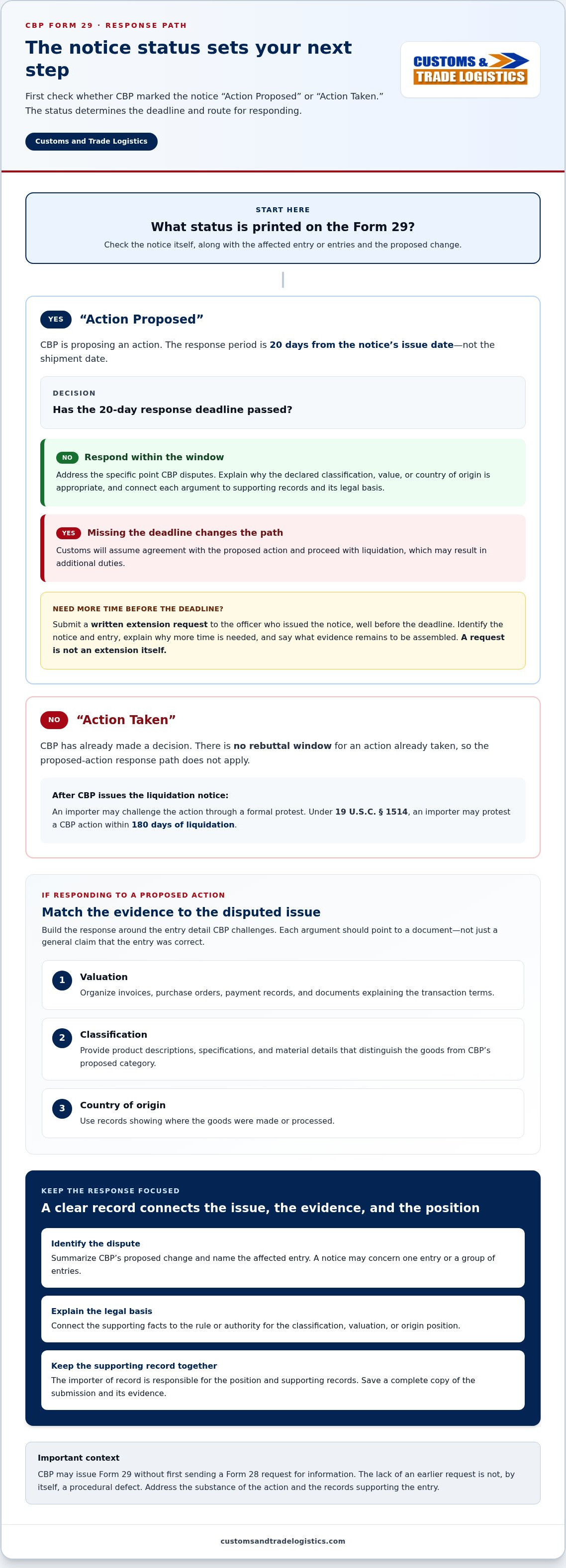
The 20-day response window
For an “Action Proposed” Form 29, the response period is 20 days from the notice’s issue date. The issue date, not the shipment date, gives you the starting point for organizing the response.
Understanding the Response Window
The 20-day response window is the period to answer CBP’s proposed action before it proceeds with liquidation. It matters because missing the deadline can change the entry’s path: Customs will assume agreement with the proposal and proceed with liquidation, which may result in additional duties.
Read the notice promptly and record its issue date, affected entry, and proposed change. For example, if CBP proposes a classification change, identify the tariff treatment under review and gather the relevant entry records. A clear timeline keeps document collection and response preparation focused.
Requesting More Time to Respond
To request an extension, submit a written request to the CBP officer who issued the Form 29, well before the response deadline. Explain which proposed action and entry the request concerns, why additional time is needed, and what information or evidence remains to be assembled.
How do you request an extension to respond to CBP Form 29? Send the written request to the issuing officer before the deadline, identifying the notice and explaining the reason for more time. Keep a copy with the notice and response records.
Use the available time to connect evidence to the issue CBP raised. A proposed tariff-classification change may call for product details that clarify the merchandise; a valuation question may require transaction records. Keep your explanation specific, with each document supporting a point in your response.
Track the notice, request, and response together. Record when the Form 29 was issued, when the extension request was sent, and when the response was filed. This chronology helps distinguish a timely response to a proposed action from later steps after liquidation.
If the deadline is approaching, prioritize a complete, focused submission over unrelated background. Address CBP’s stated concern directly, organize the supporting evidence, and make the response’s position clear. The 20-day period is tied to the issue date, so delaying the first review can leave less time to prepare.
Next steps after a Form 29 response
After submitting a response, keep the notice, filing, supporting records, and delivery evidence together. This creates a clear record of what you told CBP and which entry details support your position. Your customs broker can help track communications about the entry and identify whether CBP’s next notice changes the action or duty assessment.
CBP may accept your explanation or proceed with the proposed action. If the action changes classification, value, or origin, review the resulting entry treatment and any additional duties. Compare CBP’s decision with the records you submitted. If a detail appears incorrect, document the discrepancy and the evidence supporting a correction.
Watch for a liquidation notice. If CBP takes action and the entry is liquidated, an importer may file a protest within 180 days of liquidation under 19 U.S.C. § 1514, according to the Office of the Law Revision Counsel, U.S. House of Representatives. Track that date separately from the earlier response period; they relate to different stages of the process.
A protest denied by CBP may be challenged at the U.S. Court of International Trade upon timely payment of duties and filing a summons. That route involves formal court procedures, so organize the notice, protest, CBP decision, payment records, and entry documents. A Form 29 may also be followed by a pre-penalty notice alleging negligence, gross negligence, or fraud. Treat that notice as a separate matter and preserve the records supporting the original entry.
For each new communication, note its date, affected entry, requested action, and response deadline. Then compare the stated position with your import records and determine whether a correction or further challenge is appropriate. If you need help managing entry and customs issues as they develop, request customs clearance support.
Customs and Trade Logistics: Customs Clearance Services
Customs and Trade Logistics can help importers manage customs clearance when a Form 29 raises questions about an entry. Its Customs Clearance Services support the import process, including the entry details and documentation connected to customs review.
Customs and Trade Logistics provides customs clearance support when you need help understanding how a CBP action relates to your import records or merchandise. For broader shipment coordination, its international freight logistics services can support your import operation. The next step depends on whether your immediate concern is an entry issue, freight movement, or both.
Keep the Form 29, related entry documents, and any CBP correspondence organized so the issue is clear. Contact Customs and Trade Logistics to discuss customs clearance support for your import needs.
Move forward with a clear import plan
A CBP notice can also prompt a broader review of how your team manages entry information. Use the experience to strengthen recordkeeping, clarify who handles customs communications, and keep supporting documents accessible for future shipments. That preparation can make future customs questions easier to address.
Knowing how to respond to a CBP Form 29 notice of action is one part of maintaining a steady import process. Customs and Trade Logistics offers Customs Clearance Services, International Freight Logistics, and Import From China Consulting to support different stages of importing. If you’d like help with customs clearance or import logistics, contact Customs and Trade Logistics to discuss your needs.
With a clear record and the right operational support, you can approach your next import decision with greater confidence.
Frequently Asked Questions
Received a CBP Form 29?
Identify the entry, the CBP office, and whether the notice says “Action Proposed” or “Action Taken.” Notify your customs broker promptly and share the complete notice, including every page and attachment. For example, if a notice affects several entries, match each listed entry with its own records. Keep the original communication and note when and how you received it.
What Happens If You Don’t Respond?
If you don’t respond to a proposed action within the response period, Customs will assume agreement and proceed with liquidation. This may lead to additional duties on the affected entry. This consequence applies to the proposed action described in the notice. Save your records and watch for later CBP communications, since a subsequent notice may raise a separate issue, including a potential penalty matter.
Does agreeing with CBP Form 29 create liability on past entries?
Agreeing with a proposed action applies to the entries and treatment identified in that notice; it doesn’t establish that every earlier entry has the same issue. CBP actions may concern one entry or a group. If the same product or declaration appears in other entries, compare those records separately. Check for differences in origin, value, classification, or supporting documents before drawing conclusions.
How is CBP Form 29 delivered and answered?
Review the notice and its transmission details to see how CBP sent it and where it directs you to respond. Follow the stated submission instructions, identify the relevant entries, and organize your explanation with documents supporting each point. Keep a copy of your submission and any filing record. If the notice’s scope is unclear, clarify which entries are affected before preparing your position.
Is CBP Form 29 a bill?
No. Form 29 is a Notice of Action, not itself a bill demanding payment. It can propose a change that may affect the duties assessed after liquidation, or report an action CBP has already taken. Read it to understand the agency’s position and the entries involved. A later duty assessment or separate penalty notice is a different communication, so don’t treat every notice as an invoice.
Should I respond to Customs without contacting an Attorney?
The appropriate support depends on the notice’s issues and potential consequences. A focused classification or valuation disagreement may require careful comparison of entry records and product evidence. Allegations involving negligence, gross negligence, fraud, or a coordinated investigation raise distinct legal concerns; an attorney can help assess those issues. In either case, preserve the notice and records, and don’t let seeking advice delay attention to the stated deadline.