

Cooperation can strengthen a petition, but it doesn’t erase a customs violation. Under 19 U.S.C. 1618, U.S. Customs and Border Protection (CBP) may remit or mitigate a penalty on terms it considers appropriate, and a well-supported request can explain the circumstances, corrective steps, and cooperation that matter. According to CBP, a recipient of a prepenalty notice generally has 60 days to file a petition.
A customs notice can feel daunting, especially when a compliance failure stems from a process gap rather than deliberate misconduct. Mitigating customs penalties for compliance failures means clearly presenting the relevant facts: whether the issue was isolated, what caused it, how it was corrected, and whether the company responded promptly and fully to U.S. Customs and Border Protection (CBP). This article explains how petitions and supplemental petitions work, which aggravating factors may weaken a request, and how CBP’s authority shapes potential relief. Honest cooperation and documented corrective action can matter, while prior warnings, delays, or evidence of knowing conduct may make mitigation more difficult.
Key Takeaways
- Build a petition around the facts: explain what caused the failure, whether it was isolated, and what changed to prevent a repeat.
- Respond promptly and completely to CBP; delays, obstruction, prior warnings, or evidence of knowing conduct can weaken a mitigation request.
- Understand how CBP weighs culpability, reasonable-care records, and corrective action when deciding whether to reduce or remit a penalty.
- Recognize the type of alleged violation and the process behind it, since negligence, gross negligence, fraud, and bond breaches can lead to different consequences.
Petitions and supplemental petitions for monetary penalties
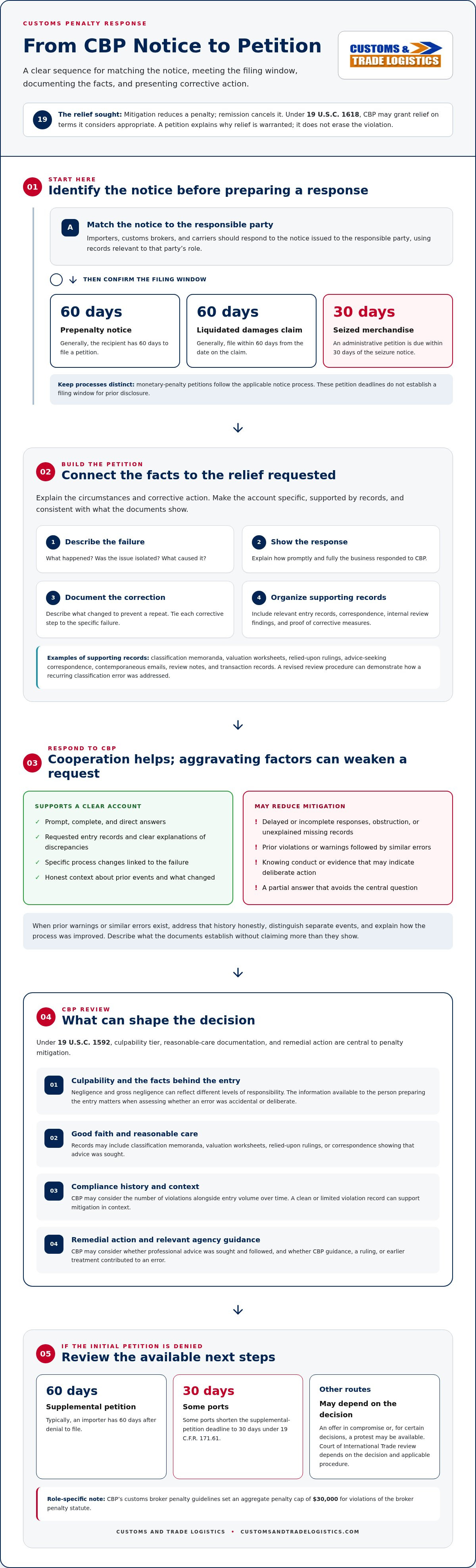
A petition asks U.S. Customs and Border Protection (CBP) to reduce or remit a penalty. The notice type determines the filing window, so identify it before preparing a response.
Requesting Penalty Mitigation or Remission
Mitigation reduces a penalty, while remission cancels it; a petition presents reasons CBP should grant relief. According to U.S. Customs and Border Protection, a recipient of a CBP prepenalty notice generally has 60 days to file a petition. A party generally has 60 days from the date on a CBP liquidated damages claim to file a petition, according to U.S. Customs and Border Protection. Match the response to the notice and explain the circumstances and corrective action.
For seized merchandise, an administrative petition must be filed within 30 days of the seizure notice. A petition concerning monetary penalties follows the applicable notice process instead.
Evidence and Records for a Petition
Evidence supports the petition’s account of the violation, its cause, and the response. Include relevant entry records, correspondence, internal review findings, and proof of corrective measures. For example, a revised review procedure can show how the business addressed a recurring classification error. Clear, organized records connect the facts to the relief requested.
Prior disclosure is distinct from a petition responding to a notice. The petition deadlines above do not establish a filing window for prior disclosure, so keep the two processes separate. To reduce repeat failures, document review responsibilities, retain supporting entry records, and record changes made after an error.
Filing Roles and Appeal Options
Importers, customs brokers, and carriers should respond to the notice issued to the responsible party, using records relevant to that party’s role. For brokers, the customs broker penalty guidelines set an aggregate penalty cap of $30,000 for violations of the broker penalty statute, according to U.S. Customs and Border Protection.
After CBP denies an initial petition, an importer typically has 60 days to file a supplemental petition, although some ports shorten the deadline to 30 days under 19 C.F.R. 171.61, according to U.S. Customs and Border Protection. An offer in compromise or, for certain decisions, a protest may also be available. A petition is an administrative request; whether a CBP decision can be appealed to the Court of International Trade depends on the decision and applicable procedure.
Aggravating factors that can reduce mitigation
For importers mitigating customs penalties for compliance failures, the response after CBP raises a concern can shape how the conduct is viewed. Prompt, complete, and direct answers support a cooperative account; delay or obstruction can work against it. For example, provide requested entry records and explain discrepancies clearly. A partial response that avoids the central question may leave CBP with an incomplete picture.
Prior violations or warnings can also weigh against relief. If CBP previously identified a classification or valuation issue, similar later errors may suggest the problem continued without an effective fix. Address that history honestly in a petition, distinguish separate events, and explain what changed. When mitigating customs penalties for compliance failures, this context helps show whether the business treated an earlier warning as a reason to improve its processes.
Knowing conduct may increase the perceived level of culpability and reduce mitigation. The facts behind an entry matter: compare the information available to the person preparing it with what was submitted to CBP. Contemporaneous emails, review notes, and transaction records can clarify whether an error was accidental or deliberate. Describe what the documents show without claiming more than they establish.
Cooperation does not erase a violation, but a factual response gives CBP a clearer account. Identify each request, answer its points, and explain any delay or missing record. Then connect corrective steps to the specific failure. For example, if a review step missed an inconsistency, show how that step changed and how the revised control applies to later entries.
Importers reviewing broader procedures can review import processes as part of their compliance efforts. A clear record of the issue, response, and process changes can help explain the business’s actions to CBP.
CBP authority to assess, remit, and mitigate penalties
CBP’s authority includes assessing penalties and considering requests for relief. The applicable statute and type of violation shape which factors matter.
Assessing Customs Penalties
Under 19 U.S.C. 1592, culpability tier, reasonable-care documentation, and remedial action are central to penalty mitigation. Negligence and gross negligence can reflect different levels of responsibility, so the facts behind an entry matter. CBP considers whether the importer exercised good faith or reasonable care, supported by records such as classification memoranda, valuation worksheets, relied-upon rulings, or advice-seeking correspondence.
CBP may also consider compliance history in context. A clean or limited violation record can support mitigation when the number of violations is considered alongside entry volume over time. Evidence that an importer sought and followed qualified professional advice may also help. If CBP guidance, a ruling, or earlier treatment contributed to an error, the agency’s role may be relevant.
Remitting and Mitigating Penalties
Under 19 U.S.C. 1618, CBP may remit or mitigate a penalty on terms it finds appropriate. Remission removes a penalty, while mitigation reduces it; the authority gives CBP room to weigh the circumstances and supporting evidence. For a petition, connect the requested relief to the relevant facts rather than relying on a general claim of good faith.
Different penalty types can call for different considerations. For liquidated damages, intent is irrelevant; first-offense status, causes outside the importer’s control, and prompt correction carry weight. Under appropriate circumstances, a penalty under section 592 may be waived for a qualifying small business entity. A penalty under section 593A may also be waived for a qualifying small business entity under appropriate circumstances. These distinctions help explain why the legal basis and the evidence must align.
What customs penalties can U.S. importers face for compliance failures?
U.S. importers may face monetary penalties, repayment of duties and taxes, or liquidated damages. The consequences depend on the legal basis for the violation, the importer’s conduct, and whether a bond condition was breached.
Commercial fraud and negligence penalties are addressed under 19 U.S.C. 1592. Negligence means failing to exercise reasonable care and competence in the same circumstances. Gross negligence involves actual knowledge or wanton disregard of relevant facts, combined with indifference to statutory obligations. A fraudulent violation requires a knowing material false statement, omission, or act, established by clear and convincing evidence. Those distinctions matter because the alleged conduct affects the case’s culpability level.
A separate consequence can apply under section 593A. If the United States was deprived of duties and taxes, those amounts must be restored, whether or not CBP assesses a monetary penalty. Restoring duties and taxes is distinct from paying a penalty, so an importer should identify both issues when reviewing a notice. For example, a drawback-related violation may involve repayment even when no monetary penalty is assessed.
CBP may also issue liquidated damages when a party breaches a bond condition under 19 C.F.R.Part 113. This claim is tied to the bond obligation, not simply to a negligence or fraud finding under 19 U.S.C. 1592. Review the notice and bond documents together to identify the alleged breach, the relevant condition, and the response process. That distinction helps determine which records and explanation address the claim.
To assess exposure, first match the notice to the alleged violation, then separate penalties from unpaid duties, taxes, or bond claims. A focused review of entry documents and the underlying transaction can clarify the issue. Get help reviewing import compliance and organizing the customs details behind a potential penalty.
Customs and Trade Logistics: Customs Clearance Services
Customs and Trade Logistics provides Customs Clearance Services to help importers coordinate customs entry requirements and shipment details. Clear records and consistent entry processes can help businesses address compliance gaps and reduce the risk of repeat errors. For broader shipment needs, International Freight Logistics and Import From China Consulting can support the movement and planning of imported goods.
Turn to Customs and Trade Logistics when you need help managing customs clearance as part of your import process. The team can help align shipment details with clearance requirements, giving your business a more organized foundation for ongoing compliance.
Contact Customs and Trade Logistics to discuss your customs clearance needs.
Strengthen your next import decision
A customs notice can also prompt a useful review of how your business prepares future entries. Make compliance part of routine operations: keep key records connected to each shipment, clarify who reviews the information, and apply lessons from past errors to the next import. This forward-looking discipline can help your team respond more clearly if questions arise again.
Mitigating customs penalties for compliance failures takes more than a persuasive petition. It also means understanding the process behind the entry and building more reliable practices around it. Customs and Trade Logistics supports importers with customs clearance and related import logistics, helping organize the movement of goods.
Talk with the team about your customs and import needs. Contact Customs and Trade Logistics to discuss a practical next step for your business.
Frequently Asked Questions
Does cooperating with CBP actually help?
Yes. A prompt, complete response can support a request for mitigation. Address each of CBP’s questions specifically, organize the supporting records, and explain any discrepancy directly. For example, if an invoice conflicts with an entry document, identify the difference and provide the transaction context. A clear, consistent response helps CBP assess the facts without avoidable confusion.
Is the penalty amount on my notice the final amount?
Not necessarily. A prepenalty notice gives the recipient an opportunity to respond before CBP reaches a decision, and a petition can request relief from a penalty. Read the notice carefully to identify the claim type, the amount asserted, and the response process. Keep the notice and related correspondence together so your response addresses the specific proposed action.
What is the single most persuasive mitigating factor?
No single factor controls every case. A persuasive petition connects its strongest evidence to the reason for the alleged violation. For one importer, records showing reasonable care may be central; for another, proof that the underlying process changed may carry more weight. Explain how each piece of evidence relates to the specific failure and requested relief.
How are U.S. customs penalties calculated for negligence, gross negligence, and fraud?
The applicable violation and culpability level shape the penalty assessment; the categories do not share one simple calculation. Negligence involves failing to use reasonable care and competence in the circumstances. Gross negligence involves actual knowledge or wanton disregard of relevant facts, with indifference to statutory obligations. Fraud requires a knowing material false statement, omission, or act established by clear and convincing evidence.
Can importers reduce or mitigate CBP penalties by voluntarily disclosing violations?
A voluntary disclosure can bring an identified compliance error to CBP’s attention, but it should not be treated as an automatic cancellation of a penalty. The relevant statute, the conduct involved, and the records supporting the disclosure all matter. Keep the disclosure factual and distinguish it from a petition responding to a notice, which requests relief from an asserted penalty.
How does reasonable care affect customs penalty liability and mitigation?
Reasonable care helps show how an importer reached its decisions and whether its process addressed the information available at the time. Connect records to the entry in question: explain who reviewed the classification, what information informed the valuation, and how a ruling or professional advice was applied. This context can help distinguish an oversight from conduct showing disregard for customs obligations.