Wood-product importers aren’t the only businesses that need to understand Lacey Act compliance for wood products. The Act prohibits trade in plants and plant products sourced illegally, and USDA’s Animal and Plant Health Inspection Service says Phase VII declaration requirements took effect on December 1, 2024, covering additional products including furniture, cork, sporting goods, footwear, and hand tools.
That means training matters for businesses that import or handle covered goods, not just companies selling raw lumber. Understanding which products are covered, what information declarations require, and how to apply due care helps teams identify compliance priorities before a shipment enters the United States.
This guide explains which industries should consider training, what importers should prioritize, when Phase VII enforcement starts, and which plant products the Act prohibits trading. It also explains how customs clearance and international freight logistics fit into importing, and where practical support can help coordinate shipments.
Key Takeaways
- Identify the teams across sourcing, purchasing, and import operations that benefit from Lacey Act training.
- Prioritize product composition and supply-chain details when preparing declarations for covered wood goods.
- Understand when Phase VII requirements apply and what penalties may follow declaration violations.
- Learn how the Act’s trade prohibition reaches illegally sourced plants and plant products, not only timber.
What industries should take Lacey Act compliance training?
A Lacey Act declaration is an import filing that identifies plant material in covered products. Training is relevant for importers, purchasing teams, product developers, and customs staff handling wood or other plant-based goods. Furniture makers and retailers, sporting-goods companies, footwear businesses, cork product suppliers, and hand-tool importers should understand how product coverage affects their shipments.
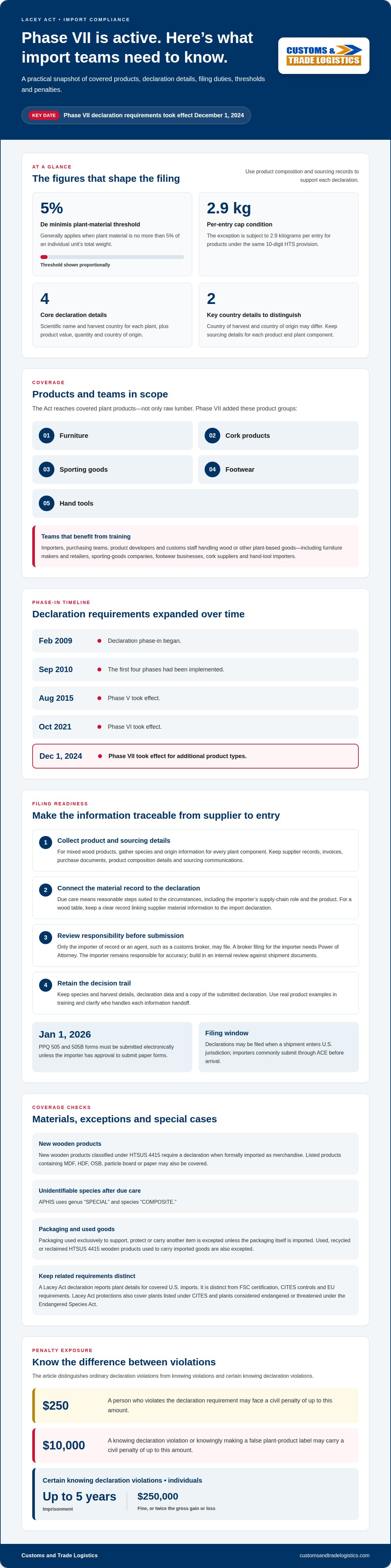
USDA Animal and Plant Health Inspection Service says Phase VII declaration requirements took effect on December 1, 2024, adding furniture, cork, sporting goods, footwear, and hand tools. The declaration phase-in began in February 2009; its first four phases were implemented by September 2010. Phase V took effect in August 2015, and Phase VI in October 2021. These milestones make training useful whenever teams classify new products or change materials.
Covered importers must report each plant’s scientific name and country of harvest. Declarations also identify the product’s value, quantity, and country of origin. Because the harvest country and country of origin may differ, teams need sourcing details for each product. For mixed wood products, gather species and origin information for every plant component. If species remain unidentifiable after due care, APHIS uses genus “SPECIAL” and species “COMPOSITE.”
New wooden products classified under HTSUS 4415 require a declaration when formally imported as merchandise. Listed products containing MDF, HDF, OSB, particle board, or paper may also be covered. USDA Animal and Plant Health Inspection Service says the de minimis exception generally applies when plant material is no more than 5 percent of an individual unit’s total weight, subject to 2.9 kilograms per entry for products under the same 10-digit HTS provision.
How does compliance differ from FSC, CITES, and the EU Deforestation Regulation? A Lacey Act declaration reports plant details for covered U.S. imports. It is distinct from FSC certification, CITES controls, and EU requirements. Lacey Act protections also cover plants listed under CITES and plants considered endangered or threatened under the Endangered Species Act.
What exemptions apply? Packaging used exclusively to support, protect, or carry another item is excepted, unless the packaging itself is imported. Used, recycled, or reclaimed HTSUS 4415 wooden products used to carry imported goods are also excepted. Training helps teams recognize these boundaries and retain sourcing records, invoices, species details, and declaration data supporting due care.
Compliance priorities for wood-product importers
Due care means taking reasonable steps suited to the circumstances, including the importer’s supply-chain role and the product. For a wood table, that means keeping a clear record linking the supplier’s material information to the import declaration. Training should connect purchasing, product teams, customs staff, and the employee responsible for filing, so details are not lost between departments.
Only the importer of record or an agent, such as a customs broker, may file a Lacey Act declaration. When a broker files for the importer, the broker needs Power of Attorney from the importer of record. The importer remains responsible for accurate information, so build an internal review into the process before submission. Assign one person to gather supplier details and another to check the declaration against shipment documents.
How do you file through the APHIS Lacey Act Web Governance System? Prepare the declaration details and submit the applicable forms electronically through the system. Beginning January 1, 2026, importers must submit PPQ 505 and 505B forms electronically unless they have approval to submit paper forms. Declarations may be filed when a shipment enters U.S. jurisdiction, and importers commonly submit through ACE before arrival.
Keep a working file documenting the decisions behind each entry. Include supplier records, purchase documents, product composition information, species and harvest details, sourcing communications, and a copy of the submitted declaration. These records help staff explain how they applied due care if questions arise. Use real product examples in training, such as a cabinet with multiple wood components, and clarify who handles each information handoff.
For shipments where entry details and customs documents must align, customs clearance services can help coordinate the import process. A clear division of responsibilities, from supplier data collection through filing, gives importers a practical framework for managing declarations without treating the broker’s submission as a substitute for importer oversight.
When does enforcement of Phase VII of the Lacey Act start?
Phase VII enforcement applies from the effective date of its declaration requirements. USDA Animal and Plant Health Inspection Service says those requirements took effect on December 1, 2024, for added product types, including furniture, cork, sporting goods, footwear, and hand tools. Importers of covered products should treat the declaration duty as active, not as a future phase-in. The national rule concerns import declarations, while the Act’s trade prohibitions apply separately to illegally sourced plants and plant products.
A civil penalty is a financial sanction for a violation, while criminal penalties can involve fines or imprisonment. A person who violates the declaration requirement may face a civil penalty of up to $250. Knowingly violating that requirement or knowingly making a false plant-product label may carry a civil penalty of up to $10,000. For certain knowing declaration violations, an individual may face up to five years in prison and a fine of $250,000 or twice the gross gain or loss. Corporate penalties for certain knowing declaration violations may include up to five years of probation and a fine of $500,000 or twice the gross gain or loss.
Timber enforcement cases show why declaration accuracy matters. In June 2024, L&D Kitchen and Bath was sentenced after pleading guilty to false declarations about timber species and harvest location for wooden cabinets and vanities. The case involved five shipments declared as Malaysian-origin products between January and May 2020.
For trafficking violations, penalties depend on the conduct and circumstances. A person exercising due care but who should have known a plant product was illegal may face a civil administrative penalty of up to $10,000. An individual who should have known may face up to one year in prison and a fine of $100,000 or twice the gross gain or loss. A corporation may face up to five years of probation and a fine of $200,000 or twice the gross gain or loss.
Lacey Act prohibition on trade in illegally harvested plants and wood products
The Lacey Act’s trade prohibition bars commerce in plants and plant products taken illegally. The 2008 amendments extended this prohibition to plants and plant products sourced in violation of laws from a U.S. state or foreign country. Wood products are included, so an accurate import declaration alone does not make illegally sourced timber lawful. The central distinction is legality at harvest, not simply whether a shipment contains wood.
Plant products are goods made from plants or containing plant material. That scope can reach timber, furniture components, and other goods made with wood. The Lacey Act also protects plants listed in an appendix to the Convention on International Trade in Endangered Species of Wild Fauna and Flora, identified as 27 UST 1087; TIAS 8249. Plants considered endangered or threatened under the Endangered Species Act of 1973 are protected too, under 16 U.S.C. 1531 et seq.
Species protections and illegal-harvest rules address related but distinct risks. CITES and the Endangered Species Act identify protected plants, while the Lacey Act also prohibits trade when harvesting violated applicable state or foreign law. For example, timber may raise a Lacey Act concern even if it is not listed as endangered, if its harvest breached local law. Assess both the product’s species and the legality of its harvest, rather than relying on a species label alone.
A practical review starts with the wood’s source and the rules governing its harvest. Match supplier information to the product and shipment, then examine whether the harvesting activity complied with relevant local requirements. Keep the distinction clear: declaration details describe plant material, while the prohibition concerns unlawful sourcing and trade. This broader test makes legality a supply-chain issue, not only a customs-filing task. To discuss your wood-product import process, get help coordinating an import shipment.
Customs and Trade Logistics
Customs and Trade Logistics coordinates import steps for wood-product shipments, from freight planning to customs clearance. Turn to the team when you need help organizing an import route, preparing for customs clearance, or arranging delivery and redistribution after arrival.
Services include Customs Clearance Services, International Freight Logistics, Import From China Consulting, and Delivery and Redistribution Services. These services support goods movement and the related import process. Your business remains responsible for providing accurate plant and sourcing information for Lacey Act declarations.
For a wood-product shipment, share the product and import details so the logistics and customs steps can be considered together. Contact Customs and Trade Logistics for a free consultation about your import needs.
Build a steadier import process
A durable approach to Lacey Act compliance for wood products starts before booking a shipment. Make plant-sourcing information part of routine purchasing and product decisions, so declaration details can follow the goods through each handoff. Clear roles for suppliers, import teams, and customs coordination help make a complex requirement a repeatable process.
When import planning, customs clearance, or freight coordination needs attention, Customs and Trade Logistics can connect those steps. Its Customs Clearance Services, International Freight Logistics, and Import From China Consulting support different parts of the import journey, while your team remains responsible for accurate sourcing information.
Ready to discuss an upcoming wood-product import? Contact Customs and Trade Logistics to talk through your needs and plan the next step with confidence.
Frequently Asked Questions
What is the Lacey Act?
The Lacey Act is a U.S. law that prohibits trade in plants and plant products taken or traded illegally. First enacted in 1900, it was amended in 2008 to cover illegally sourced plants from U.S. states and foreign countries. For importers, that means legality matters beyond completing paperwork: a wood product can raise concerns if its harvest violated applicable law.
What products/HTS codes are included in Phase VII of the Lacey Act Declaration?
Phase VII added furniture, cork, sporting goods, footwear, and hand tools to declaration requirements, effective December 1, 2024, according to USDA Animal and Plant Health Inspection Service. The specific tariff classification depends on the imported product, so a category name alone doesn’t establish its HTS code. Determine the product’s classification and whether it contains covered plant material before preparing an entry.
What wood products are covered by the Lacey Act?
For Lacey Act compliance for wood products, consider both solid wood goods and covered products containing plant material. New wooden products classified under HTSUS 4415 require declarations when formally imported as merchandise. Listed imported products containing MDF, HDF, OSB, particle board, or paper may also be covered. A product’s materials and tariff classification help determine which declaration rules apply.
What information must importers declare under the Lacey Act?
Importers declare plant species and harvest country, along with the imported plant product’s scientific name, value, quantity, and country of origin. For products containing several plant species, the declaration must address the plants in their components rather than treating the finished item as a single species. For example, a mixed-material product may require details for each identifiable wood type.
Which tariff codes and plant products require a Lacey Act declaration?
New wooden products under HTSUS 4415 require a declaration when formally imported as merchandise. Requirements also extend to listed imported goods containing plant materials such as MDF, HDF, OSB, particle board, or paper. Used, recycled, or reclaimed wooden products under HTSUS 4415 used to carry goods imported into the United States are excepted from the plant declaration requirement.
What are the penalties for Lacey Act violations and inaccurate declarations?
Penalties depend on the violation and whether it was knowing. Declaration violations and knowingly false labels can lead to civil penalties. Certain knowing declaration offenses can also carry criminal penalties, including imprisonment and fines. Trafficking illegally sourced products has separate penalties.