

Imagine your latest shipment is sitting at a U.S. port, but instead of a delivery notification, you receive a $5,000 penalty notice because of a single clerical error. With the recent implementation of Executive Order 14411 and the total suspension of the $800 de minimis exemption as of June 2026, the margin for error in international trade has effectively vanished. It's understandable if you feel overwhelmed by these shifting regulations; you likely started your business to provide great products, not to spend your nights deciphering HTSUS codes or asset requirements.
We know that the fear of unexpected CBP fines or shipment seizures can keep even the most seasoned entrepreneur awake at night. This guide is here to replace that anxiety with a sense of security and partnership. You'll learn how to master your importer of record responsibilities to ensure your business stays in "good standing" with U.S. Customs while avoiding surprise bills. We'll walk you through a clear roadmap for managing paperwork, understanding new bonding requirements, and navigating the 25% ad valorem tariffs on goods from Brazil. By the end of this article, you'll have the tools to ensure your supply chain remains in a safe pair of hands.
Key Takeaways
- Learn why the Importer of Record is the primary legal entity for US Customs and why ultimate liability for compliance rests solely with your business.
- Master the essential importer of record responsibilities, including how to manage accurate HTSUS classification and valuation to prevent costly under-invoicing penalties.
- Understand the vital distinction between your role as the principal and your customs broker's role as an agent in the clearance process.
- Gain a clear roadmap for preparing the Importer Security Filing (ISF) and other critical documentation required for 2026 trade standards.
- Discover how partnering with a seasoned logistics expert can demystify complex paperwork and provide a safe pair of hands for your international shipments.
What is an Importer of Record (IOR) and Why Does it Matter?
At its simplest, an Importer of Record (IOR) is the legal entity responsible for ensuring that goods entering the United States comply with all local laws and regulations. While many people think of themselves as just "the buyer," the government sees things differently. Understanding What is an Importer of Record (IOR)? is the first step in protecting your business from costly delays. The IOR acts as the primary point of contact for U.S. Customs and Border Protection (CBP), serving as the person or business that "vows" the shipment is legal, properly valued, and correctly classified.
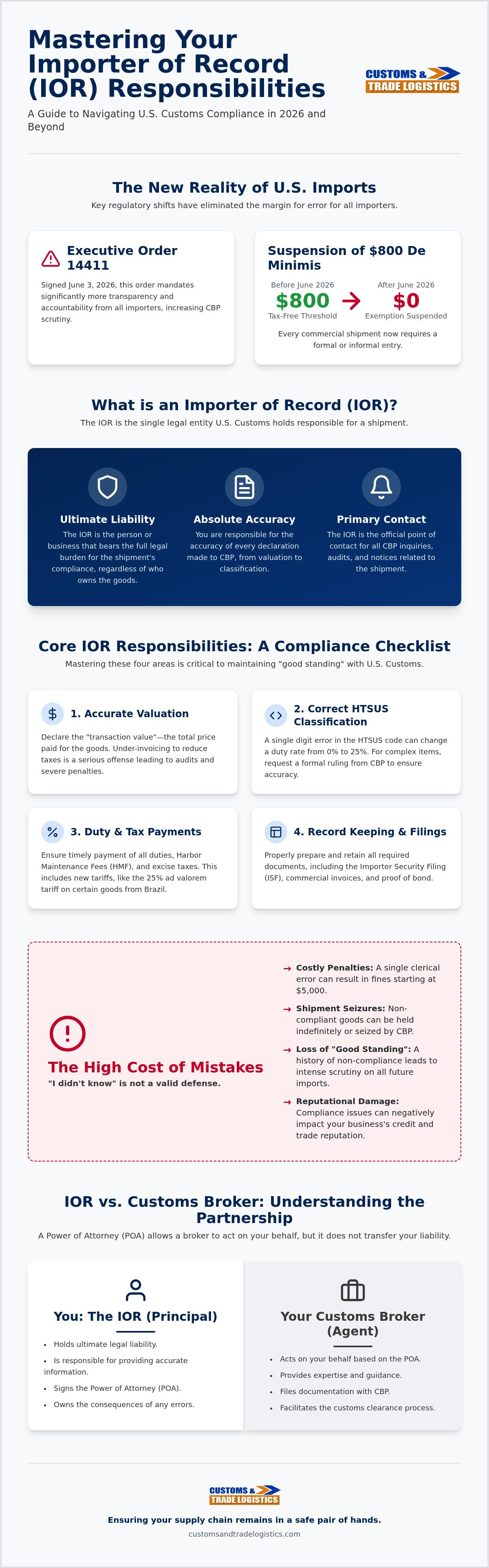
In 2026, this role has taken on a new level of weight. Following Executive Order 14411, signed on June 3, 2026, the CBP now demands significantly more transparency. With the total suspension of the $800 de minimis exemption, every commercial shipment now requires a formal or informal entry. You can't just ship small parcels under the radar anymore; every package needs a clear legal representative. You might own the goods, but being the "owner" and being the "legal importer" are two different things. The IOR is the one who bears the legal burden, regardless of who eventually sells the product.
The Legal Accountability of an IOR
When you act as an IOR, you're signing off on the absolute accuracy of every declaration made to the government. This includes the valuation of goods and the payment of duties. If a mistake happens, saying "I didn't know" won't protect you. Ignorance of customs law is never a valid defense in the eyes of the CBP. Beyond fines, your importer of record responsibilities directly impact your business's credit and trade reputation. A history of non-compliance can lead to your "good standing" status being revoked, making every future shipment a target for intense scrutiny.
Who Can Act as the Importer of Record?
Most U.S. resident corporations can easily serve as an IOR. However, if you're a non-resident corporation, 2026 rules have become much stricter. Under the new mandates, foreign IORs must now meet minimum tangible U.S. asset requirements or secure specific bonds. While individuals can technically act as an IOR for personal shipments, business entities are standard for commercial trade. To make the process smoother, you'll likely sign a Power of Attorney (POA). This document doesn't shift your importer of record responsibilities to someone else; it simply allows a licensed customs broker to act on your behalf while you remain the principal held accountable for the shipment's integrity.
Core Importer of Record Responsibilities for US Imports
If the IOR is the pilot of the shipment, then the core responsibilities are the flight plan that keeps your cargo from crashing into a wall of legal red tape. Your primary task is to exercise what the government calls "informed compliance." This means you're expected to follow CBP's reasonable care standards by proactively verifying every detail of your entry. If you're feeling the pressure of these new 2026 mandates, our customs clearance services can provide the safe pair of hands you need to ensure every box is checked correctly from day one.
Valuation and HTSUS Classification
How do you decide what your goods are actually worth? For customs purposes, you must determine the "transaction value," which is typically the total price paid or payable for the goods. Some businesses try to artificially lower this number to save on taxes, but under-invoicing is a fast track to audits and heavy penalties. Similarly, choosing the right HTSUS code is a central part of importer of record responsibilities. A single digit difference in a classification code can mean the difference between a 0% duty rate and a 25% tariff. For complex products, it's often wise to request a written ruling from CBP to avoid expensive guesswork at the port.
Duty and Tax Payments
Calculating your landed cost involves more than just the sticker price of your products. You're responsible for paying all applicable duties, federal fees like the Harbor Maintenance Fee (HMF), and specific excise taxes. This is especially critical in 2026 with the expansion of Section 301 tariffs. For instance, as of July 22, 2026, a wide range of goods originating from Brazil now face a 25% ad valorem tariff. Managing these fluctuating costs requires a valid Customs Bond, which acts as a financial guarantee to the U.S. government that all debts will be paid in full.
Your importer of record responsibilities also extend to "Other Government Agencies" (OGA). If you're bringing in food, electronics, or medical devices, you must prove compliance with FDA or EPA standards before the goods can enter commerce. Finally, don't overlook the Importer Security Filing (ISF) for ocean freight. Filing this "10+2" data late can result in a $5,000 penalty per violation. With the 2026 suspension of de minimis exemptions, even small commercial shipments that used to pass through duty-free now face these rigorous filing and payment requirements.
IOR vs. Customs Broker: Understanding the Partnership
Think of your customs broker as a highly skilled navigator, while you, the Importer of Record, remain the pilot of the ship. In the eyes of U.S. Customs, the broker is your agent, authorized to act on your behalf through a Power of Attorney. They possess the technical expertise to file entries, calculate complex duties, and facilitate the physical clearance of your goods. However, even the most experienced broker cannot take legal responsibility for errors in the data you provide. Your importer of record responsibilities stay firmly with your business, meaning you're the one held accountable for the accuracy of every declaration.
Many businesses today are tempted by digital-only platforms that promise "one-click" customs clearance. While these tools offer speed, they often lack the protective oversight of a seasoned, family-owned consultancy. A software program will typically process whatever data you upload without question. If you accidentally list the wrong country of origin or an incorrect HTSUS code, the algorithm won't tap you on the shoulder to warn you. In contrast, a partner with 35 years of industry experience acts as a "safe pair of hands," spotting potential red flags before they reach a CBP officer's desk.
The Liability Gap: Who Pays if Things Go Wrong?
Consider a scenario where a business provides their broker with an invoice that accidentally omits certain "assists," such as tooling or molds provided to the factory for free. The broker files the entry based on that invoice. Later, CBP discovers the undervaluation during a routine audit. In this situation, the government doesn't penalize the broker for filing what they were given; they penalize the IOR for failing to provide complete information. This "Liability Gap" is why the CBP audits the IOR, not the broker. Protecting your business requires adhering to "Reasonable Care" standards, which involve actively verifying that your broker has the correct facts to work with.
Why You Can’t Outsource Total Responsibility
You cannot simply "set it and forget it" when it comes to customs compliance. A critical part of managing your importer of record responsibilities is the regular review of CBP Form 7501, also known as the Entry Summary. This document is the final record of what was told to the government about your shipment. You should treat this review as a mandatory internal audit. Are the duty rates correct? Is the valuation accurate? If you spot a mistake, you must work with your broker to file a Post-Summary Correction (PSC) immediately.
Maintaining a collaborative, transparent relationship with your logistics partner is the best way to avoid surprise bills. Understanding how these partnerships are structured can also help you plan your finances more effectively. For a deeper look at the costs involved in these professional services, you can explore our guide on Understanding Custom Brokerage Service Fees. By staying involved in the process, you ensure that your broker has the tools they need to protect your business's reputation and bottom line.
Navigating Documentation and Compliance Requirements
Mastering your importer of record responsibilities means becoming a guardian of your own data. In 2026, the "paper trail" has largely gone digital, but the legal weight of those files is heavier than ever. Since the total suspension of the $800 de minimis exemption, e-commerce and Amazon FBA sellers can no longer rely on simplified "Section 321" entries. Every commercial shipment, regardless of its value, now requires a formal or informal entry supported by a precise Commercial Invoice and Packing List. If you're feeling the weight of these new documentation standards, our international freight logistics team can streamline the process for you.
Importer Security Filing (ISF) and '10+2'
If you're importing via ocean freight, the Importer Security Filing (ISF) is your first major hurdle. You must file this "10+2" data at least 24 hours before your cargo is even loaded onto the vessel at the port of origin. Why is this so critical? CBP is authorized to issue $5,000 fines for late or inaccurate filings, with a maximum of $10,000 per shipment. The 10 data elements you provide range from the manufacturer's name to the container stuffing location. Common mistakes often involve simple typos in the Bill of Lading number or the HTSUS code. Catching these errors before the ship leaves the dock is the only way to protect your bottom line.
Recordkeeping: The Five-Year Rule
Your job isn't finished once the goods are in your warehouse. CBP requires you to maintain all import records for five years from the date of entry. This isn't just a suggestion; it's a strict legal mandate known as the "Five-Year Rule." In 2026, digital records are the standard, provided they are readily accessible and unalterable. You must pay special attention to the "(a)(1)(A)" list, which includes essential documents like the entry summary, commercial invoice, and any proof of payment. Organizing these files by entry number ensures that if you're selected for a quick audit, you can retrieve the necessary proof within minutes. This level of diligence is what separates a successful importer from one facing a mountain of back-duties.
Finally, you'll need to secure the right Customs Bond to guarantee your payments to the government. For most businesses, a Continuous Bond is the preferred choice as it covers all entries at all U.S. ports for a full year. While Single Entry Bonds exist, they often lead to higher costs and more administrative work for frequent importers. Managing these importer of record responsibilities with a proactive mindset ensures that your shipments remain a source of growth rather than a source of legal anxiety.
Simplifying Your IOR Obligations with a Logistics Partner
Managing the weight of international trade alone can feel like trying to steer a massive cargo ship with a rowboat paddle. While you now understand the legal landscape, the daily execution of these tasks requires constant vigilance. Moving from a "DIY" import model to a managed logistics partnership is the most effective way to protect your business from the volatility of 2026 trade regulations. A professional broker doesn't just file paperwork; they act as a buffer between your operations and the risk of costly port delays. With over 35 years of industry experience, our team provides the seasoned oversight needed to handle importer of record responsibilities across all U.S. Customs ports nationally.
The value of a veteran partner becomes clear when shifting trade wars or new executive orders suddenly change the rules of the game. Digital platforms often struggle to provide the nuanced advice required when a shipment is flagged or when a new tariff, like the recent 25% ad valorem tax on Brazilian goods, is implemented. We offer a stabilizing force that replaces the anxiety of "what if" with the security of "it's handled." By letting experts manage the granular procedural details, you free up your time to focus on scaling your business and serving your customers.
Transitioning from Overwhelmed to Compliant
How do you make the switch to a more secure import process? Our onboarding for a new Importer of Record is a methodical, step-by-step journey designed to identify gaps in your current strategy. We don't just look for errors; we search for duty-saving opportunities that most small businesses overlook, such as Duty Drawback programs that can put money back in your pocket. For a deeper look at how this process works, explore our guide on Customs Clearance Services in the US. This transition ensures that your internal records match the high standards required for a CBP audit.
A Safe Pair of Hands for Your Global Trade
Choosing a family-owned and operated consultancy means you aren't just another account number in a database. Whether you are an Amazon FBA seller or a growing SMB, your shipments represent your livelihood. We treat them with the same protective care. Our goal is to ensure your goods never get stuck at the port due to a missing ISF filing or an incorrect HTSUS code. We bridge the gap between small-scale operations and the global marketplace, acting as your dedicated advocate at every U.S. port. If you're ready to secure your supply chain and master your importer of record responsibilities, contact Customs and Trade Logistics for a compliance review today. Let us provide the safe pair of hands your business deserves.
Securing Your Future in Global Trade
Understanding your role as the primary legal entity for U.S. Customs is the first step toward building a resilient supply chain. While a broker navigates the technical filings, the ultimate accountability for accurate data, valuation, and duty payments remains your most critical task. By mastering your importer of record responsibilities, you protect your business from the disruptions that modern trade enforcement can bring. It's about more than just avoiding penalties; it's about establishing a reputation for reliability that keeps your goods moving across borders without delay.
Ready to lift the heavy administrative burden from your shoulders? With over 35 years of customs brokerage expertise, our family-owned team acts as a safe pair of hands for your business. We provide national coverage across all U.S. ports to ensure your shipments are handled with the protective care they deserve. Simplify your import compliance with a free consultation and let us help you navigate the complexities of international trade with total peace of mind. You've built a great business; let's make sure the world can see it.
Frequently Asked Questions
Can a foreign company be an Importer of Record in the US?
Yes, but the requirements changed significantly in June 2026 under Executive Order 14411. Foreign companies must now meet minimum tangible U.S. asset or bonding requirements to act as an IOR. Additionally, foreign entities are now barred from using informal entries for low-value shipments and must either be CTPAT-validated or work with a CTPAT-validated customs broker to ensure a secure supply chain.
What is the penalty for failing to meet Importer of Record responsibilities?
Penalties for non-compliance are severe and can quickly impact your bottom line. For example, a late or inaccurate Importer Security Filing (ISF) results in a $5,000 fine per violation. Beyond monetary costs, failing to meet importer of record responsibilities can lead to shipment seizures at the port or a loss of your "good standing" status, which triggers mandatory inspections for all your future cargo.
Is the Importer of Record always the same as the consignee?
No, these are two distinct roles that often belong to different parties. The consignee is the individual or business receiving the goods, while the IOR is the entity legally responsible for the import's compliance and duty payments. In many Amazon FBA or third-party logistics setups, the business owner acts as the IOR while the warehouse or fulfillment center is listed as the consignee.
Does the Importer of Record need a specific license?
U.S. Customs doesn't require a general "importer's license" for most commercial goods. You simply need a valid IRS business tax ID (EIN) or a Social Security number to identify your business to the CBP. However, certain regulated products like food, alcohol, or medical devices may require additional permits or licenses from other government agencies before they can be legally entered into commerce.
How much does a Customs Bond cost for a new Importer of Record?
The cost of a bond depends on whether you choose a Single Entry Bond or a Continuous Bond. A Single Entry Bond is usually calculated based on the value of the specific shipment plus duties. A Continuous Bond covers all your imports for a full year and is generally more cost-effective for frequent shippers. You should consult your broker to determine the exact bond amount needed for your importer of record responsibilities.
What is 'Reasonable Care' in the context of US Customs?
Reasonable care is the legal standard CBP uses to determine if you've been diligent in your filings. It requires you to proactively verify your HTSUS classifications, valuations, and countries of origin rather than guessing. If you don't have the internal expertise to manage these details, the government expects you to seek professional guidance from a licensed customs broker to ensure your declarations are accurate.
Can I change the Importer of Record after the shipment has departed?
It is possible to change the IOR while the shipment is in transit, but it requires swift administrative action. You must update the manifest and ensure the new IOR has a valid Power of Attorney and Customs Bond on file before the ship arrives at the U.S. port. If you wait until the goods have reached the dock, you'll likely face significant delays and additional storage fees.
How do I verify if my HTSUS code is correct?
The most reliable way to verify a code is to consult with a licensed customs broker who can analyze your product's materials and function. You can also search the official Harmonized Tariff Schedule database for similar items. For complex or high-value products, you can request a formal "Binding Ruling" from CBP, which provides a written legal guarantee that your classification is correct and protects you from future audits.


