
The freight route is only part of the decision. Planning how to import goods for a trade show means matching air, ocean, or road freight to the shipment and event schedule, preparing accurate documents, and coordinating customs clearance and delivery. A Merchandise Processing Fee generally applies to U.S. imports unless the goods qualify under a free trade agreement.
It’s understandable to focus first on getting booth materials to the venue on time. But the shipment’s destination, the type of goods, and whether they’ll be returned, sold, given away, or consumed can also affect the customs entry and possible import charges.
This guide covers freight planning, customs clearance, Canadian event documents, and potential fees. You’ll learn what to consider when choosing air, ocean, or road transport, how temporary and permanent entries differ, and how to coordinate delivery to the event venue or an advance warehouse.
Key Takeaways
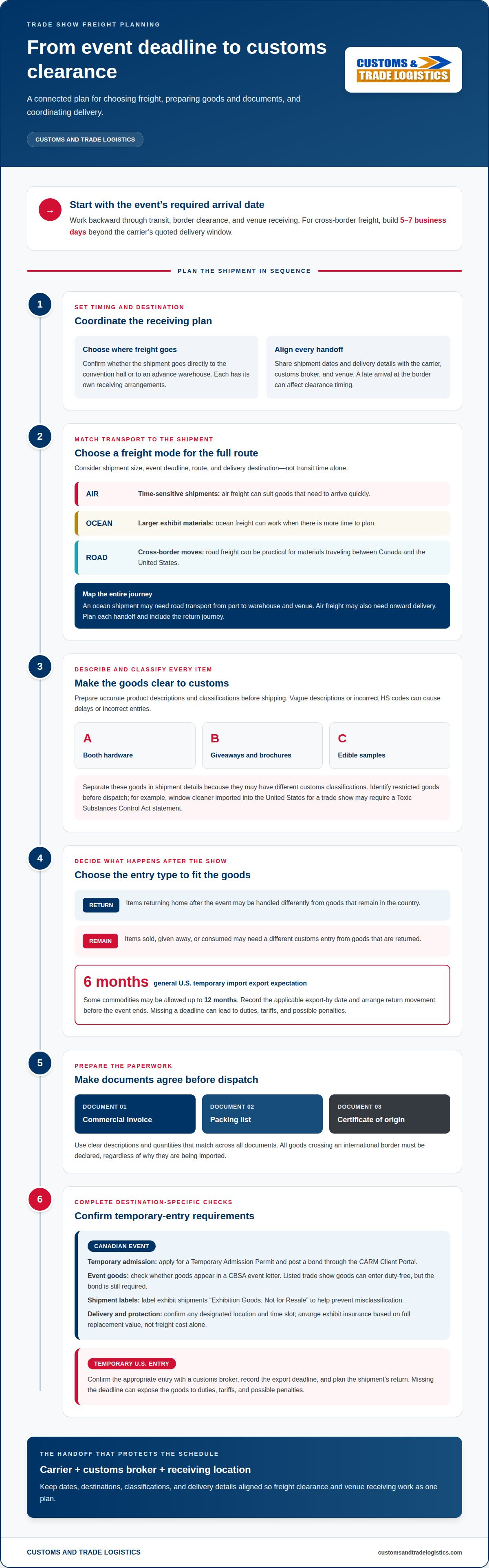
- Build customs clearance time into your event schedule and allow an extra 5-7 business days beyond the carrier’s quoted delivery window for cross-border freight.
- For temporary imports into Canada, plan for the required event documents, a Temporary Admission Permit, and a bond through the CARM Client Portal.
- Choose air, ocean, or road freight based on your shipment and delivery plan, including whether goods are going to the convention hall or an advance warehouse.
- Sort goods by what will happen to them after the show: items sold, given away, or consumed may need a different customs entry from goods returning home.
Coordinating shipment timing and customs clearance
Plan freight, customs clearance, and the event’s delivery window together. Incorrect paperwork can delay release. Missing a temporary import’s export deadline can lead to duties, tariffs, and possible penalties.
-
Coordinate shipment schedules
Set the event delivery deadline first, then work backward through transit, border clearance, and venue receiving times. For cross-border shipments, build 5-7 business days beyond the carrier’s quoted delivery window into the schedule.
Confirm whether freight is going to the convention hall or an advance warehouse, since each has its own receiving arrangements. A late arrival at the U.S. border can affect clearance timing. Share shipment dates and delivery details with the carrier, customs broker, and venue so each handoff is coordinated.
-
Classify products for customs compliance
Prepare accurate descriptions and classifications for every product before shipping. Customs uses product classifications to determine applicable requirements, so vague descriptions or incorrect HS codes can cause delays or incorrect entries.
Separate booth hardware from giveaways, brochures, and edible samples in your shipment details. These goods may have different customs classifications. Identify restricted goods before dispatch, too. For example, window cleaner imported into the United States for a trade show may require a Toxic Substances Control Act statement, according to the U.S. Environmental Protection Agency.
Decide with a customs broker which entry type fits the goods. Items returning after the event may be handled differently from goods sold, given away, or consumed. A Temporary Import Bond has an applicable export deadline: U.S. trade show goods entered this way are generally expected to leave within six months, with some commodities allowed up to 12 months.
-
Prepare customs clearance documents
Prepare a commercial invoice, packing list, and certificate of origin for the international shipment. Use clear descriptions and quantities that match across the documents. Customs clearance is the release of goods at an international border, and all goods crossing the border must be declared, regardless of why they’re being imported.
Work with a customs broker experienced in trade shows to review classifications, prepare for clearance, and coordinate shipment timing. For temporary imports, record the required export-by date and arrange the return movement before the event ends. Missing the applicable deadline can expose the shipment to duties, tariffs, and possible penalties.
CBSA International Events and Convention Services Program
For a Canadian event, coordinate temporary entry, event paperwork, delivery arrangements, and insurance before international freight leaves its origin.
- The Canada Border Services Agency’s International Events and Convention Services Program is a federal contact for requirements related to events and conventions in Canada. Start by identifying the event and the goods you plan to exhibit. Label exhibit shipments “Exhibition Goods, Not for Resale” to help prevent misclassification.
- Plan temporary admission for goods that will leave Canada after the event. Canadian temporary trade show importers need to post a bond in the CARM Client Portal and apply for a Temporary Admission Permit. The permit covers temporary admission, while the bond remains part of the process.
Check whether the goods are listed in a CBSA event letter. Listed trade show goods can enter duty-free, but the bond is still required. Keep event paperwork consistent with shipment descriptions so customs can identify the goods during entry.
- Match the freight plan to the venue’s receiving instructions. International trade show shipping may require delivery to a designated location within a specific time slot. An advance warehouse can receive exhibit materials before the event or accept a booth moving from another show. Confirm the destination and delivery window in the event information before dispatch.
- Arrange exhibit insurance based on the value of the materials, not just their freight cost. Coverage should reflect the full replacement value of booth hardware, graphics, and accessories. If a shipment is damaged or lost, freight charges alone don’t represent the cost of replacing the exhibit.
For support coordinating cross-border event freight and customs steps, international shipment planning can bring the moving parts together.
Air, ocean, and road freight options
Choose freight by considering the shipment’s size, event deadline, route, and delivery destination. Air, ocean, and road each shape the logistics plan differently.
- Compare the three modes against the event’s required arrival date. Air freight can suit a time-sensitive shipment, while ocean freight can work for larger exhibit materials when there’s more time to plan. Road freight can be practical for cross-border moves, such as materials traveling between Canada and the United States.
Decide what must arrive together and what can travel separately. For example, prioritize a display needed for booth setup, then plan less urgent materials around the same event schedule. Don’t choose a mode based on transit time alone: customs clearance and venue receiving windows also affect when goods reach the booth.
- Match the freight mode to the complete route, not only the international leg. An ocean shipment may still need road transport between the port, an advance warehouse, and the convention hall. Air freight may also require onward delivery from the arrival point. For a Canada-to-U.S. exhibit, map each handoff so the carrier, customs broker, and receiving location share the same destination details.
Include the return journey in your plan when display materials will leave after the event. A one-way schedule can overlook the time and transport needed to return the booth to its origin.
- Confirm the receiving location before comparing shipping arrangements. Charges can differ depending on whether freight goes directly to a convention hall or to an advance warehouse. The warehouse may receive materials before the event or accept a booth moving from another show.
Use the exhibitor manual to identify delivery locations and time slots, then align the carrier’s arrival with those instructions. If there are multiple destinations, coordinate each delivery separately rather than treating the event site as the only stop. The key is to choose a mode only after the route, customs timing, receiving window, and return movement fit one workable logistics plan.
Handling trade show goods sold or left in the U.S.
- Sort the shipment by what will happen to each item after the show: return it, sell it, give it away, consume it, or leave it in the United States. A booth display returning home has a different outcome from brochures distributed to visitors. Give the customs broker a clear breakdown before selecting an entry type.
- Use a consumption entry for goods intended to be consumed at the event. Consumable goods cannot be entered under a Temporary Import Bond, so samples such as edible products need the appropriate consumption entry. Promotional items may also require a consumption entry and potentially a full entry with duties and taxes. Identify giveaways separately from reusable booth materials.
- Plan the entry for items sold or left in the United States. Goods that won’t be re-exported need an entry that reflects their final disposition, rather than paperwork treating every item as a temporary exhibit. For example, separate products sold at a booth from display equipment scheduled to return after the show.
A consumption entry is also recommended for trade show goods that are consumable, duty-free, or eligible under a free trade agreement. Eligibility and intended use affect which entry is appropriate, so provide accurate descriptions and quantities for each category.
- Keep temporary goods separate from items staying behind. Temporary import arrangements may require goods to leave the country within an applicable timeframe. Track the export-by date and coordinate the return shipment. Goods returning from the United States also require attention to U.S. export rules. Duties and taxes may apply.
- Before shipping, share the itemized disposition plan with the customs broker handling the U.S. entry. This helps align the documents with what will be sold, distributed, consumed, or returned. Plan customs clearance for your event goods with support for the shipment’s entry and intended use.
Customs and Trade Logistics: Import From China Consulting
Customs and Trade Logistics helps coordinate import steps for trade show goods coming from China and provides customs and freight support. Its Import From China Consulting helps plan the shipment, while Customs Clearance Services and International Freight Logistics support border clearance and transport coordination. Delivery and Redistribution Services can move freight onward after arrival.
This support can help when you need to align the entry plan, freight route, and event delivery arrangements, especially if goods have different destinations after the show. Clear details about the products, event location, and intended use help shape the logistics plan.
Contact Customs and Trade Logistics to discuss your trade show shipment.
Set Your Next Event Shipment in Motion
The next trade show is easier to plan when freight decisions begin alongside booth planning, not just before dispatch. Assign one person to coordinate shipment details across your event team, carrier, customs broker, and venue. That person can keep decisions moving as the exhibit plan changes, from adjusting what travels to clarifying where materials should go.
Knowing how to import goods for a trade show also means treating the shipment as part of the event itself. Build customs and transport coordination into your planning so freight arrangements support setup, the show schedule, and the materials’ final destination. When a shipment involves several moving parts or imports from China, experienced logistics support can help bring the plan together.
For help planning your next event shipment, contact Customs and Trade Logistics. A clear plan gives your team more room to focus on the event ahead.
Frequently Asked Questions
Is A Merchandise Processing Fee Applied?
Generally, a Merchandise Processing Fee applies to U.S. imports unless the goods qualify under a free trade agreement. Eligibility depends on the agreement and the shipment’s origin and product details. When planning how to import goods for a trade show, distinguish this fee from customs duties and taxes, which may also apply depending on classification and entry type. Include potential import charges in your event budget.
What documents are required to import goods into the U.S. for a trade show?
Prepare a commercial invoice, packing list, and certificate of origin, along with the bill of lading or air waybill for transport. Include any applicable government permits or certificates. For example, describe and itemize different exhibit products rather than using a broad label such as “trade show materials.” Consistent details help the customs broker prepare the entry.
What is a temporary importation bond (TIB), and when should I use one for trade show goods?
A Temporary Import Bond is an entry option for eligible goods brought into the United States temporarily and intended for export afterward. Trade show goods entered this way are generally expected to be exported within six months, with some commodities allowed up to 12 months. Consider it for reusable display equipment returning home. Consumable goods cannot use a TIB and require a consumption entry.
How do I declare and classify trade show goods with U.S. Customs and Border Protection?
Declare every item crossing the U.S. border and provide a clear product description for customs classification. For example, list a display stand separately from branded brochures or edible samples, since different goods can have different classifications. A customs broker can help determine the appropriate HS codes and prepare the entry. The goods’ intended use, composition, and final destination inform the classification and entry details.
What duties, taxes, and fees apply to goods imported for a U.S. trade show?
Charges depend on the goods’ classification, origin, and entry type. A Merchandise Processing Fee generally applies unless the shipment qualifies under a free trade agreement; duties and taxes may also apply. Goods sold, given away, or consumed at the event may require a consumption entry, potentially with duties and taxes. Separate these items from reusable displays so each category receives appropriate customs treatment.
How far in advance should I ship trade show goods, and how do I choose a customs broker and freight forwarder?
Planning how to import goods for a trade show includes allowing an extra 5-7 business days beyond the carrier’s quoted delivery window for cross-border shipments, plus time for the venue’s receiving schedule. Choose a customs broker experienced with trade shows to help classify goods and coordinate clearance. Align the freight forwarder’s route and delivery plan with the broker and venue, especially when an advance warehouse or multiple event destinations are involved.