
The nearest coast isn’t always the best port. Choosing a US port of entry means weighing ocean transit against the inland distance to your warehouse, customers, and consignees. A port that looks convenient on a map can add time and transportation costs if your goods must travel a long way inland.
It’s natural to focus first on where a vessel arrives, but the port is only one part of the route. The practical choice depends on where your cargo goes next and how quickly it needs to get there.
This guide compares East, Gulf, and West Coast options, showing how port-to-warehouse distance, customer locations, inland freight, and delivery timing shape the decision. Use it to assess the full journey instead of choosing a port based on coastline alone.
Key Takeaways
- Compare East, Gulf, and West Coast routes by the full journey, including ocean transit and inland freight, not just the port’s coastal location.
- Map each port’s distance from your warehouse to understand how the final inland leg affects delivery planning.
- Consider where customers and consignees are located, since port proximity can influence delivery speed, distribution costs, and inventory flow.
- Keep traveler immigration wait times separate from cargo clearance decisions; the right port depends on whether you’re planning a trip or moving freight.
East Coast, Gulf Coast, and West Coast port options
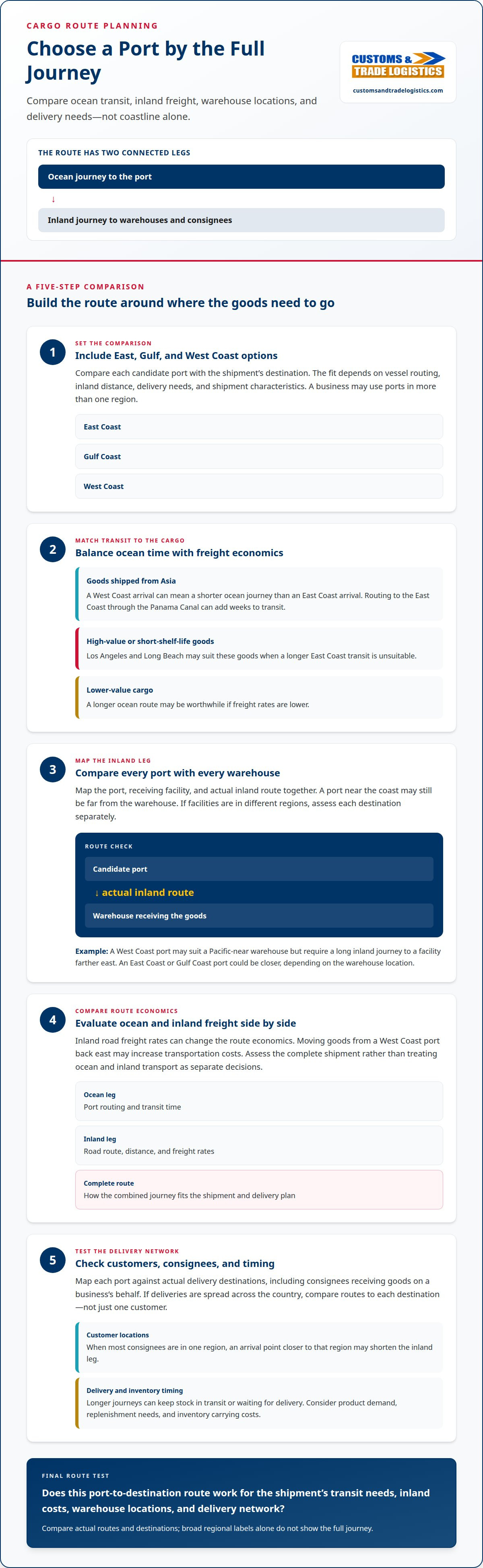
For cargo, compare the port with the destination, not just the coastline. East Coast, Gulf Coast, and West Coast ports can all serve an import route, and a business may use ports in more than one region. The best fit depends on vessel routing, inland distance, delivery needs, and the shipment’s characteristics.
For goods shipped from Asia, a West Coast arrival can mean a shorter ocean journey than an East Coast arrival. Routing to the East Coast through the Panama Canal can add weeks to transit. Los Angeles and Long Beach may suit high-value or short-shelf-life goods when a longer East Coast transit is unsuitable. For lower-value cargo, a longer ocean route may be worthwhile if freight rates are lower.
Travelers face a different decision. According to U.S. Customs and Border Protection, the Office of Field Operations determines travelers’ admissibility at U.S. ports of entry. Nonimmigrants seeking admission must be inspected in person by an immigration officer at an official port. Required documents depend on citizenship, immigration status, and travel purpose, so there isn’t one universal set for every traveler. Port choice is generally a personal decision and need not be made at a visa interview. For a trip with a domestic connection, the first U.S. airport where you land and go through immigration is your port of entry. Entry by land, air, or sea still involves arriving at an official port, though the route and processing point differ.
At a land crossing, check current wait-time information for the specific crossing and direction, then check again before departure. A long queue can disrupt onward plans, while a crossing far from your destination can add driving time. Global Entry, NEXUS, and other trusted traveler programs may affect which processing options suit a traveler, so consider the specific port and route together. Don’t assume a program makes every crossing equally convenient.
For official port hours and contact details, use the U.S. Customs and Border Protection port directory. For cargo, compare inland freight routes from each candidate port before deciding.
Port proximity to warehouses
When choosing a US port of entry, compare each candidate with the warehouse receiving the goods. Map the port, facility, and inland route together. A port may be close to the coast but far from the warehouse. That distance shapes the overland leg and can affect transport planning and the shipment’s arrival schedule.
For example, a West Coast port may suit a warehouse near the Pacific, but require a long inland journey to a facility farther east. An East Coast or Gulf Coast port could be closer to that warehouse, depending on its location. Compare actual port-to-facility routes rather than relying on broad regional labels.
Distance is only one part of the comparison. Inland road freight rates can change the route economics, and moving goods from a West Coast port back east may increase transportation costs. Compare the ocean journey and inland leg side by side to see how each route works as a complete shipment, rather than as separate transport stages.
A second test when choosing a US port of entry is whether one arrival point serves all your warehouses. If facilities sit in different regions, compare each port with each destination. A route that fits a western warehouse may be less practical for an eastern facility. Lower-value goods may justify longer transit in exchange for lower freight rates, while high-value or short-shelf-life cargo can put more weight on transit time.
Use the warehouse’s location, shipment needs, and inland route to assess each option. If several ports remain workable, compare how their onward routes fit your distribution plan. For complex inbound routes, port-to-warehouse freight planning can connect the port decision with the goods’ next movement.
When selecting a port of entry, map the distance between each candidate port and your warehousing facilities. Compare every facility with the port that would serve it, so the distance reflects the actual destination. This keeps the decision focused on where the goods are going, rather than on the port in isolation. Revisit the comparison if your planned warehousing facilities change.
Proximity of ports to customers and consignees
A port can be close to a warehouse yet far from the customers receiving the goods. Map each port against actual delivery destinations, including consignees that receive shipments on a business’s behalf. For example, compare inland routes from East Coast and West Coast ports to the same eastern customers. Port proximity can affect delivery speed and inland distribution costs.
If you serve multiple customer regions, list the destinations for each shipment and identify where demand is concentrated. When most consignees are in one region, an arrival point closer to that region may shorten the inland leg. If deliveries are spread across the country, compare routes to each destination instead of judging a port by its distance from one customer. A port that suits one consignee may not serve another efficiently.
Delivery timing also affects inventory turnover. Goods that reach customers sooner can move through inventory sooner, while longer journeys can keep stock in transit or waiting for delivery. This timing can influence carrying costs, especially when a business must maintain inventory as shipments travel inland. Consider product demand and replenishment needs alongside port-to-customer distance.
Which U.S. port of entry is best for connecting flights or onward travel? For a trip with a domestic connection, the port of entry is the first U.S. airport where the traveler lands and goes through immigration. Choose an airport that fits the onward itinerary and brings the traveler closer to the final destination, allowing for the connection after arrival.
For cargo, compare the full route from the arrival port to each consignee, not just the ocean journey. A simple route comparison can show whether a port’s inland reach aligns with your delivery network. Consider delivery timing, customer locations, and inventory needs together. The closest port is useful only when its onward routes fit the shipment’s destinations.
Which U.S. ports of entry have the shortest customs wait times?
No single U.S. port consistently has the shortest wait for every traveler or shipment. Traveler queues and cargo processing are different measures, and conditions can change with arrival volume, timing, and inspection needs. Compare the specific crossing or port that fits your route instead of relying on a national ranking.
For land travel, compare the current wait estimate for the crossing and direction you plan to use. Check again close to departure, because a queue can change while you’re on the road. Weigh the estimate against extra driving, onward connections, and your destination. A shorter queue at a distant crossing may not save time across the whole journey.
Some ports are designated for particular processing needs, not as universal fast lanes. CBP designated 14 ports for optimized processing of high volumes of TN and L applicants. The program began in mid-September 2014. The Peace Bridge in Buffalo, New York, is an optimized port and a Class A port, but that designation doesn’t establish the shortest general wait for all travelers.
For cargo, a traveler queue estimate won’t tell you how quickly a shipment will clear. Customs processing is part of the cargo route, alongside arrival timing and inland transport. Compare how each candidate port fits the shipment’s destination and schedule. A port with a convenient traveler crossing may still require a longer freight journey to the consignee.
Separate the questions before deciding: how long might a traveler wait at a crossing, and how does a cargo port fit the shipment’s full route? For freight, accurate shipment information and customs paperwork help support the clearance process. If your import route needs customs clearance support, get help with customs clearance as you assess port options.
Most people arriving in the United States also undergo customs inspection at ports of entry. There, CBP officers or employees accept merchandise, clear travelers, collect duties, and enforce U.S. import and export laws and regulations. Immigration policy and programs are also enforced at these ports. Optimized U.S. ports of entry receive higher volumes of NAFTA applications and consequently have greater expertise adjudicating them, but that specialization does not make them the shortest-wait option for everyone. Forum participants describe port choice as a personal decision, not one that has to be made at a visa interview.
Customs and Trade Logistics
Customs and Trade Logistics helps importers connect port decisions with the broader journey their goods must take. When weighing a port against warehouse locations, customer destinations, and inland routes, you can use its customs clearance and international freight logistics support to coordinate those considerations. Importers bringing goods from China can also use import consulting, while delivery and redistribution services support onward movement.
This support is useful when several ports appear workable, but the best fit still depends on how the shipment will clear and reach its consignee. A clear view of the full route helps align the port choice with the next steps.
Contact Customs and Trade Logistics to discuss your import route.
Turn the port decision into a workable import plan
Your port choice should support how your business plans to move goods beyond arrival. As sourcing plans or consignee locations change, revisit whether the route still fits your distribution needs. A shipment profile that includes origin, final destinations, and onward movement gives the decision practical context.
For help putting that plan into action, Customs and Trade Logistics offers Customs Clearance Services and International Freight Logistics. Import From China Consulting also supports businesses planning imports from China. These services connect port planning with the customs and transportation work involved in an import, helping you move from comparing routes to planning the shipment.
Choosing a US port of entry is one part of building a reliable import route. Bring your shipment plans and destination needs into the conversation, then decide on a path that fits your business. Contact Customs and Trade Logistics to discuss your import plans and take the next step with confidence.