

What if the shipping term that seems to cover everything leaves you responsible for a costly handoff? For small business importers, understanding incoterms for small business importers starts with separating three things that are easy to confuse: who arranges transport, who pays each cost, and when shipment risk transfers from seller to buyer.
A supplier’s quoted term can sound like a complete delivery plan, but Incoterms allocate only specific tasks, costs, and risks. They don’t settle every detail of an import. Knowing what the chosen rule covers helps you identify gaps before your goods are on the move.
This guide explains common Incoterms, how to choose a rule that fits your shipment and each party’s capabilities, and what to coordinate with freight and US customs arrangements. Although this is a 2026 guide, the current official rules are Incoterms 2020. Customs and Trade Logistics has over 35 years of experience supporting small and medium-sized businesses with customs clearance and international freight logistics. Clear shipping responsibilities help organize supplier, freight, and customs handoffs.
Key Takeaways
- Use understanding incoterms for small business importers to compare who arranges transport, covers costs, and takes on shipment risk.
- Match the Incoterm to your shipment mode and agree on a precise named place to clarify where delivery responsibilities apply.
- Compare convenience with control: a seller-arranged shipment can still leave important transport or import tasks for you to coordinate.
- Before agreeing to a supplier’s proposal, map each party’s responsibilities and document the chosen rule and place in the sales contract.
- Connect the agreed Incoterm to freight coordination, customs entry, and final delivery so each handoff has a clear next step.
What Incoterms Mean for Small Business Importers, and What They Do Not
Incoterms allocate specified delivery tasks, costs, and risks between a seller and a buyer. For a small business importing goods, the agreed rule helps answer practical questions: Who arranges each stretch of transport? Where does the seller’s delivery responsibility end? At what point does the risk of loss or damage shift to the buyer?
Clear terms matter because international shipments pass through several hands. If the supplier’s responsibilities and yours aren’t clearly divided, a task can fall between them. The named place is essential: it identifies where the rule applies and clarifies the agreed handoff. For context on the rules’ purpose and history, see this comprehensive overview of Incoterms.
Which responsibilities do Incoterms allocate?
Each rule sets out delivery obligations and divides particular transport-related tasks and costs between the parties. It also specifies when risk transfers. The exact point depends on the rule and named place. Insurance is required under some rules, such as CIP and CIF, but it isn’t a blanket requirement for every Incoterm.
For example, a US buyer might agree with a supplier in China to use FCA at a specifically named handoff point. The seller delivers the goods to the carrier or other party designated by the buyer at that point, and risk transfers there. The buyer arranges the main carriage from the agreed handoff. This is one possible setup, not a template for every shipment. The rule, named place, and shipping arrangements should match the actual transaction.
What Incoterms do not decide
Incoterms don’t set the sale price, payment method, or when ownership transfers. Those terms belong elsewhere in the sales contract. An Incoterm also doesn’t settle every obligation connected to the transaction or replace product-specific import compliance requirements.
Delivery risk, ownership, and customs compliance are separate questions: an Incoterm defines certain delivery responsibilities, but the contract and import plan must address the rest.
That distinction is central to understanding incoterms for small business importers. A supplier may arrange transport or deliver goods to an agreed destination, but the term alone isn’t a complete freight, customs, and final-delivery plan. Your shipment still needs coordinated handoffs, appropriate documentation, and clarity about who is managing each step. Treat the Incoterm as one part of the agreement and align it with the wider import process before the goods move.
Incoterms 2020 Rules: Which Ones Small US Importers Commonly Compare
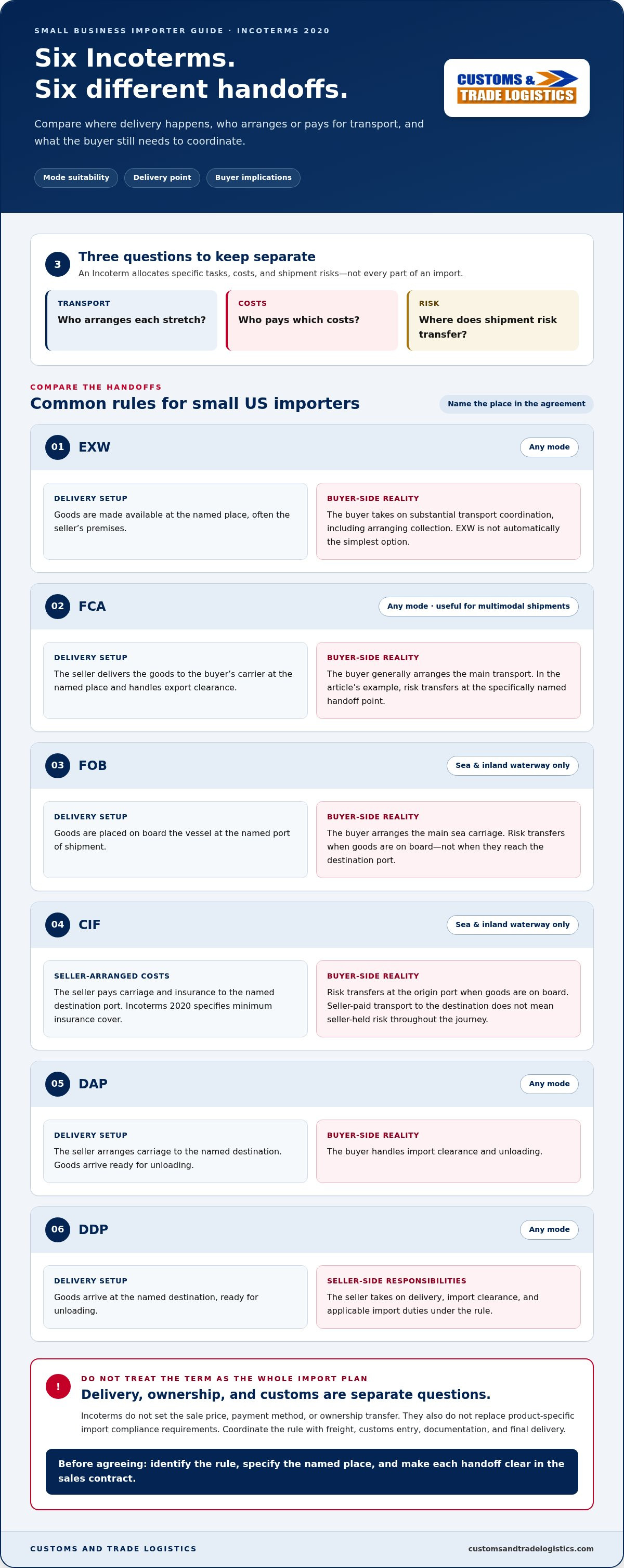
The right term depends on how the goods will travel and how much of the shipment you’re prepared to coordinate. The current edition is Incoterms 2020, published by the International Chamber of Commerce (ICC). Identify both the rule and its named place in the sales agreement. These six examples are common points of comparison, not universal recommendations.
| Rule | Transport suitability | Delivery point | Practical buyer implications |
|---|---|---|---|
| EXW | Any mode | Goods made available at the named place, often the seller’s premises | Buyer takes on substantial transport coordination, including arranging collection. It isn’t automatically the simplest option. |
| FCA | Any mode | Goods handed to the buyer’s carrier at the named place | Seller delivers to the carrier and handles export clearance; buyer generally arranges main transport. Useful for multimodal shipments. |
| FOB | Sea and inland waterway only | Goods placed on board the vessel at the named port of shipment | Buyer arranges the main sea carriage. Risk transfers when goods are on board, not when they reach the destination port. |
| CIF | Sea and inland waterway only | Goods placed on board at the shipment port; seller pays carriage and insurance to the named destination port | Seller arranges and pays those costs, but risk transfers at the origin port when goods are on board. Incoterms 2020 specifies minimum insurance cover. |
| DAP | Any mode | Goods arrive at the named destination, ready for unloading | Seller arranges carriage to that point; buyer handles import clearance and unloading. |
| DDP | Any mode | Goods arrive at the named destination, ready for unloading | Seller takes on delivery, import clearance, and applicable import duties under the rule. |
EXW, FCA, and FOB: where seller delivery responsibilities differ
EXW makes the goods available to the buyer at the named location, leaving the buyer to organize collection and much of the onward movement. FCA gives the seller a clearer handoff role: the seller delivers the goods to the buyer’s nominated carrier at the agreed point. This can suit shipments using more than one transport mode. FOB is different: use it only for sea or inland-waterway transport, and name the port where the goods will be loaded aboard the vessel.
CIF, DAP, and DDP: what a delivered offer can mean
CIF includes seller-arranged carriage and specified insurance, but payment for transport to the destination port doesn’t mean the seller carries risk throughout the journey. DAP brings the goods to the named destination ready for unloading, while DDP assigns the seller broader import-side responsibilities under the rule. A phrase such as “delivered to your door” isn’t a substitute for the precise Incoterm and named place.
Understanding incoterms for small business importers means comparing the handoff and responsibilities, not just the supplier’s headline offer. Customs and Trade Logistics coordinates freight and customs steps around your agreed term. Learn more about import freight and customs support.
Incoterms Tradeoffs: Who Controls Freight, Risk, and Import Responsibilities?
A supplier-arranged or delivered shipment can feel simpler, but convenience doesn’t automatically make it safer for your business. A seller may organize transport while your company has less say over the carrier or route. The Incoterm assigns specific responsibilities, but you still need to plan for import compliance, insurance, and the handoffs that fall to you.
Use this comparison to weigh the tradeoffs. The right fit depends on your shipment and your ability to manage each task.
| Arrangement | Potential advantage | Tradeoff to consider |
|---|---|---|
| Buyer arranges more transport, as with FCA | Greater control over carrier selection and freight coordination | Your team takes on more planning and must manage the carrier handoff. |
| Seller pays for carriage to a port, as with CIF | Less need to book the main sea transport yourself | Cost responsibility and risk transfer occur at different points; the seller’s payment for carriage doesn’t mean the seller carries risk to the destination. |
| Seller delivers to a named destination, as with DAP | Fewer transport stages for your business to arrange | The buyer still has import-side tasks under the rule, and the named destination must be precise. |
| Seller takes on broader delivery duties, as with DDP | Can reduce the buyer’s direct coordination of import delivery tasks | Don’t assume the term resolves every compliance or business-planning question. Make responsibilities and the delivery point explicit. |
When is supplier-arranged shipping convenient, and what should you understand?
Having a supplier arrange transport can reduce the number of bookings your team handles. The tradeoff is less direct control over arrangements and potentially less visibility into how each handoff is planned. Put the exact Incoterm and named destination in the sales agreement instead of relying on a loose phrase such as “shipping included.”
Convenience is only one part of the decision. Even when a rule assigns particular customs-related tasks to the seller, it doesn’t erase applicable US import obligations or replace your planning for the goods, records, and final delivery. Match the supplier’s proposal to the tasks your business can realistically coordinate.
How should a small importer think about risk transfer?
Risk transfer is the point specified by the selected rule where responsibility for the relevant risk of loss or damage shifts from seller to buyer. It isn’t necessarily the point where transport costs change hands. For example, under CIF, a seller can pay for carriage and insurance to the named destination port while risk transfers earlier, once the goods are on board the vessel at the shipment port.
This difference matters when planning insurance, freight handoffs, and customs entry. Understanding incoterms for small business importers means checking the risk point separately from who pays each transport cost. Coordinate the agreed term with customs entry arrangements and freight planning. A US customs clearance services guide can help you understand how customs entry fits into the wider plan.
How to Choose and Document an Incoterm for Your Import
A workable Incoterm should match the shipment and the people managing each handoff. Don’t accept a supplier’s proposed term based on convenience alone. Compare its responsibilities with your business’s capacity to coordinate freight, customs tasks, and final delivery. Then record the agreement clearly so everyone is working from the same plan.
A practical Incoterms decision checklist
Use this sequence to assess a proposed rule before accepting it:
- Identify the transport mode. Confirm whether the shipment moves by road, air, rail, sea, or a combination. Check that the proposed rule applies to that mode. For example, FOB and CIF are for sea and inland-waterway transport, not every shipment involving a container.
- Specify the delivery point. Name the precise place where delivery occurs under the rule. Map the handoffs from the supplier to the carrier, any transfer points, and your final destination. A broad label such as “port” may leave too much room for different interpretations.
- Compare responsibilities with your capabilities. List who arranges each transport leg, who handles applicable insurance duties, and who coordinates import and delivery steps. Consider whether your team can manage those tasks or needs freight and customs support.
- Check the risk handoff. Identify the point where risk transfers under the selected rule, separately from who pays for transport. Make sure the arrangement fits your shipment planning and insurance decisions.
- Write the full term into the agreement. State the rule, exact named place, and edition, such as “FCA [named place], Incoterms 2020.” If contract wording raises legal questions, align it with qualified trade or legal guidance.
Make the agreed term actionable across shipment paperwork
Once both parties agree, use the same rule, named place, and edition in the sales agreement and relevant shipping documents and instructions. Differences between the contract and the information used to arrange transport can create confusion about who is responsible at a handoff.
Before the goods move, coordinate the supplier’s shipment details with the freight plan and customs-entry preparation. Make sure the parties responsible for each step have the information they need, and resolve discrepancies early. A small-business customs paperwork guide can also help you prepare the shipment documents.
Clear Incoterm documentation turns a negotiated split of responsibilities into a plan people can follow. Customs and Trade Logistics coordinates freight and customs handoffs around your agreed term. Get support with import logistics coordination.
Put Your Incoterms Choice Into Practice With Coordinated Import Support
An agreed Incoterm becomes useful when it connects to the actual steps of an import. First, the supplier prepares the goods and completes the handoff set out in the agreement. The responsible party then coordinates the relevant freight arrangements. The shipment moves through customs entry and, after release, continues to its planned delivery point. Clear ownership of each step helps prevent gaps between the supplier, carrier, customs process, and final recipient.
What coordinated import support can help organize
Customs and Trade Logistics supports small and medium-sized importers with customs clearance, international freight coordination, import consulting, and delivery and redistribution services. Depending on your shipment and operational needs, this can include coordinating information from your supplier, preparing for customs entry, arranging freight movement, and planning delivery after the customs handoff. If goods need to reach more than one destination, delivery redistribution can form part of the plan.
With over 35 years of industry experience, the family-owned firm understands the importance of connecting each stage. That experience supports small businesses balancing supplier communications, freight arrangements, and US customs steps without a large in-house logistics team.
Prepare for a productive import-planning conversation
Gather a few details before discussing your shipment. Having them ready can make it easier to identify which handoffs and responsibilities need coordination:
- The proposed Incoterm, including its edition and named place
- A clear description of the goods and the planned shipment mode
- Available shipment timing and the supplier’s current arrangements
- Your desired delivery outcome, including where the goods need to go after arrival
Share what the supplier has offered and which freight, customs, or delivery tasks your business currently handles. This gives the planning conversation a practical starting point. Understanding incoterms for small business importers isn’t just about choosing a term; it’s about connecting that choice to the people and steps that will carry the shipment forward.
If you’re planning an import, discuss your proposed Incoterm and the freight, customs, and delivery coordination your shipment needs with Customs and Trade Logistics.
Make Your Next Import Plan Clear From the Start
Understanding incoterms for small business importers means looking beyond who pays for freight. The agreed rule sets specific delivery tasks and risk handoffs, while the named place and edition make the agreement clearer. Your full import plan should also account for freight coordination, customs entry, and delivery to the destination.
Before goods move, compare the supplier’s proposed term with your shipment mode and your team’s capacity to manage each responsibility. Record the exact Incoterm, named place, and Incoterms 2020 edition in the sales agreement, then coordinate the details across supplier, freight, and customs handoffs.
Customs and Trade Logistics is a family-owned customs brokerage and logistics consulting firm with over 35 years of industry experience, supporting small and medium-sized businesses with imports across US customs ports. If you’re preparing a shipment, talk with our team about coordinating your import shipment.
A clear plan can make a complex import feel more manageable. Customs and Trade Logistics can help coordinate the freight, customs, and delivery steps involved in your import.
Frequently Asked Questions
What are Incoterms, and why do small business importers need to understand them?
Incoterms are internationally recognized rules that allocate specified delivery tasks, costs, and risks between a seller and buyer. They help clarify who arranges transport and where delivery responsibilities change. For small businesses, understanding incoterms for small business importers can make supplier conversations and shipment planning clearer. The rules don’t replace the sales contract or settle every customs, payment, or ownership question, so treat them as one part of a complete import plan.
Which Incoterm is best for a small business importing into the US?
There isn’t one best Incoterm for every small business. The right choice depends on the transport mode, named delivery point, and each party’s ability to coordinate freight and import tasks. Compare the supplier’s proposed rule with your business’s import plan, including who will manage each handoff. Then record the exact rule and named place in the agreement. Don’t choose a term only because its wording sounds convenient or comprehensive.
Does DDP mean the seller handles everything when shipping to the US?
No. DDP assigns substantial delivery responsibilities to the seller under the rule, including import clearance and applicable duties, but it doesn’t resolve every commercial or regulatory issue for the buyer. Specify the named destination and understand how the parties will manage the transaction’s import requirements. Incoterms don’t replace other contract terms or eliminate the need to understand your business’s applicable US import obligations.
Are FOB and CIF suitable for air freight or every type of shipment?
No. FOB and CIF are designed for sea and inland-waterway transport, so they aren’t general-purpose terms for air, road, rail, or multimodal shipments. For those modes, consider rules intended for any mode, such as FCA, where appropriate. State the transport mode and named place clearly, and check the proposed term against current International Chamber of Commerce guidance to help ensure it fits the shipment.
Do Incoterms determine when ownership of imported goods transfers?
No. Incoterms allocate specified delivery responsibilities, costs, and risks, but they don’t by themselves determine ownership transfer or payment terms. Address those points separately in the broader sales agreement. Keep delivery risk, title, and payment distinct when reviewing a supplier contract. If the contract wording or transaction raises legal questions, seek guidance from a qualified legal professional before relying on your interpretation.
What information should an importer include when agreeing on an Incoterm?
Include the exact three-letter rule, its edition, and the precise named place or port required by that rule. For example, specify “FCA” with the agreed place and “Incoterms 2020,” rather than writing only “FCA” or “shipping included.” Use consistent wording in the sales agreement and relevant shipping documents. Also map who arranges transport and delivery tasks, and coordinate the term with customs planning and final delivery.
Can a customs broker help with Incoterms and an import shipment?
A customs broker can help manage customs entry preparation and submission, and coordinate relevant import information as part of the broader shipment plan. Incoterms set responsibilities between seller and buyer, so customs brokerage is one part of the overall arrangement. Share the proposed rule, named place, and shipment details early. Customs and Trade Logistics is a family-owned customs brokerage and logistics consulting firm with over 35 years of experience supporting small and medium-sized importers.