
Would you leave your business's front door wide open when a single mistake could cost you $5,000 in penalties? For many importers, the fear of expensive demurrage fees or storage costs due to paperwork errors is a constant source of anxiety. You aren't alone if you feel overwhelmed by the scale of international operations or confused about whether you need a bond or just insurance. It's a heavy burden, but it doesn't have to stay that way.
Mastering the process starts with understanding us customs bond requirements so you can treat your bond like a financial passport for your cargo. With the recent June 2026 Executive Order signaling even stricter enforcement and higher penalty floors, getting your documentation right is more critical than ever. We're here to help you move from confusion to total confidence in your compliance.
This guide provides a clear breakdown of bond types and a checklist of the essential documents needed to clear US Customs. You'll learn how to avoid those dreaded ISF filing fines and keep your international supply chain moving at the speed your business demands. Let's demystify these requirements and put your shipping chain on solid ground.
Key Takeaways
- Discover how proper documentation acts as the connective tissue of global trade, protecting your business from expensive demurrage and detention fees.
- Gain clarity on the tripartite agreement between the importer, surety, and CBP by understanding us customs bond requirements and the role of the commercial invoice.
- Learn how specialized documents like Certificates of Origin can unlock preferential duty rates and identify when certain goods require extraordinary permission.
- Implement a "Pre-Alert" system with your foreign suppliers to establish a redundant digital document trail and stop delays before they start.
- Understand why partnering with a seasoned logistics expert provides a "safe pair of hands" to manage your compliance in a shifting regulatory landscape.
The Role of Documentation and Bonds in Managing the International Shipping Chain
When paperwork friction occurs, the costs are immediate and painful. You've likely heard horror stories about demurrage and detention fees that can accrue at hundreds of dollars per day while a shipment sits in limbo. These aren't just administrative nuisances; they're profit killers. A single typo on a Commercial Invoice or a missing signature can trigger an intensive cargo exam. These exams aren't just time-consuming; they often come with significant labor and storage bills that the importer must pay. By ensuring accurate data entry at the very start of the chain, you prevent these downstream disasters from ever taking root.
We often speak about the "Golden Thread" of logistics. This is the concept that every piece of data must remain consistent across every form, from the foreign supplier’s packing list to the final entry filed with U.S. Customs and Border Protection (CBP). If your Bill of Lading says one thing and your bond application says another, the thread breaks, and your shipment stops.
Demystifying the Logistics Data Flow
Moving from Compliance to Strategic Logistics Management
CBP now utilizes sophisticated automated targeting systems to scan for risk before a ship even docks. These systems look for patterns and discrepancies. Because a customs bond is fundamentally a specialized Surety Bond that protects the government's revenue, any hint of inaccuracy makes you a target for closer scrutiny. With total U.S. imports reaching over $4.3 trillion in 2025, the government relies on these automated "red flags" to manage the massive volume.
Understanding US Customs Bond Requirements and Core Documents
Single Entry vs. Continuous Customs Bonds
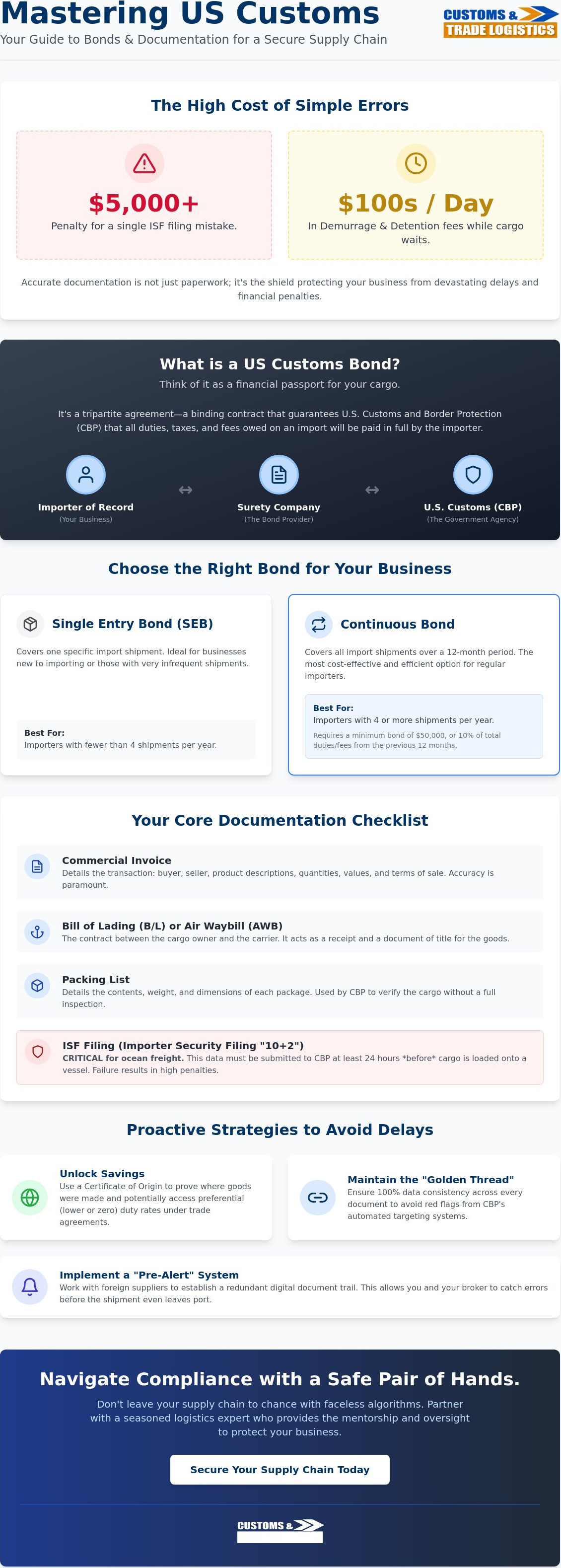
Choosing the right bond type depends on your shipping frequency and long-term goals. A Single Entry Bond (SEB) covers one specific shipment and is often used by occasional importers. However, if you plan on importing more than four times a year, the return on investment for a Continuous Bond is significant. The minimum amount for a continuous bond is $50,000, usually calculated at 10% of the total duties and fees you paid in the previous 12 months. Since the June 2026 Executive Order, enforcement has tightened, making it vital to have a customs clearance partner who can help you calculate these amounts accurately to avoid bond insufficiency flags.
The Importer Security Filing (ISF) 10+2 Rule
Timing is everything with the Importer Security Filing, or ISF. For ocean freight, you must submit 10 data elements to CBP at least 24 hours before the vessel departs from the foreign port. This filing provides the government with a digital footprint of who is shipping what and where it's coming from. CBP enforces a strict $5,000 fine for any ISF filing that is submitted late or contains inaccurate information. Missing this window doesn't just result in a fine; it often triggers intensive exams that can stall your supply chain for weeks.
The Commercial Invoice: More Than Just a Bill
Your Commercial Invoice is the primary record of transaction and valuation. It must include full descriptions, quantities, unit prices, and the correct currency for every item in the container. Most importantly, it needs the correct Harmonized System (HS) code to determine the duty rate. Errors here are the most common reason shipments get flagged for secondary inspections. Alongside this, your Bill of Lading (BOL) serves as the legal contract of carriage and title to the goods, while the Packing List acts as a roadmap for physical inspections. When these documents work in harmony, your cargo moves with the professional assurance your business deserves.
Specialized Requirements for Specific Goods and Origins
Not all cargo is treated equally when it crosses the border. While we've discussed the foundational paperwork, certain commodities require a deeper level of oversight from Partner Government Agencies (PGAs). If you're importing food, chemicals, or electronics, understanding us customs bond requirements involves more than just a financial guarantee; it requires specific certifications that prove your goods are safe and legal. These additional layers of documentation act as a protective shield for both your business and the American consumer.
For instance, a Certificate of Origin is your key to unlocking preferential duty rates under trade agreements like the USMCA. Without this specific form, you might end up paying standard duty rates on goods that should be duty-free. Similarly, if you're moving agricultural products or plants, you'll need Phytosanitary or Health Certificates to satisfy USDA and FDA regulations. For those in the industrial sector, Toxic Substances Control Act (TSCA) statements are mandatory for chemicals and many plastics to ensure environmental compliance. Managing these specialized requirements is where a seasoned mentor's oversight becomes invaluable, preventing your shipment from being sidelined by a regulatory technicality.
Importing from China: The Documentation Nuances
Documentation and Bonds for Amazon FBA Sellers
Selling on Amazon FBA presents a unique set of challenges regarding the Importer of Record (IOR) status. It's a common misconception that Amazon will act as the IOR for your shipments; they won't. You, as the seller, must act as the IOR and maintain the necessary customs bond. Amazon typically acts only as the Ultimate Consignee, meaning they're the final destination but carry no legal responsibility for the entry. This distinction is vital because if your paperwork lists Amazon as the IOR, the shipment will be rejected at the port. Additionally, your labeling and shipping manifests must match perfectly to avoid redistribution delays. Having a safe pair of hands to guide you through these FBA-specific hurdles ensures your inventory reaches the warehouse without costly detours.
Managing the Chain: Best Practices to Avoid Customs Delays
How do you stop a delay before it starts? While understanding us customs bond requirements provides the financial foundation for your imports, the daily management of your documentation determines the actual speed of your supply chain. Proactive management is the difference between a seamless delivery and a container stuck in a terminal for weeks. We recommend establishing a robust Pre-Alert system with your foreign suppliers. This ensures that every document is in your hands the moment the cargo leaves the factory floor, not days after it hits the water.
A critical benchmark we follow is the 72-hour rule. You should aim to have all your documents finalized and reviewed at least 72 hours before the vessel reaches the pilot station. Waiting until the ship is docking is a recipe for disaster. During this window, perform a quick cross-reference check between the Bill of Lading, the Commercial Invoice, and the Packing List. Are the quantities identical? Does the weight match? Mathematical errors are low-hanging fruit for customs officials looking to flag a shipment for a secondary exam. Regular audits of your Harmonized Tariff Schedule (HTS) classifications also ensure that your duty payments remain accurate and compliant with the latest regulations.
The Power of Digital Logistics Management
The days of relying solely on physical paper are over. Utilizing Electronic Data Interchange (EDI) between your international freight logistics partner and the carriers speeds up the flow of information significantly. This digital approach facilitates Remote Location Filing (RLF), allowing your broker to file entries at any U.S. port from a single centralized office. We highly recommend using searchable PDF formats for all customs submittals to allow for AI-assisted auditing and faster retrieval during a government inquiry.
Working with Your Supplier on Document Quality
Your suppliers are your partners, but they may not always be experts in U.S. compliance. You can act as a seasoned mentor by providing them with pre-approved templates that meet all U.S. Customs standards. Ensure that all descriptive fields are translated into clear English and that the "Sold To" and "Ship To" parties are identified with pinpoint accuracy. By maintaining a redundant, cloud-based document trail, you ensure that even if a physical copy is lost, your "safe pair of hands" has everything needed to keep the goods moving. If you need help refining these processes, our team specializes in customs clearance services that take the administrative weight off your shoulders.
Navigating Compliance with a Professional Partner
How do you maintain peace of mind when the rules are constantly shifting? In the wake of the June 3, 2026 Executive Order, which tightened enforcement and increased vetting requirements for all importers, the stakes for international trade have never been higher. Understanding us customs bond requirements is only the beginning of a secure operation. True security comes from having a seasoned partner who has seen every possible scenario over 35+ years of industry experience. We act as your dedicated advocate, standing between your business and the threat of unfair fines, seizures, or administrative delays that can paralyze your growth.
The Customs Brokerage Advantage
Your Next Steps in Global Trade
Are you ready to secure your supply chain and move forward with confidence? Your next move should be a comprehensive logistics health check on your current documentation and bond sufficiency. This is especially vital if you're preparing for your first major import from China or scaling your Amazon FBA operations in an increasingly regulated market. By auditing your HTS codes and verifying your bond limits now, you prevent the friction that stops most importers in their tracks. We're ready to guide you through every step of this journey. Let Customs and Trade Logistics manage your international shipping chain today.
Take Command of Your International Supply Chain
Managing a global business means staying one step ahead of the paperwork that keeps your cargo moving. You've seen how accurate documentation and proactive timing, like the 72-hour rule, prevent expensive terminal fees and secondary exams. By understanding us customs bond requirements and maintaining a digital document trail, you transform your logistics from a source of anxiety into a competitive advantage.
You don't have to carry this administrative burden alone. With 35+ years of industry expertise and a specialized focus on complex China-to-US import logistics, our family-owned team is here to be your dedicated mentor. We provide the personalized oversight and protective care that faceless digital platforms simply can't match. It's time to replace confusion with professional assurance and keep your supply chain moving without friction.
Ready to secure your next shipment? Request a Professional Logistics Consultation today and let us handle the complexities of compliance for you. Your growth is our priority, and we're excited to help you navigate the global marketplace with total confidence.
Frequently Asked Questions
What is the most important document for international shipping?
The Commercial Invoice is the most vital document in your shipping chain. It serves as the primary record for valuation, commodity description, and country of origin. CBP uses this data to determine how much duty you owe. Without a precise invoice, your goods cannot be legally entered into U.S. commerce. It's the document that supports the financial guarantee provided by your customs bond.
Can I file my own customs documentation as a small business?
You are legally allowed to file your own documentation, but most small businesses find the process overwhelming. Acting as your own broker requires deep knowledge of the Harmonized Tariff Schedule and federal regulations. A single mistake in understanding us customs bond requirements or filing data can lead to expensive penalties. Partnering with a professional advocate ensures your compliance is handled with the protective care your business deserves.
What happens if my international shipping documents have an error?
Paperwork errors typically result in your cargo being flagged for an intensive examination. These exams are expensive and time-consuming, often resulting in daily storage fees at the terminal. If the error is significant, CBP may also assess liquidated damages against your customs bond. This is why cross-referencing your Bill of Lading and Commercial Invoice before the ship sails is a critical best practice for every importer.
How long should I keep copies of my international shipping records?
You must maintain all international shipping records for a minimum of five years from the date of entry. This requirement includes your Commercial Invoice, Packing List, and any specialized certificates or licenses. Keeping a redundant, cloud-based digital trail is the best way to ensure you're prepared for a government audit. Failure to produce these records when requested can lead to substantial fines and increased scrutiny of your future shipments.
What is an HS code and why is it required on my invoice?
An HS code, or Harmonized System code, is a universal numerical number used to classify your products. It's required because it tells the government exactly what you're importing so they can apply the correct duty rate. Using an incorrect code can lead to underpayment of duties, which triggers audits, or overpayment, which hurts your bottom line. Accurate classification is a cornerstone of strategic logistics management.
Do I need a different customs bond for air freight vs. ocean freight?
What is a Pro Forma invoice and can I use it for customs entry?
A Pro Forma invoice is a preliminary document and isn't acceptable for a final customs entry. While it's useful for arranging prepayments or obtaining import licenses, CBP requires a formal Commercial Invoice for the actual clearance process. The final invoice must reflect the actual transaction value and specific details of the goods being shipped. Using a Pro Forma for entry can lead to valuation disputes and delays.


