
Did you know that as of June 2026, the era of treating international shipping as a simple click and ship process is officially over? With the signing of Executive Order 14411, the government has made it clear that importing is now a privilege reserved for those who can prove their systemic accountability. This Complete guide to Customs and Trade Logistics is designed to help you navigate these high stakes with the assurance of a seasoned partner.
It's completely normal to feel overwhelmed by the suspension of the $800 de minimis threshold or the confusion surrounding new HTS code scrutiny. You've worked hard to build your business, and the last thing you need is a shipment seized at the port or a surprise penalty eating into your margins. We understand that managing multiple vendors while staying compliant feels like a heavy administrative burden that shouldn't fall on your shoulders alone.
Our goal is to act as your dedicated advocate, turning that anxiety into a sense of total security. This expert roadmap provides a step-by-step understanding of the import process, from mastering customs clearance to optimizing freight forwarding. We'll show you how to lower your logistics costs through better coordination and ensure your supply chain remains rock solid in this new regulatory environment.
Key Takeaways
- Identify the three essential pillars of the importer’s ecosystem to create a stable and predictable flow for your goods.
- Compare the distinct roles of customs brokers and freight forwarders to determine how a hybrid support model can streamline your operations.
- Gain actionable strategies for managing the China-to-US pipeline, specifically focusing on Section 301 tariffs and modern enforcement shifts.
- Master the documentation process by reviewing this Complete guide to Customs and Trade Logistics to avoid the top five errors that frequently trigger costly audits.
- Discover why partnering with a seasoned, family-oriented mentor provides the administrative relief and security that digital-only platforms often lack.
Demystifying US Customs and Trade Logistics: The Importer’s Ecosystem
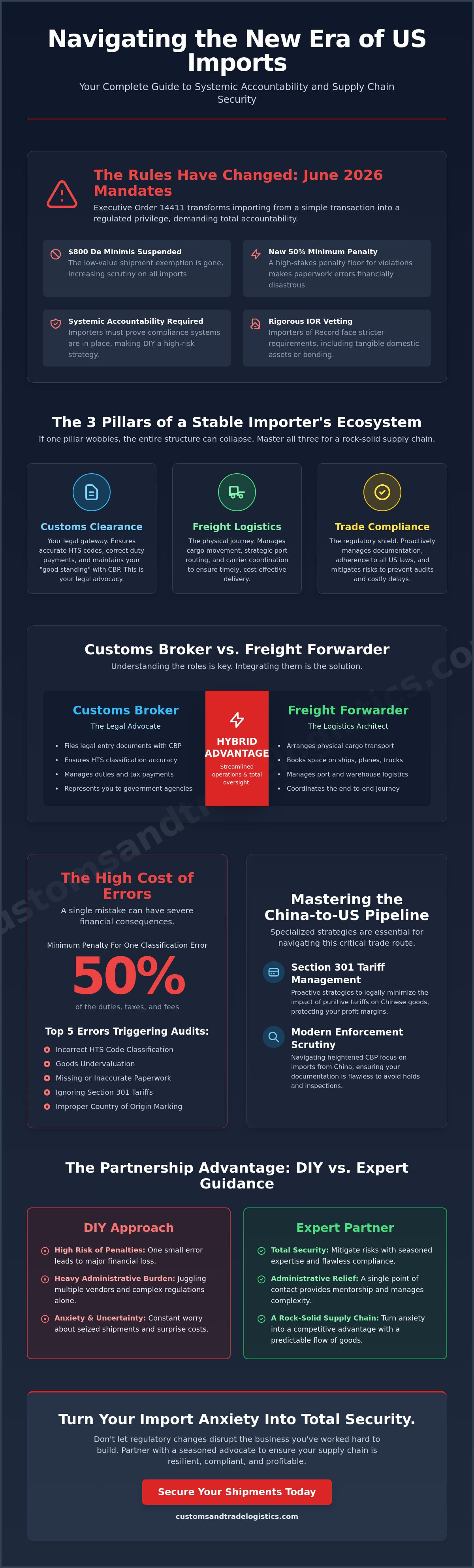
Think of your import business as a living ecosystem. It isn't just a series of boxes moving across an ocean; it's a delicate balance between three essential pillars: Customs Clearance, Freight Logistics, and Trade Compliance. If one pillar wobbles, the entire structure can collapse. This Complete guide to Customs and Trade Logistics helps you build a foundation that won't crack under the pressure of shifting global regulations. Right now, the shift from simple transportation to integrated supply chain management means you need oversight at every stage, from the factory floor in Ningbo to your warehouse door in New Jersey.
The landscape changed significantly on June 3, 2026, with the signing of Executive Order 14411. US Customs and Border Protection (CBP) no longer views importing as a right. It's a privilege. The government now demands systemic accountability, including new requirements for Importers of Record to maintain tangible domestic assets or bonding. Trying a "DIY" approach to customs entry in this environment is a high-risk strategy. With a new minimum penalty floor of 50% for violations and the total suspension of de minimis exemptions, one small paperwork error can lead to a financial disaster that stalls your growth. You need a safe pair of hands to manage these complexities while you focus on scaling your brand.
The Key Players in Your Shipping Chain
- The Customs Broker: Your legal advocate. They don't just file papers; they ensure your HTS codes are accurate and your duties are paid correctly to keep you in "good standing" with the CBP.
- The Freight Forwarder: The architect of your cargo’s journey. They coordinate the physical movement of goods across borders, managing the space on ships and planes to ensure your inventory arrives when you need it.
- The Importer of Record (IOR): This is usually you. As the IOR, you're legally responsible for ensuring all goods comply with US laws. Under the 2026 mandates, your vetting is more rigorous than ever, making professional partnership a necessity rather than a luxury.
Why Logistics Expertise is Your Competitive Advantage
Have you ever looked at your "landed cost" and wondered why it’s so high? Professional logistics management isn't just about moving boxes; it's about strategic port routing. By choosing the right entry point, you can bypass the hidden costs of port congestion and those dreaded daily storage fees that eat your profits. Expertise also acts as a shield against "Customs Holds." When your documentation is perfect and your compliance history is clean, your shipments spend less time under inspection and more time in your customers' hands. In this Complete guide to Customs and Trade Logistics, we emphasize that oversight is the difference between a thriving supply chain and a series of expensive delays.
Customs Brokerage vs. Freight Forwarding: Choosing the Right Support
Are you wondering whether you need a customs broker or a freight forwarder? It's a question we hear often, and the answer is rarely an "either-or" choice. In the modern trade environment, the two roles are increasingly integrated. While a customs broker acts as your legal advocate before the government, the freight forwarder serves as the architect of your cargo’s physical journey. This Complete guide to Customs and Trade Logistics highlights why a hybrid approach is now the gold standard for businesses that want to avoid the administrative burden of managing multiple vendors. By 2026, digital documentation has become the baseline, but the real value lies in the human advisory that helps you interpret complex data.
When you evaluate service fees for a brokerage entry, you aren't just paying for data entry. You're paying for the mitigation of risk. A single error in classification can lead to a minimum penalty floor of 50% under the newest enforcement standards. Professional oversight ensures your business remains in "good standing" with the CBP, which is essential for continued operations. If you're feeling overwhelmed by these requirements, our customs clearance services provide the stabilizing force you need to keep your supply chain moving without interruption.
The Customs Broker’s Toolkit
The core of a broker's work is HTS Classification. This is the art and science of assigning the correct duty codes to your products. It requires deep industry literacy to ensure you aren't overpaying duties or, worse, underpaying and triggering an audit. Brokers also manage the Importer Security Filing (ISF), often called the "10+2" rule. This must be filed at least 24 hours before your goods are loaded onto a vessel. To stay compliant, you'll also need a customs bond. Whether you choose a continuous bond for high-volume shipping or a single-entry bond for occasional imports, your broker ensures the financial guarantees are in place. For more foundational advice, the CBP provides Tips for New Importers and Exporters that can help you understand these baseline requirements.
The Logistics Coordinator’s Role
Once the paperwork is in order, the physical logistics begin. This starts with managing the "Ocean Leg," which involves everything from container loading at the origin to monitoring the vessel's progress toward a US port. After arrival, the focus shifts to drayage and redistribution. This is the critical step of moving your goods from the pier to a warehouse or distribution center. A seasoned coordinator uses intermodal transport, combining sea, rail, and truck routes to maximize efficiency and lower your total landed cost. This Complete guide to Customs and Trade Logistics emphasizes that seamless coordination between the broker and the logistics team is what prevents your cargo from sitting idle at the port, racking up expensive storage fees.
The China-to-US Pipeline: Specialized Logistics for Modern Brands
Sourcing from China remains a cornerstone for US brands, but the "China-to-US pipeline" has become increasingly complex. It's no longer just about finding a reliable supplier; it's about surviving a gauntlet of enforcement actions. As of June 2026, Section 301 tariffs on Lists 3 and 4A remain firmly in place following recent Supreme Court decisions. This Complete guide to Customs and Trade Logistics helps you account for these significant costs before they sink your profit margins. With the suspension of the de minimis exemption that took effect in late 2025, even small, low-value shipments now face full scrutiny and duty requirements.
You don't have to face these hurdles alone. The shift from reactive enforcement to systemic accountability means that your documentation must be flawless before your cargo even touches a vessel. By coordinating quality control with logistics at the point of origin, you ensure that what you ordered is exactly what arrives at the pier. This proactive oversight is the stabilizing force that replaces shipping anxiety with a sense of security and partnership.
Logistics for Amazon and E-commerce Sellers
Many e-commerce brands fall for the "door-to-door" myth offered by overseas suppliers. While it sounds convenient, these arrangements often lack the oversight needed to handle US-specific compliance. If your shipment is seized because of an informal entry error, your supplier isn't the one facing the CBP. You are. You need an independent advocate to manage our delivery and redistribution services, which involve breaking down bulk imports for multi-location delivery to FBA centers. Planning is also vital. Between the annual Chinese New Year factory closures and the Q4 peak season, your logistics timeline needs to be set months in advance to avoid the "holiday bottleneck" that can leave your digital shelves empty.
China Import Consulting: Beyond the Paperwork
Our Import From China Consulting services go beyond just pushing paper. It starts with understanding your Incoterms. Do you know the real-world difference between "Ex Works" (EXW) and "Free on Board" (FOB)? Choosing the wrong term could leave you liable for costs and risks you aren't prepared to handle. We recommend verifying all supplier documentation before the goods leave the port. This approach identifies duty-saving opportunities and prevents the top paperwork errors that trigger audits. For a deeper dive into the legal requirements, the U.S. Customs and Border Protection's Guide for Commercial Importers remains the definitive resource for understanding entry procedures and compliance standards.
Avoiding Costly Mistakes: A Guide to Compliance and Paperwork
Mistakes in international trade are often the result of a simple lack of clarity, yet they carry heavy consequences. With the 2026 enforcement shifts, specifically the 50% minimum penalty floor for violations established by Executive Order 14411, precision in your documentation is no longer optional. This Complete guide to Customs and Trade Logistics advocates for a "mentorship" approach to compliance. Instead of just filing entries, we treat every shipment as a chance to refine your internal processes and build a stronger, more resilient supply chain.
What triggers a US Customs audit? It's usually one of the "Top 5" paperwork errors: inconsistent product descriptions, incorrect HTS codes, vague country of origin markings, mathematical errors on unit pricing, or missing manufacturer details. Managing your Bill of Lading and Commercial Invoice with extreme precision is the best way to prevent these red flags. If you do receive a Form 28 (Request for Information), don't panic. It's a standard inquiry, and with a knowledgeable partner, it's easily managed. To ensure your paperwork is audit-ready, you can rely on our customs clearance services to handle the heavy lifting.
The Power of Attorney (POA) in Customs
The Power of Attorney is the foundational document that grants your broker the legal authority to represent your business before US Customs. Without a properly executed POA, your broker cannot act on your behalf, which leads to immediate delays at the port. Once this legal authority is established, it streamlines the entire entry process, allowing your "safe pair of hands" to navigate the regulatory landscape with confidence and speed. It's a simple document that carries immense weight in your shipping ecosystem.
Valuation and Classification Pitfalls
HTS misclassification remains the most common cause of retroactive penalties and audits. It's tempting to look for a lower duty rate, but "undervaluing" goods or using an incorrect code to save money is a short-sighted strategy that always backfires. Under the 2026 standards, you must establish a "Reasonable Care" standard for your business. This means taking proactive steps to verify that your valuations are accurate and your classifications are legally sound. Remember, the CBP now expects you to demonstrate systemic accountability, and professional oversight is the most reliable way to prove you're a compliant and trustworthy importer.
Why a Family-Owned Partner is the Logical Choice for Your Supply Chain
The rise of digital-only platforms has promised a "one-click" solution for international shipping, but these tools often fail when the unexpected happens. In a field governed by shifting federal mandates and strict enforcement, you need more than an algorithm. You need a mentor. While this Complete guide to Customs and Trade Logistics provides the roadmap, the partner you choose to drive that journey determines your success. For small and medium-sized businesses, human intuition and 35 years of experience are the only real defenses against a volatile global market.
Customs and Trade Logistics acts as a "safe pair of hands" for your growing brand. We bridge the gap between your local operations and the vast global marketplace, offering a stabilizing force that lifts the administrative burden from your shoulders. Unlike large automated call centers where you're just a ticket number, a family-owned partner provides a boutique level of service. You gain national reach and professional oversight without losing the personal connection that's essential for a true partnership. It's time to move from being an overwhelmed importer to a confident, savvy global trader.
The Value of 35+ Years in the Industry
Think about the massive disruptions the shipping world has faced over the decades. We've guided clients through port strikes, global pandemics, and the major trade law overhauls of 2026. This longevity isn't just a number; it represents long-standing relationships with port authorities and a deep understanding of how to pivot when routes are blocked. When you call us, you aren't reaching a script-reader in a distant office. You're talking to a seasoned veteran who offers personalized consulting based on real-world problem-solving. We've seen the industry evolve, and we use that history to protect your business today.
Getting Started with Your Logistics Roadmap
Your journey toward a more efficient supply chain starts with a methodical plan. We begin with an initial consultation to assess your current shipping volume and identify your specific needs. From there, we guide you through the essential steps of setting up your Customs Bond and executing your Power of Attorney. These actions ensure that your business has the legal authority and financial guarantees required to move goods without delay. If you're ready to secure your supply chain, you can Contact Customs and Trade Logistics for a personalized import assessment. Let us help you master this Complete guide to Customs and Trade Logistics by putting our decades of expertise to work for your brand.
Ready to Secure Your Global Supply Chain?
The trade landscape of 2026 demands a higher level of diligence than ever before. By following this Complete guide to Customs and Trade Logistics, you've taken the first step toward transforming your import operations from a source of stress into a competitive advantage. You now understand that navigating Section 301 tariffs and the new Importer of Record requirements requires more than just software. It requires a dedicated advocate who understands the nuances of every US port.
Don't let the administrative burden of international trade slow your growth. With over 35 years of industry experience, our family-owned and operated team provides the personalized service and expertise in all US Customs ports that your business deserves. We're ready to act as your safe pair of hands, ensuring every shipment is a success. This level of care is what turns a complex process into a predictable journey.
Are you ready to trade with confidence? Let our family-owned team manage your next shipment and experience the relief of a truly professional partnership. Your future as a global trader is bright, and we're here to guide you every step of the way.
Frequently Asked Questions
What is the difference between a customs broker and a freight forwarder?
A customs broker is your legal representative before the CBP, focusing on compliance, duty payment, and classification. The freight forwarder acts as the logistics architect, managing the physical movement and space on vessels or planes. While their roles are distinct, this Complete guide to Customs and Trade Logistics emphasizes that they must work in tandem to ensure your goods move smoothly from the factory to your door. Most modern importers find that a partner who can bridge both worlds provides the most security.
How much does it cost to hire a customs broker for a single shipment?
Brokerage fees depend on several factors, including the complexity of the entry and the number of HTS lines involved. Most brokers charge a base entry fee for their services, with additional costs for items like customs bonds or specialized filings such as the ISF. Since every shipment is unique, it's best to request a quote based on your specific cargo and volume. This ensures you're paying for the exact level of oversight your business requires to stay compliant.
Do I need a customs broker if I am only importing small quantities for Amazon FBA?
Yes, you almost certainly do. The total suspension of the $800 de minimis threshold in August 2025 means that even small e-commerce shipments are now subject to formal or informal entry procedures. Amazon won't act as your Importer of Record, so you're legally responsible for all duties and taxes. A broker ensures your small shipments don't get stuck in a massive backlog at the port, which is vital for maintaining your Amazon seller rating.
What is an HTS code and how do I find the right one for my product?
The Harmonized Tariff Schedule (HTS) code is a ten-digit number used to determine the duty rates for your specific goods. Finding the right code involves analyzing the material, function, and use of your product. You can use the official HTS search tool provided by the government, but misclassification is a leading cause of penalties. We recommend having a seasoned professional verify your codes to ensure you're paying the correct amount and following the law.
How long does the customs clearance process typically take at US ports?
If your paperwork is perfect, customs clearance usually takes between 24 and 48 hours. However, this timeline can stretch if your shipment is flagged for an inspection or if there are issues with your customs bond. The process is much faster when your broker files the Importer Security Filing (ISF) and entry documents well before the ship arrives. Proactive planning is the best way to avoid the anxiety of a shipment sitting idle at the pier.
What happens if my shipment is flagged for a US Customs inspection?
If your cargo is flagged, it's moved to a Centralized Examination Station (CES) for a physical or X-ray scan. This process causes delays and results in additional costs for drayage and exam fees that the importer must pay. While inspections can happen at random, maintaining a clean compliance history and perfect documentation reduces your risk. We act as your advocate during these times, coordinating with the port to get your goods released as quickly as possible.
Can a customs broker help me reduce the duties I pay on imports from China?
A broker can help you identify legal duty-saving opportunities through accurate HTS classification and origin verification. This Complete guide to Customs and Trade Logistics highlights that while Section 301 tariffs remain a challenge, expert oversight ensures you aren't overpaying through simple clerical errors. We also help you navigate complex trade enforcement actions to find the most cost-effective path for your China-to-US supply chain. It's about paying exactly what you owe and not a penny more.
What is a Continuous Customs Bond and do I need one?
A Continuous Customs Bond is an annual financial guarantee that covers all your imports for a twelve-month period. You generally need one if you plan to import more than three or four times a year. It's more cost-effective than buying a Single Entry Bond for every shipment and significantly speeds up the clearance process. Having a continuous bond on file shows the CBP that you're a serious, committed importer, which helps build your reputation for systemic accountability.


