
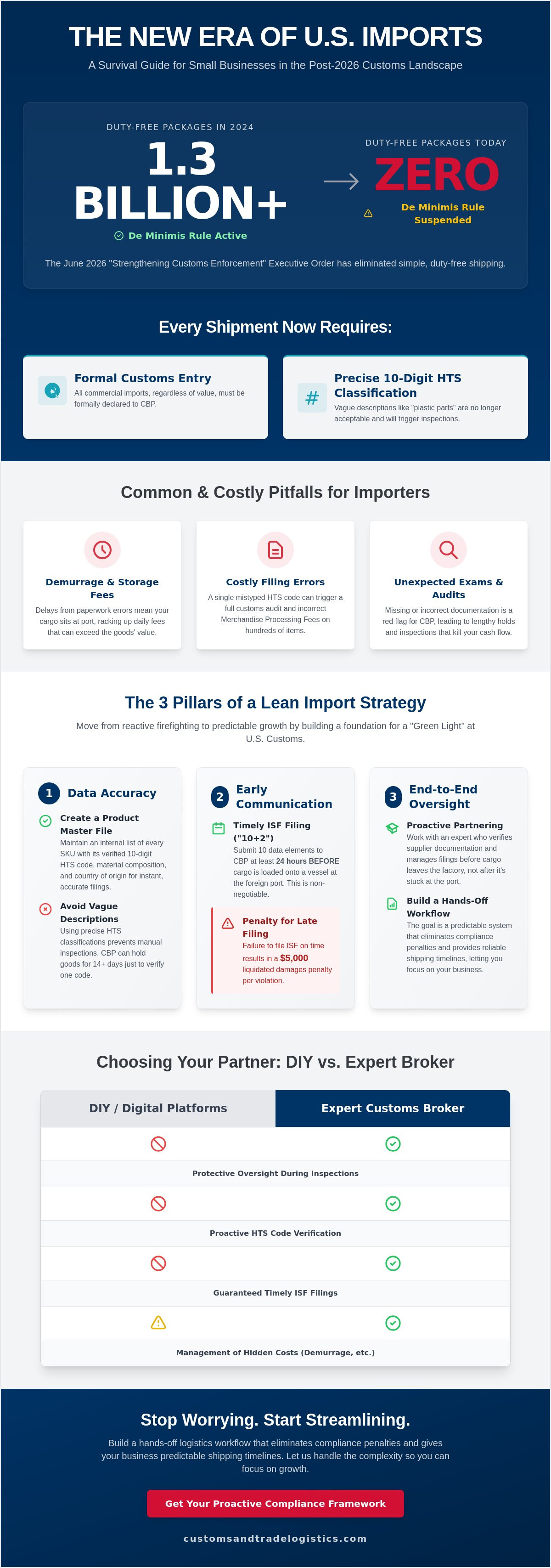
Did you know that in 2024, over 1.3 billion packages entered the U.S. duty-free, but as of today, that number has effectively dropped to zero? If you feel like the rules of international trade just shifted beneath your feet, you aren't alone. Between the total suspension of the de minimis threshold and the strict new requirements of the June 2026 "Strengthening Customs Enforcement" Executive Order, the days of simple, duty-free shipping are gone. Focusing on streamlining import logistics for small business is no longer just about saving time; it's about survival in an environment where every shipment now requires formal entry and precise 10-digit HTS classification.
We understand how overwhelming it feels to face rising Merchandise Processing Fees and the threat of costly demurrage when you just want to get your products to your customers. You deserve a partner who replaces that anxiety with a sense of security. This guide will show you how to master these new complexities with actionable strategies that reduce delays and cut unnecessary costs. We'll walk through a proactive compliance framework that transforms your shipping from a source of constant worry into a predictable, hands-off workflow that scales with your ambition.
Key Takeaways
- Identify the specific friction points, like incorrect valuations and missing paperwork, that lead to expensive port storage fees.
- Master the three pillars of a lean strategy, including how streamlining import logistics for small business requires perfect HTS code accuracy and early ISF filings.
- Evaluate the critical differences between self-service digital platforms and the protective oversight of an expert customs broker during inspections.
- Implement a methodical five-step audit process to verify supplier documentation before your cargo even begins its journey.
- Gain the tools to build a hands-off logistics workflow that eliminates compliance penalties and provides your business with predictable shipping timelines.
Why Import Logistics Feels Like a Bottleneck for Small Businesses
For many small business owners, the port isn't just a destination; it's a black hole where profits vanish. You've likely felt that spike of adrenaline when a shipment is flagged for an unexpected exam or when a simple paperwork error results in thousands of dollars in storage fees. We define streamlining import logistics for small business as the creation of a seamless, predictable path from your foreign supplier's factory floor to your customer's front door. It's about removing the friction that stops your growth and replaces it with a steady, manageable flow of goods.
Common friction points often start with missing paperwork or incorrect valuations. Since the suspension of the de minimis rule in August 2025, every commercial shipment now requires a formal entry and a precise 10-digit HTS classification. If your documentation doesn't match these strict 2026 requirements, your cargo sits. This leads to the hidden costs of un-streamlined logistics, specifically demurrage fees and exam costs. When a container stays at the port past its free time, the daily charges can quickly exceed the value of the goods inside. Effective logistics management ensures these hurdles are cleared before the ship even docks.
The High Cost of DIY Logistics
Handling your own customs entries might seem like a way to save money, but it often leads to expensive filing errors. A single mistyped HTS code can trigger a full customs audit or result in the minimum Merchandise Processing Fee of $33.58 being applied incorrectly across hundreds of line items. These delays don't just cost money; they kill your cash flow and leave your shelves empty. The administrative burden of international trade is the exhaustive hours spent deciphering federal regulations and managing document trails that pull a founder away from their core mission. It's a weight that no startup should carry alone.
The 2026 Landscape: New Challenges for Importers
The trade environment has changed significantly following the June 3, 2026 Executive Order titled "Strengthening Customs Enforcement." Port arrival times are more volatile due to heightened scrutiny and a move toward stricter enforcement of Import Security Filings (ISF). Because "just-in-time" inventory models are now highly vulnerable to these regulatory shifts, your business needs a robust strategy that accounts for longer lead times and more frequent documentation checks. Foreign Importers of Record face even tighter restrictions, making it vital to have a domestic partner who understands the new bonding and disclosure requirements. Success in this era requires moving from a reactive mindset to one of total oversight and preparation.
The Three Pillars of a Lean Import Strategy
Building a lean strategy isn't about working harder; it's about working smarter with the data you already have. To achieve a "green light" at U.S. Customs, you need a foundation built on three specific pillars: data accuracy, early communication, and end-to-end oversight. When these elements work in harmony, they ensure that by the time your vessel reaches the pier, the government already knows, classifies, and trusts your cargo. This proactive approach is the heart of streamlining import logistics for small business, moving you away from reactive firefighting and toward predictable growth.
Mastering Documentation and HTS Classification
The Harmonized Tariff Schedule (HTS) is the language of global trade. Every item you import has a specific 10-digit code that determines exactly how much duty you owe. If your commercial invoice uses vague descriptions like "plastic parts" instead of the precise HTS classification, you are essentially inviting a manual inspection. Customs and Border Protection (CBP) can hold non-compliant goods for 14 days or longer just to verify a single code. To avoid this, we recommend maintaining a "Product Master File." This internal document should list every SKU you import alongside its verified HTS code, material composition, and country of origin. Having this data ready allows for instant, accurate filings every time you order.
The Critical Role of ISF Filing
Communication must happen long before your goods touch the water. The Importer Security Filing, commonly known as "10+2," requires importers to provide ten data elements to CBP at least 24 hours before the cargo is loaded onto a vessel at the foreign port. Timing here is non-negotiable. If you file late, you face a $5,000 liquidated damages penalty per violation. Beyond the fine, late filings significantly increase the likelihood that your cargo will be flagged for an intensive (and expensive) exam upon arrival. A seasoned broker helps you avoid these pitfalls by integrating directly with your supplier's data to ensure the ISF is filed correctly and on time. For those looking for broader support, the U.S. Small Business Administration offers Export and trade assistance to help you understand the wider regulatory environment.
The final pillar is end-to-end oversight. Logistics doesn't end when the ship docks; it ends when the product is in your warehouse or your customer's hands. By coordinating your international freight logistics with domestic redistribution, you eliminate the "dead time" where cargo sits waiting for a truck. This level of coordination requires a partner who sees the whole journey. If you're tired of managing these moving parts alone, our team at Customs and Trade Logistics can act as your "safe pair of hands," ensuring every pillar of your strategy is rock solid.
Choosing Your Partner: Digital Platforms vs. Expert Brokers
How do you decide between a flashy digital dashboard and a seasoned expert? Many small business owners are drawn to the "self-service" model of massive digital freight forwarders because the interface looks simple. However, these platforms often treat your cargo as just another data point in an algorithm. When the reality of the pier doesn't match the data on your screen, an automated system won't pick up the phone to advocate for you. For a small business, a "safe pair of hands" isn't a luxury; it's the difference between a successful delivery and a shipment stuck in legal limbo.
A dedicated logistics consultant acts as a vital bridge between your overseas suppliers and U.S. Customs and Border Protection (CBP). They speak the technical language of both sides, ensuring that when a factory prepares your commercial invoice, it's already formatted for a smooth U.S. entry. This proactive coordination is what truly defines streamlining import logistics for small business in a high-stakes trade environment.
When Automation Isn’t Enough
Digital-only platforms often struggle during periods of volatility, such as port strikes or the sudden regulatory shifts we saw with the June 2026 Executive Order. If your goods require clearance from a Partner Government Agency (PGA), such as the FDA or the Department of Agriculture, the process becomes significantly more complex. Automation can't navigate the nuances of these specific regulations or handle the detailed disclosures now required for all importers. This is where the "mentor" advantage becomes clear. An expert partner doesn't just file your paperwork; they provide reliable advice on sourcing and shipping routes that help you stay ahead of the curve.
National Reach with a Personal Touch
Working with a broker who clears cargo at every port in the United States provides a level of flexibility that local-only agencies can't match. Whether your goods arrive in Long Beach, Savannah, or via air in Chicago, you shouldn't have to manage multiple relationships. With over 35 years of experience, a family-owned consultancy brings a level of problem-resolution speed that only comes from decades of working alongside CBP officers. We understand that small businesses need a partner who understands their specific growth scale. You aren't just a number in a database. You're a partner whose success is tied to our own. This personal connection is the missing ingredient in many strategies for streamlining import logistics for small business, providing the relief you need to focus on your customers.
5 Steps to Streamline Your Supply Chain from Factory to Door
Success in international trade isn't just about moving boxes; it's about moving information faster than the cargo itself. When you align your documentation with your physical supply chain, you eliminate the friction that causes costly delays. By following a methodical workflow, streamlining import logistics for small business becomes a repeatable process rather than a monthly crisis. Here is the five-step path we recommend for every shipment.
- Step 1: Pre-Shipment Audit. Don't wait for the cargo to reach the water. We verify all supplier paperwork, including commercial invoices and packing lists, against your HTS Product Master File before the goods leave the factory.
- Step 2: Coordinated Freight. Selecting the right path depends on your current inventory levels. We help you choose between the cost-efficiency of ocean freight or the speed of air freight to keep your budget in check.
- Step 3: Seamless Customs Entry. By submitting data electronically the moment the vessel departs, we aim for an "instant release" from CBP. This allows you to bypass the administrative "black hole" at the port.
- Step 4: Port-to-Door Transport. As soon as the container is discharged, a coordinated drayage team must be ready. This step ensures your cargo doesn't sit idle on the pier.
- Step 5: Redistribution. For many, the journey ends at a single warehouse. For others, it requires breaking down the shipment for multiple destinations or e-commerce fulfillment centers.
Special Focus: Amazon FBA and E-commerce Logistics
Importing directly to Amazon fulfillment centers presents a unique set of hurdles. Have you ever faced the "split shipment" headache where Amazon requires one container to be sent to three different states? This can be a logistical nightmare for a small business. Our redistribution services solve this by receiving your bulk shipment at a domestic hub, breaking it down, and labeling it according to Amazon’s strict requirements. We ensure your broker understands the specific delivery windows and palletizing rules that Amazon demands, preventing rejected shipments and costly "no-show" fees.
Optimizing the "Final Mile"
The journey isn't over until the goods are safely in your hands or your customer's warehouse. The handoff between the ocean carrier and the domestic trucker is where many small businesses lose time and money. We focus on reducing "dwell time" at the port. Every day a container sits on the pier past its "free time" results in escalating demurrage fees that eat your margin. By coordinating the final mile before the ship docks, we provide the relief of a predictable delivery schedule. If you are ready to remove the guesswork from your process, you can streamline your supply chain with our expert team today.
Navigating Global Trade with Customs and Trade Logistics
Does the thought of a customs audit keep you up at night? It shouldn't. As a family-owned firm with over 35 years of industry experience, we've seen every type of port disruption and regulatory overhaul. We don't just file papers; we provide the protective care your business needs to thrive in a global marketplace. By streamlining import logistics for small business, we ensure your goods move efficiently from the factory to the final destination without the typical headaches of DIY importing. Our team acts as your dedicated advocate, ensuring that your compliance is airtight and your costs are controlled.
Our comprehensive suite of services covers every critical link in your supply chain. We provide expert Customs Clearance Services to navigate the new 2026 enforcement standards, ensuring your HTS classifications are beyond reproach. Our International Freight Logistics team manages the movement of your cargo across oceans and borders, while our Import From China Consulting helps you manage the complexities of sourcing from one of the world’s largest manufacturing hubs. Finally, our Delivery and Redistribution Services ensure your products reach their final domestic destination, whether that’s an Amazon FBA center or a private warehouse. We provide total management from the moment your order is placed.
The transition from a chaotic shipping process to a "hands-off" workflow is a major milestone for any growing brand. It provides the peace of mind that comes from knowing a veteran is watching over your cargo. We believe that streamlining import logistics for small business is the foundation of long-term success. When you outsource the logistical heavy lifting, you reclaim the time needed to innovate and expand your market reach. You aren't just hiring a broker; you're gaining a mentor who is deeply invested in your company's journey.
A Reliable Partner for Growing Brands
We handle the end-to-end international shipping chain so you don't have to. This isn't just about moving freight; it's about demystifying the rules that govern trade. We take the time to explain the "why" behind new bonding requirements or HTS changes, acting as a knowledgeable bridge between your operations and the global market. You deserve a partner who values your growth as much as you do. If you're ready to simplify your operations and secure your supply chain, we invite you to Contact us for a logistics consultation today.
Master Your Logistics and Scale with Confidence
Are you ready to move past the anxiety of port delays and unexpected customs fees? Mastering the complexities of 2026 trade regulations starts with a commitment to data accuracy and proactive communication. By implementing the three pillars of a lean strategy and following a methodical five-step workflow, you transform your supply chain from a bottleneck into a competitive advantage. You don't have to navigate these shifting tides alone. Focusing on streamlining import logistics for small business allows you to reclaim your time and focus on what you do best: building your brand.
With over 35 years of industry experience and national coverage across all US Customs ports, we act as a stabilizing force for your operations. Whether you are navigating the nuances of China-to-US imports or managing the strict requirements of Amazon FBA, we provide the expert oversight you need. It's time to lift the administrative burden of international trade off your shoulders. Let Customs and Trade Logistics manage your next shipment and experience the relief of a truly predictable workflow. Your business is ready for the global stage; let's ensure your cargo is too.
Frequently Asked Questions
What is the most common reason for customs delays for small businesses?
Missing or inaccurate documentation is the primary cause of port delays. Since the de minimis suspension in August 2025, every commercial item now requires a formal entry and a 10-digit HTS code. If your commercial invoice doesn't match the physical cargo exactly, Customs and Border Protection will hold the shipment for an intensive exam, which can add weeks to your timeline.
How much does a customs broker typically charge for import services?
Brokerage costs are generally structured around the complexity of the entry and the number of HTS lines involved. Fees typically include a base entry charge, a bond fee, and government processing costs like the Merchandise Processing Fee. Because every business has different needs, it's best to discuss your specific volume and product types to get an accurate estimate for your operations.
Can I import from China to the US without a customs broker?
You can legally file your own entries, but it's rarely recommended for commercial shipments due to the high risk of errors. The June 2026 "Strengthening Customs Enforcement" Executive Order increased the bonding and disclosure requirements for all importers. Most small businesses find that the threat of a $5,000 ISF fine or a seized shipment far outweighs the cost of professional brokerage expertise.
How do I choose the right HTS code for my imported products?
Choosing the correct code requires applying the Harmonized Tariff Schedule's General Rules of Interpretation to your specific product materials and functions. Even a slight error in how you describe a "plastic part" versus a "machine component" can lead to higher duty rates or audits. Professional classification is a vital step in streamlining import logistics for small business and ensuring long-term compliance.
What is an ISF filing and when must it be completed?
The Importer Security Filing (ISF), also known as "10+2," is a mandatory document for all ocean freight entering the United States. You must submit this data to customs at least 24 hours before your goods are loaded onto the vessel at the foreign port. Late filings result in automatic liquidated damages and significantly increase the likelihood of your cargo being flagged for an expensive inspection.
How can Amazon sellers streamline their international import process?
Amazon sellers can simplify their workflow by using redistribution services to manage the "split shipment" requirements of FBA fulfillment centers. Instead of shipping multiple small parcels from overseas, you send one bulk container to a domestic hub. We then break down the shipment and label it to meet Amazon's strict requirements, which helps in streamlining import logistics for small business by reducing total freight costs.
What is the difference between a freight forwarder and a customs broker?
A freight forwarder organizes the physical transportation of your cargo, while a customs broker manages the legal entry of those goods into the country. Think of the forwarder as the travel agent for your products and the broker as the expert advocate who clears you through the border. Many growing brands prefer a partner who can coordinate both roles to ensure a seamless handoff between the ship and the warehouse.
How can I avoid demurrage and detention fees at US ports?
Avoiding these storage fees requires you to coordinate your drayage team and clear customs before the ship even docks. Demurrage starts the moment your "free time" at the pier expires, which can happen in as little as two days. By ensuring your paperwork is submitted early and your trucker is scheduled for the first available appointment, you keep your cargo moving and protect your profit margins.


