
What if your biggest barrier to expansion isn't your sales volume, but the very logistics chain you're using to fulfill it? Since the June 3, 2026, Executive Order overhauled customs enforcement, scaling import logistics for business growth has become a high-stakes game of precision. It's no longer just about finding the cheapest boat; it's about protecting your "good standing" as an importer in a world of suspended de minimis thresholds and the 10% Section 122 global surcharge.
We understand the anxiety that comes with these growing pains. It's frustrating to see your margins hit by the 0.3464% Merchandise Processing Fee or to feel the weight of stricter bonding requirements as your volume increases. You've worked hard to build your brand, and you shouldn't have to fear a CBP audit every time you add a new supplier from China. This guide will show you how to transition from reactive shipping to a high-volume, compliant logistics engine. You'll learn how to manage multiple vendors efficiently and automate your processes to ensure a predictable, cost-effective path to the global marketplace.
Key Takeaways
- Identify the specific operational bottlenecks that cause small-scale shipping processes to fail as your order volume increases.
- Learn how to meet the "Reasonable Care" standard to maintain total regulatory compliance and protect your business from CBP audits.
- Discover how moving from transactional shipping to a strategic freight model is vital for scaling import logistics for business growth.
- Master the use of continuous customs bonds and landed cost forecasting to stabilize your cash flow and lower per-unit logistics expenses.
- Understand how a seasoned logistics partner acts as a "safe pair of hands" to manage complex, high-volume inventory movements safely.
Identifying the Logistical Bottlenecks in Your Growth Strategy
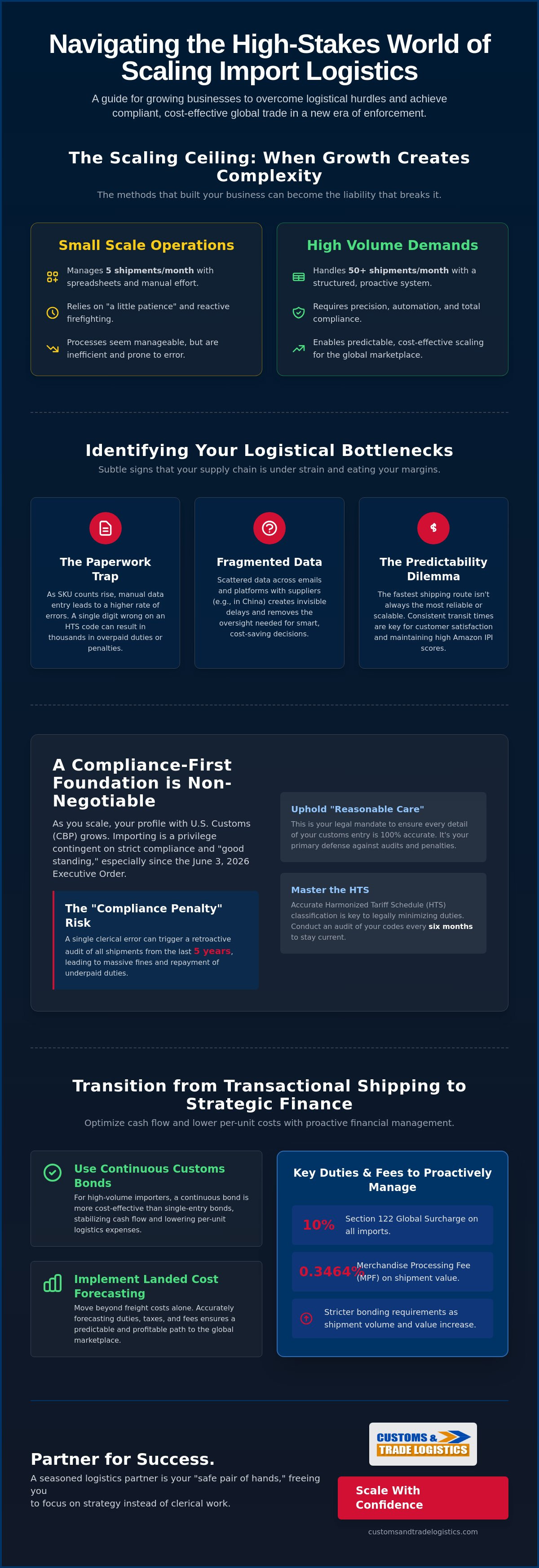
Have you ever noticed that the shipping methods that worked when you started are now causing more headaches than they solve? It's a common phenomenon we call the "Scaling Ceiling." When you're managing five shipments a month, a spreadsheet and a little patience might get the job done. However, once you hit 50 shipments, that same approach becomes a liability. Successfully scaling import logistics for business growth requires moving away from reactive firefighting and toward a structured, proactive system.
Signs of a bottleneck are often subtle at first. You might notice hidden costs creeping into your invoices or find that product launches are delayed because goods are stuck in a port. If you're still handling customs entries yourself, you're playing a risky game. High-volume inventory demands precision. Fragmented communication with suppliers in China often creates invisible delays that eat your margins before the goods even reach the water. When your data is scattered across different emails and platforms, you lose the oversight needed to make smart, cost-saving decisions.
The Paperwork Trap: When Documentation Becomes a Full-Time Job
Are you spending more time on data entry than on growing your brand? As your SKU count rises, manual entry leads to a higher rate of errors. A single digit wrong on an HTS classification can result in thousands of dollars in overpaid duties or, worse, a penalty for underpayment. Transitioning from scattered spreadsheets to an integrated system for logistics management isn't just a luxury; it's a necessity for survival. It ensures that every document is accurate, compliant, and ready for the scrutiny of CBP. This shift frees your team to focus on strategy rather than clerical work.
Predictability vs. Speed: The Importer’s Dilemma
It's tempting to always choose the fastest route to get stock on shelves. But is the fastest route the most scalable? Often, the answer is no. Speed often comes with higher costs and less reliability. Building buffer time into your supply chain allows you to absorb the shocks of port congestion or weather delays without missing a beat. For e-commerce sellers, consistent transit times are the secret to maintaining high Amazon IPI scores. When your logistics are predictable, your business remains healthy, and your customers stay happy. Scaling import logistics for business growth is about creating a rhythm that your team can rely on every single day.
Building a Compliance-First Foundation for Higher Import Volumes
As your business expands, your profile with U.S. Customs and Border Protection (CBP) changes. You're no longer an occasional importer; you're a high-volume participant in the global supply chain. This shift brings increased scrutiny. The executive order issued on June 3, 2026, made it clear that importing is a privilege contingent on strict compliance and "good standing." When you're scaling import logistics for business growth, your foundation must be built on "Reasonable Care." This isn't just an industry term; it's your legal mandate to ensure every detail of your entry is 100% accurate.
If you treat compliance as an afterthought, you risk the "Compliance Penalty." A single clerical error on a high-volume SKU doesn't just result in one fine. It can trigger a retroactive audit of every shipment you've made over the last five years. Imagine the financial strain of repaying half a decade of underpaid duties plus interest and penalties. To avoid this, you need a record-keeping system that grows with you. Aligning your internal processes with the standards discussed in the National Freight Strategic Plan helps ensure your operations stay resilient against shifting federal requirements.
Mastering the Harmonized Tariff Schedule (HTS)
Choosing an HTS code that's "close enough" is a dangerous gamble when you're moving thousands of units. Accurate HTS classification acts as the primary lever for legally minimizing your duty spend while insulating your business from costly miscalculation penalties. You should conduct a periodic audit of your classifications every six months. This ensures you're using the latest HTS Revision 10 updates and taking advantage of any new duty-saving opportunities or exemptions that might apply to your specific goods.
The Power of Attorney (POA) and Your Broker Relationship
Signing a Power of Attorney (POA) is a significant step; it's the moment you appoint a "safe pair of hands" to represent your business to the federal government. You need a partner who understands the nuances of your specific commodities and can navigate the complexities of the June 2026 bonding requirements. Utilizing a single-broker strategy for national port coverage provides a unified view of your data, making it much easier to defend your business during a spot check. Partnering with a dedicated team for customs clearance services ensures your growth doesn't trigger unnecessary red flags. A seasoned broker doesn't just file paperwork; they act as a diligent advocate for your brand's longevity.
Transitioning from Transactional Shipping to Strategic Freight Coordination
Are you still treating every shipment as a separate transaction? When you're first starting, booking a one-off freight quote feels like the right move. However, scaling import logistics for business growth requires a shift toward strategic coordination. Transactional shipping is reactive; it leaves you at the mercy of daily market fluctuations. Strategic coordination looks at the big picture, aligning your inventory needs with a predictable transport schedule. It turns your supply chain from a cost center into a competitive advantage.
You might wonder if a digital freight forwarder is the right fit for your expansion. While automated platforms offer sleek interfaces, they often struggle with the nuances of high-volume growth. A traditional logistics consultant provides something an algorithm can't: a deep understanding of your business's specific needs. They act as a seasoned mentor, helping you move from Less than Container Load (LCL) shipments to Full Container Load (FCL) strategies. This transition is a major milestone. By consolidating goods from multiple suppliers in China into a single FCL, you significantly reduce your per-unit costs and minimize the risk of damage during handling. It's a cleaner, more efficient way to move inventory.
For high-volume Amazon FBA sellers, door-to-door logistics is no longer optional. It's the only way to maintain the speed and reliability your account health depends on. Managing the entire journey from the factory floor to the fulfillment center ensures that nothing falls through the cracks. It provides the oversight needed to keep your shelves stocked and your IPI scores high.
The Human Element in a Digital Trade World
What happens when a vessel omits your scheduled port or a strike halts operations? In these moments, an algorithm won't pick up the phone to find a solution. Having a seasoned advocate in your corner is invaluable, especially when a shipment is flagged for a customs exam. Personal relationships with carriers often mean the difference between getting left on the dock and receiving priority during peak seasons. These connections provide a sense of security that technology simply can't replicate. We believe that a "safe pair of hands" is worth more than any piece of software when your cargo is on the line.
Redistribution and Delivery: The Final Leg of Scaling
The journey doesn't end when the ship docks. Managing the transition from the port to your final warehouse is where many businesses face their steepest costs. Coordinating the "last mile" requires precision to avoid expensive demurrage and detention fees. This is where professional delivery and redistribution services become your secret weapon. By streamlining this final leg, you ensure that your inventory is ready for sale exactly when you need it. This methodical approach concludes the journey with total resolution and peace of mind, allowing you to focus on the next phase of your expansion.
Financial Optimization: Managing Duties and Cash Flow at Scale
How do you ensure your bank account stays as healthy as your sales figures? Scaling import logistics for business growth means your financial stakes are higher than ever. A small miscalculation in your landed cost forecast can turn a profitable product launch into a deficit when you're ordering thousands of units. Before you sign off on a massive purchase order, you must account for the current 10% Section 122 global surcharge and the updated Merchandise Processing Fee (MPF) of 0.3464%. These costs, alongside freight and insurance, determine your true bottom line.
Continuous Customs Bonds are a vital tool for the growing importer. Unlike single-entry bonds that require a separate fee and repetitive paperwork for every shipment, a continuous bond covers all your entries for a full year. It reduces per-shipment friction and signals to CBP that you're a serious, established player in the market. Duty drawback allows you to recover up to 99% of duties paid on imported merchandise that is later exported or destroyed. For businesses utilizing our Import From China Consulting, navigating the ongoing Section 301 tariffs requires a proactive approach to sourcing and valuation to keep your margins viable as you expand.
Duty Management Strategies for Growing Margins
It's vital to understand the difference between the estimated duties you pay at the time of entry and the final liquidation by CBP. Liquidation is the official closing of the entry, and it's the moment your duty liability is truly finalized. To lower your tax base, you might explore "First Sale" valuation. This strategy allows you to base the duty on the price paid by a middleman to the manufacturer rather than the price you pay to that middleman. This method requires total financial transparency and meticulous reporting, but the savings for high-volume importers can be substantial.
Protecting Your Capital with Cargo Insurance
Don't assume your goods are safe just because you've hired a reputable carrier. Standard carrier liability is often limited to a small dollar amount per pound or package, which is never enough when your entire season's inventory is on a single vessel. Cargo insurance provides the security you need during high-value growth phases. It acts as a safety net, ensuring that a single maritime accident or port delay doesn't wipe out your business capital. Integrating insurance into your standard logistics workflow is a hallmark of a mature, scaled operation.
If you're ready to stabilize your supply chain costs and protect your margins, reach out to us for expert international freight logistics and personalized financial guidance.
Partnering for Success: How Expert Brokerage Fuels Business Expansion
Choosing the right partner is the final and most critical step in scaling import logistics for business growth. At Customs and Trade Logistics, we've spent over 35 years acting as a seasoned mentor for businesses making the leap from local operations to global players. As a family-owned firm, we don't just see you as an account number. We provide the "safe pair of hands" your inventory requires, offering the protective care and diligent oversight that only decades of experience can produce. We specialize in simplifying the complex, turning what feels like an intimidating wall of regulations into a clear, manageable roadmap for expansion.
From China to Your Customer: A Seamless Journey
Many of the brands we support are high-volume Amazon sellers who rely heavily on our Import From China Consulting. We understand the specific hurdles of the China-to-US supply chain, from navigating factory holidays to meeting strict FBA labeling requirements. We take the heavy administrative lifting off your shoulders, managing the documentation and carrier coordination so you can focus on what you do best: selling. We've helped numerous small sellers transition into high-volume importers by replacing their manual, error-prone processes with automated, compliant systems that never miss a beat.
Getting Started with a Strategic Growth Audit
The first step to partnering with Customs and Trade Logistics is a comprehensive look at your current operations. During your initial consultation, we'll review your HTS classifications, bonding status, and landed cost models to identify immediate opportunities for savings and risk reduction. We believe that scaling import logistics for business growth should feel like a partnership, not a burden. We're here to demystify the industry and provide the professional assurance you need to reach the next level. Scaling your business starts with a conversation.
Securing Your Supply Chain for the Long Haul
Transitioning from a small operation to a high-volume enterprise is a milestone to celebrate, but it requires a fundamental shift in how you handle your inventory. You've learned that identifying bottlenecks and moving from transactional shipping to strategic coordination are essential steps for long-term stability. By building a compliance-first foundation, you protect your business from audits while optimizing your cash flow through smarter duty management. Scaling import logistics for business growth doesn't have to be an overwhelming burden when you have the right support in place.
At Customs and Trade Logistics, we're a family-owned and operated firm that has spent over 35 years acting as a "safe pair of hands" for growing brands. We offer national coverage across all US Customs ports and possess specialized expertise in China-to-US logistics to ensure your goods move seamlessly. Let our 35 years of expertise scale your import logistics; contact us today to start your growth audit. We're ready to help you turn your logistical challenges into a clear path for expansion.
Frequently Asked Questions
How do I know when it is time to switch from a shipping app to a customs broker?
You should switch when your administrative burden begins to interfere with your daily sales operations or when your shipment complexity rises. While apps handle simple labels, a broker manages the legal "Reasonable Care" standards required as you expand. If you are experiencing frequent customs delays or struggling to find the correct HTS codes, it's time for the professional oversight of a dedicated partner.
What are the biggest risks of scaling my import volume too quickly?
The biggest risks include triggering a retroactive CBP audit due to documentation errors and suffering a severe cash flow crunch from unexpected fees. Rapid expansion often exposes weaknesses in manual data entry, leading to expensive penalties. Without a "safe pair of hands" to manage the increased volume, you might find your margins erased by port storage fees and unpredictable shipping delays.
Can a customs broker help me reduce the duties I pay on imports from China?
Yes, an expert broker identifies legal avenues like "First Sale" valuation and duty drawback to lower your overall tax base. By ensuring your HTS classifications are precise, we prevent you from overpaying the 10% Section 122 surcharge or Section 301 tariffs. This financial optimization is a core component of scaling import logistics for business growth and protecting your bottom line.
Do I need a different customs bond as my business grows?
You will likely need to transition from single-entry bonds to a Continuous Customs Bond. A continuous bond covers all your entries for a full year and is much more cost-effective as your shipment frequency increases. It also streamlines the clearance process, allowing your goods to move through the port without the friction of bonding each individual load every time you ship.
How does scaling import logistics affect my Amazon FBA inventory management?
Scaling your logistics ensures your Amazon IPI scores remain healthy by providing predictable, door-to-door delivery times. When you move from LCL to FCL strategies, you gain better control over your stock levels and reduce the risk of stockouts during peak seasons. This consistency is vital for maintaining your "Buy Box" eligibility and keeping your customers happy as your sales volume expands.
What is the most common mistake businesses make when scaling their international shipping?
The most common mistake is treating logistics as a series of isolated transactions rather than a unified strategy. Many businesses focus solely on the lowest freight quote, ignoring the hidden costs of compliance errors and port delays. Successfully scaling import logistics for business growth requires a shift toward a proactive, compliance-led infrastructure that values long-term reliability over the cheapest possible boat.
How do I manage logistics if I am importing from multiple suppliers simultaneously?
You can manage multiple suppliers by utilizing buyer's consolidation services to combine various orders into a single Full Container Load (FCL). This approach simplifies your paperwork, as you clear one large shipment instead of several small ones. It significantly reduces your per-unit shipping costs and provides a unified view of your inventory movement from China to your final warehouse.
What paperwork is required for high-volume commercial imports that I did not need for small shipments?
High-volume commercial imports require a formal entry, including a detailed Commercial Invoice, Packing List, and an Importer Security Filing (ISF). You may also need specific Certificates of Origin or permits depending on your specific commodity. Unlike small parcel shipments, these documents must strictly adhere to CBP's "Reasonable Care" standards to avoid the risk of costly exams and financial penalties.


