
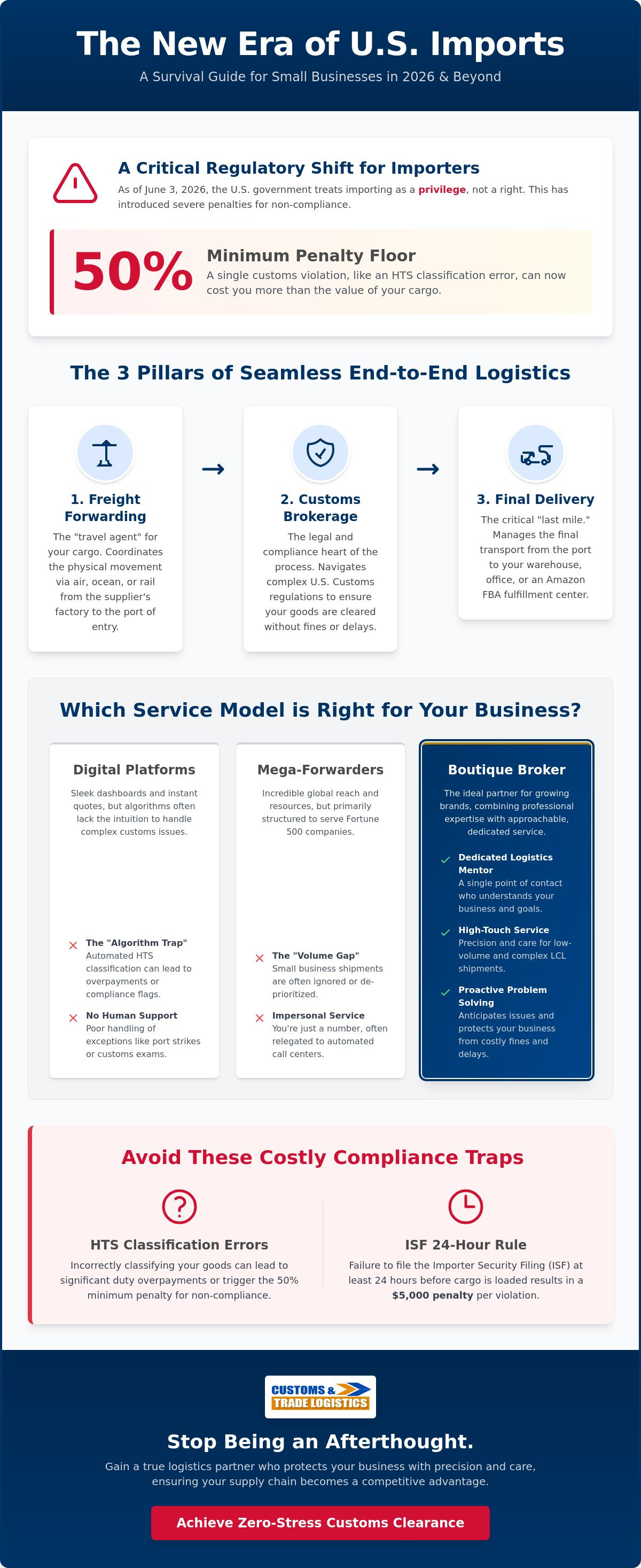
As of the June 3, 2026 executive order, the U.S. government officially treats importing as a privilege rather than a right. This shift introduced a 50% minimum penalty floor for customs violations, meaning a single HTS classification error could now cost you more than the cargo itself. If you feel like the global freight giants only answer your emails when it's convenient, you aren't alone. Finding the right import freight services for small business is no longer just about moving boxes; it's about protecting your company from a regulatory environment that has become increasingly unforgiving.
It's exhausting to manage volatile ocean rates and the new 10% Section 122 global surcharge while being treated like an afterthought. You deserve a partner who acts as a dedicated mentor rather than just another vendor. This guide will show you how to evaluate providers to ensure they have the expertise to navigate the post-de minimis landscape and the personal touch to help you scale. We'll compare the most reliable freight strategies for 2026 so you can achieve zero-stress customs clearance and keep your growth on track.
Key Takeaways
- Understand the three pillars of end-to-end logistics—international transport, customs brokerage, and final delivery—to ensure your goods move seamlessly from supplier to doorstep.
- Compare digital, mega, and boutique service models to find the import freight services for small business that offer the right balance of technology and personal oversight.
- Learn how to vet potential partners based on their ability to clear cargo at any U.S. port and their commitment to providing a dedicated logistics mentor.
- Identify critical compliance traps, such as HTS classification and the ISF 24-hour rule, to protect your business from unexpected fines and delivery delays.
- Discover the benefits of partnering with a family-oriented brokerage that treats your shipments with the same care and precision as their own.
What are Import Freight Services for Small Business?
The Core Components of Import Logistics
Success in global trade relies on three distinct stages of movement. First, there is Freight Forwarding. If you've ever wondered What is a Freight Forwarder?, think of them as the travel agent for your cargo. They coordinate the physical movement via air, ocean, or rail. Second is Customs Brokerage. This is the legal side of the journey where specialists navigate U.S. Customs regulations to ensure your entry is compliant. Finally, Redistribution handles the "last mile," moving your products from the port of entry to your warehouse, office, or an Amazon FBA center.
Why Small Businesses Require Specialized Freight Handling
Comparing Service Models: Digital vs. Mega-Forwarder vs. Boutique Broker
How do you decide which logistics provider deserves your trust? When selecting import freight services for small business, you'll generally encounter three distinct models: the high-tech digital forwarder, the massive global "mega-forwarder," and the boutique family-owned broker. Each offers a different experience, but for a growing brand, the choice often dictates whether your logistics feel like a competitive advantage or a constant source of anxiety. Choosing the wrong partner is expensive, especially if you're at a stage where every shipment represents a significant portion of your inventory.
The Digital Platform Trap
The primary danger of digital-only platforms is the reliance on algorithms. Automated HTS classification tools often choose the most "obvious" code rather than the most accurate one. This can lead to massive tax overpayments or, worse, flags for non-compliance that trigger intensive exams. During a port strike or a sudden carrier delay, an algorithm-led support system won't help you find a creative solution to reroute your cargo. Professional human oversight ensures that your specific product nuances are accounted for before they reach the scrutiny of a customs official. Without a dedicated advocate, you're left to solve complex regulatory problems with a generic support ticket.
The Personal Touch: Why 35+ Years of Experience Matters
In a regulated industry, there's no substitute for a "safe pair of hands." Reading through the CBP Tips for New Importers highlights just how many legal responsibilities fall on your shoulders as the Importer of Record. A boutique partner with over 35 years of experience understands these requirements inside and out. Family-owned businesses like Customs and Trade Logistics treat every container with protective care because they know your growth is the foundation of their own success.
If you want to move beyond automated ticketing systems and build a long-term strategy, a boutique partner like Customs and Trade Logistics offers the direct communication you need. Instead of booking one-off shipments and hoping for the best, you gain a mentor who helps you forecast costs and navigate the 10% Section 122 global surcharge. This level of partnership turns logistics from a heavy administrative burden into a predictable, manageable part of your business. It's about finding a stabilizer that allows you to focus on your products while they focus on the movement and oversight of your cargo.
Evaluation Criteria: How to Vet an Import Logistics Partner
Port coverage is one of the first things you should verify. Some brokers only have the capacity to clear cargo at their home base, which limits your flexibility if a West Coast port strike or weather event forces a reroute to the East Coast. True national coverage means your partner can clear customs at any U.S. port of entry. Additionally, transparency in pricing is a non-negotiable trait. Your provider should explain the Harbor Maintenance Fee (HMF) of 0.125% and the Merchandise Processing Fee (MPF), which currently sits at 0.3464% with a minimum of $29.66 per entry. If these aren't mentioned upfront, you aren't seeing the full picture of your landed costs.
Questions Every Small Business Should Ask
Don't be afraid to ask tough questions during the vetting process. A seasoned mentor will welcome the opportunity to show their expertise. Start by asking how they handle the Import Security Filing (ISF) 24-hour rule. Because the penalty for a late or inaccurate ISF is a flat $5,000, you need a partner who prioritizes this filing before your goods even leave the foreign port. If you sell on marketplaces, ask if they can assist with delivery and redistribution to Amazon FBA centers. Finally, inquire about their process for HTS code verification. Close enough isn't good enough for U.S. Customs, and you need to know a human expert is double-checking your classifications to prevent audits.
Red Flags in Small Business Freight
Watch out for unusually low "teaser" rates. In the volatile 2026 market, where ocean freight rates can fluctuate by thousands of dollars in a single month, a quote that seems too good to be true often hides massive surcharges. Another red flag is a lack of knowledge regarding Partner Government Agency (PGA) filings. If your products fall under the jurisdiction of the FDA or EPA and your broker seems confused by the paperwork, your shipment is at high risk for seizure. Slow response times during your initial inquiry are also a warning sign. If they don't have time to answer your questions when they're trying to win your business, they certainly won't be there when your container is stuck at the terminal.
Avoiding Compliance Traps: The Small Business Survival Guide
Compliance isn't just about following rules; it's about protecting your cash flow. For those utilizing import freight services for small business, the regulatory environment can feel like a minefield. The stakes are high because U.S. Customs and Border Protection (CBP) holds the importer of record responsible for every detail, regardless of whether you or your supplier filled out the forms. A single oversight in your China-to-U.S. shipping leg can lead to seized cargo or penalties that wipe out your entire season's profit.
The Import Security Filing (ISF), often called the "10+2" rule, is the first major hurdle. You must file this electronically at least 24 hours before your goods are even loaded onto the vessel at the foreign port. If you miss this window, you face an automatic $5,000 fine. Similarly, HTS classification requires absolute precision. Choosing a code that is "close enough" is a recipe for an audit. You must also decide on a customs bond. While a single-entry bond might seem cheaper for one shipment, a continuous bond is almost always the smarter choice for businesses planning to import three or more times a year. It covers all your entries for 12 months and simplifies the clearance process.
Paperwork Perfection: The Importer's Essential Documents
Your logistics journey lives and dies by three documents: the Commercial Invoice, the Packing List, and the Bill of Lading. The Commercial Invoice must detail the transaction value and country of origin, while the Packing List describes the physical dimensions and weight of each carton. The Bill of Lading is perhaps the most critical because it serves as the title to your goods. For a deeper dive into these requirements, see our guide on Customs Clearance Services in the US: The Complete Importer’s Guide for 2026. Ensuring these are accurate before the ship leaves the origin port is the best way to prevent delays.
The Cost of Non-Compliance
When paperwork is missing or incorrect, the port doesn't just wait for you to fix it; they charge you for the space you're taking up. Demurrage fees apply to containers held inside the terminal, while detention fees are charged for equipment kept past the agreed-upon timeframe. A 10-day customs hold can easily result in thousands of dollars in storage fees and port charges that far exceed the original cost of shipping. A proactive broker prevents these costs by reviewing every document for accuracy before your cargo even touches the water. If you want to secure your supply chain, you can request a customs clearance consultation today to ensure your next shipment is fully compliant.
Why Customs and Trade Logistics is the Premier Choice for Small Businesses
Selecting the right import freight services for small business is a decision that impacts your bottom line every single day. At Customs and Trade Logistics, we bring over 35 years of experience to your corner. We aren't a faceless digital platform or a global mega-forwarder where you're just a shipment number in a database. As a family-owned business, we treat your growth as our own priority. We provide the professional assurance you need to stop worrying about customs holds and start focusing on your brand's future.
The "Safe Pair of Hands" Philosophy
We believe in demystifying the import process for every client we serve. Many brands start their journey by letting their foreign suppliers handle the shipping. This often leads to hidden costs and a total lack of control over the delivery timeline. We recently helped a growing home goods brand transition from supplier-managed freight to our professional oversight. By taking control of their logistics, they reduced their transit times by 12 days and eliminated unexpected "arrival fees" that the supplier had been passing on. We act as a stabilizer for your supply chain, lifting the heavy administrative burden off your shoulders so you can breathe easier.
Get Started with a Logistics Consultation
Our team coordinates the entire end-to-end journey with meticulous care. From the moment your goods leave a factory in China to the final delivery at your warehouse, we provide total management and protective oversight. Our specialized China-to-US import consulting helps you navigate the 2026 surcharge environment and complex HTS classifications with ease. We are ready to act as your dedicated mentor in an increasingly regulated industry. Contact Customs and Trade Logistics for a personalized quote to secure your supply chain today.
Secure Your Supply Chain for 2026 and Beyond
The landscape of international trade is shifting quickly, but these changes don't have to stall your growth. By moving away from automated platforms and toward a dedicated partnership, you ensure that your shipments receive the human oversight they deserve. Choosing the right import freight services for small business means finding a balance between technical compliance and personal support. You now have the tools to vet providers for national port coverage and avoid costly traps like late ISF filings.
At Customs and Trade Logistics, we've spent over 35 years acting as a seasoned mentor for brands navigating the complexities of global trade. Whether you need specialized logistics for Amazon FBA sellers or expert clearance at all U.S. Customs ports, our family-owned team is here to stabilize your operations. Don't let the administrative burden of customs hold you back from scaling your business. We pride ourselves on being a stabilizing force that turns logistics from a source of anxiety into a competitive advantage.
Get a Professional Logistics Consultation Today and experience the relief of having a safe pair of hands managing your journey. We are ready to help you turn your supply chain into a reliable engine for success. You've built a great brand; let us help you move it forward with confidence.
Frequently Asked Questions
What is the most cost-effective way for a small business to import from China?
LCL (Less than Container Load) ocean freight is generally the most budget-friendly method for small businesses moving bulkier goods. It allows you to share container space and split costs with other shippers rather than paying for an entire 40-foot unit. However, you must factor in the current 10% Section 122 global surcharge and volatile ocean rates when calculating your total landed cost to ensure your margins remain healthy.
Do I need a customs broker if I am only importing small quantities?
Yes, because the $800 de minimis exemption was suspended in August 2025, meaning all shipments now require a formal entry regardless of their value. Even for a single pallet, you are legally responsible for accurate HTS classification and duty payments. A broker ensures you comply with the June 2026 executive order regarding Importer of Record assets and bonding, protecting you from steep non-compliance penalties.
What is the difference between a freight forwarder and a customs broker?
A freight forwarder manages the physical movement of your cargo, while a customs broker handles the legal entry into the United States. Think of the forwarder as the travel agent for your boxes and the broker as the legal advocate who navigates CBP regulations. Most high-quality import freight services for small business combine both roles into a single, seamless experience to simplify your supply chain management.
How long does it typically take for a small business shipment to clear US Customs?
Most shipments clear within 24 to 48 hours if all paperwork is submitted accurately before arrival. However, this timeline can stretch to a week or more if your cargo is flagged for an intensive exam or if your ISF was filed late. Proactive documentation review by a seasoned specialist is the only way to ensure a predictable clearing schedule and avoid costly terminal storage fees.
What are the common hidden fees in international freight services?
Unexpected costs often include terminal handling charges, chassis splits, and storage fees like demurrage or detention. You should also watch for the Merchandise Processing Fee (MPF) and Harbor Maintenance Fee (HMF), which are government-mandated but sometimes omitted from "teaser" quotes. A transparent partner will detail these fees upfront to prevent surprises at the port and help you maintain a predictable shipping budget.
Can a freight forwarder help with Amazon FBA labeling and redistribution?
Yes, specialized logistics partners provide delivery and redistribution services specifically tailored for e-commerce entrepreneurs. This includes ensuring your pallets meet Amazon's strict dimensions and coordinating the final truckload to the fulfillment center. Using a provider who understands FBA nuances prevents your inventory from being rejected at the warehouse gate, which can be an expensive and time-consuming mistake for a growing brand.
What happens if my shipment is flagged for a US Customs exam?
Your shipment will be moved to a Centralized Examination Station (CES) for physical inspection by CBP officers. This process adds significant costs for drayage and storage, which the importer is required to pay. Having a broker who double-checks your HTS codes and PGA filings reduces the statistical likelihood of being flagged for these costly inspections, providing a much-needed sense of security for your operations.


