

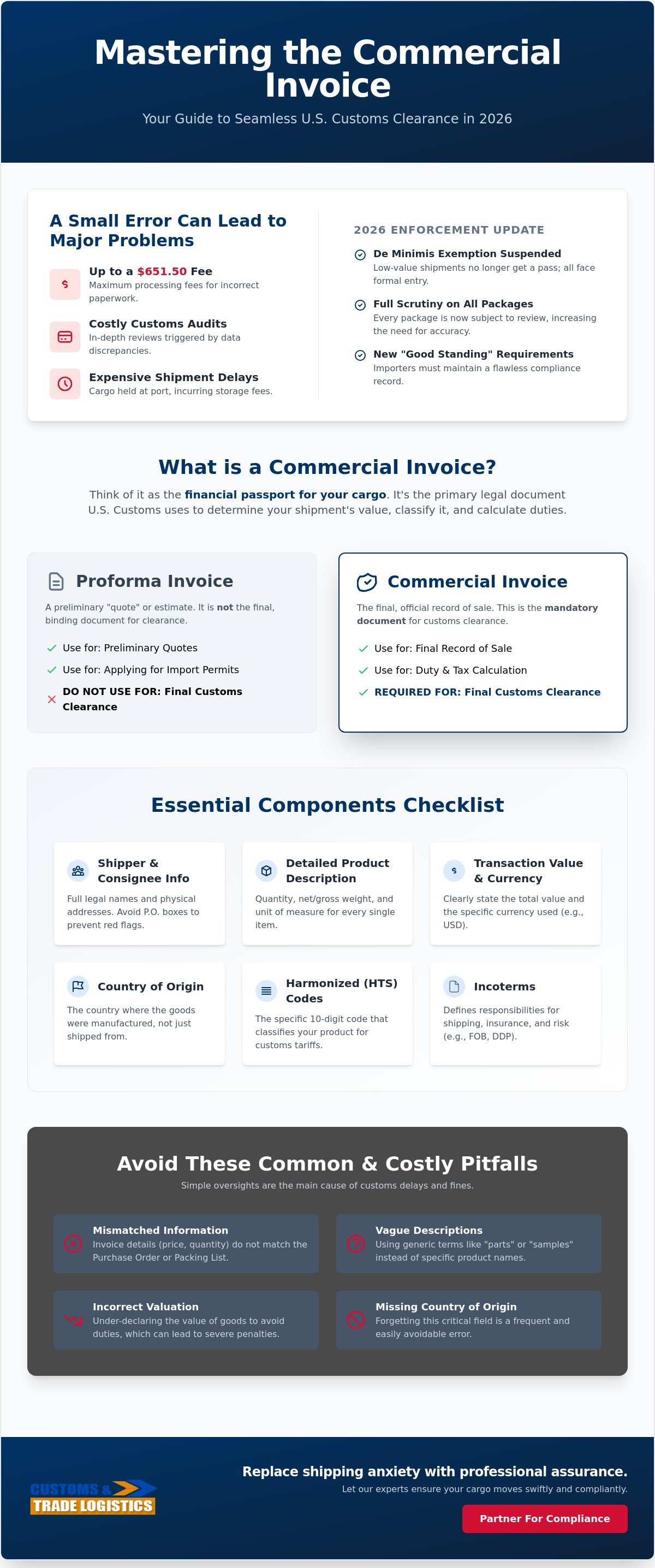
What if the smallest clerical error on your paperwork was the only thing standing between your shipment and a $651.50 maximum processing fee? It's a stressful reality for many importers in 2026, especially since the suspension of the de minimis exemption means every single package now faces full scrutiny and formal entry requirements. You're likely tired of the confusion surrounding 10-digit HTS codes and the constant fear that a minor oversight will trigger a costly customs audit or expensive storage delays. We understand that these administrative burdens can feel overwhelming, but you don't have to face them alone.
We believe international trade shouldn't feel like a gamble, so we've simplified the process of preparing a commercial invoice for customs clearance to give you total peace of mind. Our goal is to replace that shipping anxiety with a sense of security and professional assurance. This guide provides a clear checklist of mandatory invoice fields and explains the latest 2026 enforcement rules, including the new "good standing" requirements for importers. You'll learn exactly how to ensure your cargo moves swiftly from the factory to your warehouse while avoiding hidden costs and unnecessary holds.
Key Takeaways
- Understand why your commercial invoice is a critical legal document that tells the story of your shipment to US Customs.
- Master the mandatory fields required for a compliant commercial invoice for customs clearance, ensuring every HTS code and value is accurate.
- Learn to spot common pitfalls, like mismatched unit prices or missing countries of origin, before they lead to costly audits.
- Follow a step-by-step drafting process that aligns your purchase orders with your packing lists for seamless transit.
- Gain the confidence to navigate 2026's stricter enforcement rules by understanding the value of expert logistical oversight.
What is a Commercial Invoice for Customs Clearance?
Think of the commercial invoice as the passport for your cargo’s financial identity. While it might look like a standard bill of sale you'd use for domestic business, it carries far more weight in international trade. A commercial invoice for customs clearance is the primary document used by US Customs and Border Protection to determine the true value of your goods. It isn't just a record of what you bought; it's a legal declaration between the exporter and the importer that dictates how much duty you'll pay and whether your shipment even enters the country.
To understand the basics, looking at What is a Commercial Invoice? reveals that this document must contain specific data points required by global trade regulations. Unlike a simple receipt, it details the transaction's terms, the parties involved, and a granular description of the items. It provides the narrative that customs officers need to verify your shipment's legitimacy. Without this document, your cargo is essentially a mystery to the port authorities. In an era of increased vetting, leaving any room for mystery is a risk your business can't afford to take.
Commercial vs. Proforma Invoices: The Critical Difference
One of the most frequent mistakes we see involves using a proforma invoice for final entry. It's an easy error to make, but it often causes significant delays. A proforma invoice is essentially a preliminary quote or a placeholder. It helps you understand the expected costs before a shipment is finalized, but it doesn't represent the final, binding transaction. In contrast, the commercial invoice is the final record of sale. You can use a proforma for things like opening a letter of credit or applying for an import permit, but for the actual customs clearance process, only the final commercial version will suffice. Relying on a quote when the government expects a final declaration is a quick way to get your shipment flagged for a manual review.
Why This Document is the Key to Your Supply Chain
An accurate invoice is your best defense against intensive examinations. When your paperwork is clear and compliant, customs officers can quickly verify the details and move your goods along the line. If the data is vague or contradictory, your cargo might be pulled aside for a physical inspection. This adds time and unexpected costs to your journey. This document also plays a vital role in calculating precise duties and taxes. By providing clear valuations and descriptions, you ensure you aren't overpaying the government or risking fines for underpayment. Getting professional import paperwork assistance starts with respecting the weight of this single piece of paper. It’s the foundation of a smooth, predictable supply chain that protects your brand’s reputation and your bottom line.
The Checklist: Essential Components of a Compliant Invoice
Creating a compliant commercial invoice for customs clearance requires more than just filling out a template; it demands a level of precision that mirrors the complexity of global trade. If you've ever felt that pit in your stomach while submitting paperwork, you're not alone. To help ease that anxiety, we've compiled the absolute essentials that must appear on your document to meet official U.S. government guidance. These fields aren't suggestions; they're the mandatory building blocks of a successful entry.
First, you must include the full legal names and physical addresses for both the shipper (exporter) and the consignee (importer). Avoid using P.O. boxes, as these often trigger red flags for customs officials who need to verify the physical locations of the businesses involved. Next, provide a detailed breakdown of the quantity, net and gross weight, and the unit of measure for every single item in the shipment. You also need to state the total transaction value clearly, along with the specific currency used for the sale. Finally, don't forget the Incoterms. Terms like FOB (Free on Board) or DDP (Delivered Duty Paid) are vital because they define exactly who is responsible for shipping costs, insurance, and risk transfer.
Mastering the Harmonized System (HS) Codes
Think of the HS code as the universal language of customs officials worldwide. These 6-to-10 digit numbers tell the government exactly what you're importing without the need for translation. It's tempting to use generic codes to try and lower your duty rates, but this is a dangerous game. In 2026, with increased vetting and higher bonding requirements, misclassification can lead to heavy fines or a "bad standing" mark on your importer history. To find the correct code, you can use the official HTS search tools or consult with a mentor who understands the nuances of the tariff schedule. Accuracy here is your best insurance against unexpected costs.
The Art of the 'Detailed Description'
Vague descriptions are the leading cause of holds at the port. If you write "Electronics" on your invoice, you're almost guaranteed a delay. Instead, be specific. "Lithium-ion power banks for mobile phones" gives the officer a clear picture and speeds up the process. A great rule of thumb is the "What, Made of, Used for" rule. What is the item? What material is it made of? What is its intended use? Providing these clear descriptions is the most effective way to reduce customs clearance delays and keep your supply chain moving steadily.
If the complexity of these requirements feels like a heavy administrative burden, remember that you don't have to manage it by yourself. Our team provides customs clearance services that act as a safe pair of hands for your growing business.
Common Pitfalls: Why Customs Delays Happen to Good Importers
Even the most diligent business owners can fall victim to simple paperwork errors that carry massive financial consequences. In the eyes of US Customs, a mistake isn't just a typo; it's a compliance failure. Preparing a commercial invoice for customs clearance requires a level of scrutiny that goes beyond basic accounting. If your data doesn't perfectly align, you risk more than just a phone call. You risk your shipment being held indefinitely while costs mount up at the port.
Mathematical errors are among the most common reasons for a hold. If your unit price multiplied by the quantity doesn't exactly match the total invoice value, the system will flag your entry for manual review. Similarly, every single item on your invoice must have its manufacturing origin clearly labeled. Missing the "Country of Origin" for even one small component can halt an entire container. There is also the dangerous temptation of undervaluation. While "low-balling" the price might seem like a way to save on duties, it's a high-risk gamble. Under the "Strengthening Customs Enforcement" executive order signed on June 3, 2026, CBP has increased vetting and established a "good standing" requirement for all importers. An audit triggered by suspicious pricing could damage your reputation for years.
Consistency is your best friend. Your invoice data must be a mirror image of what is listed on your Packing List and Bill of Lading. When these documents don't talk to each other, customs officials see a red flag. Following the official requirements for a commercial invoice is the only way to ensure your narrative remains consistent across the entire supply chain.
The Hidden Costs of Paperwork Errors
A two-day delay might not sound like much, but in logistics, time is literally money. If your paperwork is stuck, your cargo stays at the port, triggering demurrage and detention fees that can easily reach thousands of dollars. Beyond the storage costs, "suspicious" or incomplete invoices often trigger physical exams. These inspections are thorough, time-consuming, and, most importantly, they are billed to you. Every hold also negatively impacts your "Importer of Record" score. A poor history makes you a target for future inspections, creating a cycle of delays that can cripple a growing brand.
Language and Currency Barriers
Did you know that all commercial invoices for US entry must be in English? If your supplier provides documents in another language, you must include a certified translation. Currency is another sticking point. If you are handling multi-currency transactions, you need to clearly note the exchange rate used at the time of sale to avoid valuation disputes. Finally, standardize your measurements. Confusion between metric and imperial units can lead to incorrect weight declarations, which is a frequent cause of "inconsistent data" flags. If these technical details feel like a heavy burden, consider letting a dedicated logistics partner provide the oversight you need to stay compliant.
A 5-Step Process for Drafting Your Commercial Invoice
How do you turn all these complex regulations into a single, compliant document? Creating a commercial invoice for customs clearance doesn't have to be a source of stress if you follow a methodical, step-by-step path. By treating the drafting process as a sequence of protective checks, you ensure that your paperwork acts as a "safe pair of hands" for your cargo. This methodical approach is what separates seasoned importers from those who frequently face port delays.
- Step 1: Gather your data. Start by placing your purchase order and packing list side-by-side. Every detail, from the unit price to the total weight, must be perfectly consistent across all three documents.
- Step 2: Map your HS codes. Assign the correct 10-digit HTS codes to every line item. As we discussed earlier, accuracy here is vital for determining your duty rates in 2026.
- Step 3: Use a professional template. Don't try to reinvent the wheel. Draft the invoice using a professional format that includes all mandatory fields, including your tax ID and the specific Incoterms for the transaction.
- Step 4: Audit for red flags. Review your descriptions for vague phrases like "samples," "parts," or "gift." These terms are magnets for customs inspections; replace them with the specific "What, Made of, Used for" descriptions.
- Step 5: Get a pre-clearance review. Before you hit "send," share the draft with your broker. This final verification step is often missing from major carrier guides, but it is the best way to catch errors before they become expensive problems.
If you want an expert to look over your shoulder and verify your paperwork, our customs clearance services provide that final layer of security before your cargo ever leaves the factory.
Using Templates vs. Automated Systems
Are you still using basic Excel templates for your imports? For small-scale operations, a well-structured spreadsheet is often enough to maintain oversight. However, as your business grows, you might find that manual data entry leads to more "human error" flags. This is when it's time to move toward automated trade management software. In 2026, customs systems increasingly favor digital invoices that are machine-readable. This technology allows for faster data processing at the port, which can shave days off your total transit time.
The Final Review Checklist
Before any document is finalized, perform a 30-second "sanity check." First, verify that the "Sold To" and "Ship To" addresses are correct for tax compliance, as these are often different for businesses using third-party warehouses. Next, confirm that the currency is clearly stated and that the date and signature are present. In 2026, digital signatures are widely accepted, but they must be valid and clearly legible to be recognized by CBP officials. Taking this extra moment of diligence ensures your shipment moves steadily toward its destination without a hitch.
Partnering for Compliance: How Professional Oversight Protects Your Brand
In a world where automated tools promise instant solutions, why do the most successful importers still rely on human expertise? While software can help you generate a commercial invoice for customs clearance, it can't navigate the nuances of a sudden regulatory shift or advocate for your business during a complex dispute. Our family-owned firm brings over 35 years of experience to the table, providing a level of professional assurance that an algorithm simply cannot replicate. We don't just file your paperwork; we act as a stabilizing force that protects your brand from the volatility of global trade.
Think of us as a "safe pair of hands" that manages the heavy administrative burden so you don't have to. When US Customs flags a shipment or requests additional valuation data, you need an advocate who understands the language of the port. We move beyond basic filings to provide strategic logistics consulting, helping you optimize your supply chain as your business grows. We specifically specialize in helping Amazon sellers navigate the unique complexities of China-to-US imports, ensuring that your inventory reaches the warehouse without getting caught in a web of compliance errors.
Customs and Trade Logistics: Your Mentor in Global Trade
Do you feel overwhelmed by the scale of international operations? Our mission is to demystify the import process for small and medium businesses, replacing that sense of anxiety with security. We believe in the power of personal connection, which is why we act as a dedicated partner who knows your specific product line and business goals. By handling the entire end-to-end chain, from the factory floor to the final delivery and redistribution, we ensure that no stage of the journey is overlooked. This holistic oversight is what allows our clients to scale with confidence, knowing their regulatory foundation is solid.
Ready to Streamline Your Import Process?
Are you ready to spend less time on paperwork and more time on growth? By letting us manage your commercial invoice for customs clearance and broader logistics needs, you significantly reduce the risk of costly storage fees and audits. This total management allows you to focus on scaling your sales while enjoying the peace of mind that comes from total compliance. We are here to act as your knowledgeable bridge to the global marketplace, providing the protective care your business deserves.
Let Customs and Trade Logistics manage your next shipment.
Secure Your Global Growth with Compliance
Mastering your commercial invoice for customs clearance is the most effective way to protect your profit margins from the hidden costs of port delays. By focusing on precise HTS classification and the "What, Made of, Used for" rule, you've already taken the first steps toward a more resilient supply chain. These administrative details might seem small; however, they serve as the foundation for your brand's reputation with US Customs in an increasingly strict regulatory environment.
You don't have to carry this administrative burden alone. Our family-owned firm offers 35+ years of industry expertise to act as your dedicated advocate in the global marketplace. We provide specialized support for SMB importers and Amazon FBA sellers who need a safe pair of hands to navigate complex logistics. Get Expert Help with Your Import Paperwork and replace shipping anxiety with total peace of mind. Your business is ready to scale, and we're here to ensure nothing stands in your way.
Frequently Asked Questions
Do I always need a commercial invoice for international shipping to the US?
Yes, you must provide a commercial invoice for every commercial shipment entering the United States. Following the suspension of the $800 de minimis exemption in August 2025, every package now requires formal customs entry regardless of its transaction value. This document is the only way for officials to verify what is inside your shipment and calculate the correct duties owed to the government.
Can I use a proforma invoice for customs clearance if the final price hasn't changed?
No, you cannot use a proforma invoice for the final customs entry process. US Customs requires a commercial invoice because it represents the actual, finalized transaction between the buyer and the seller. Even if your pricing hasn't changed since the initial quote, a proforma is legally considered a preliminary document and won't be accepted for formal clearance in 2026.
What happens if I put the wrong HS code on my commercial invoice?
Using an incorrect HS code can lead to expensive shipment delays, heavy fines, or even a full customs audit. Because these codes determine your duty rates, misclassification is often viewed as an attempt to avoid paying the correct taxes. Under the 2026 enforcement rules, consistent errors will damage your "good standing" status, making it harder and more expensive to import goods in the future.
Who is responsible for preparing the commercial invoice: the buyer or the seller?
The seller or exporter is typically responsible for creating the document, but the importer of record bears the legal responsibility for its accuracy. You should always review the draft provided by your supplier to ensure it meets all specific US requirements. If the data is incorrect or vague, you are the one who will face the penalties and storage fees at the port.
Is a commercial invoice the same as a bill of lading?
No, these documents serve two entirely different purposes in your supply chain. A commercial invoice for customs clearance details the financial transaction and the value of the goods for tax assessment. A bill of lading acts as a contract of carriage and a receipt for the cargo, focusing on the physical movement and ownership of the goods during transit.
How do I determine the 'value' of goods if they are samples or gifts?
You must declare the fair market value of the goods even if you didn't pay for them. Customs regulations don't allow a "$0" value declaration; instead, you should state what it would cost to replace the items or the price they would typically sell for. Clearly mark the invoice as "Samples only, no commercial value" while still providing a realistic dollar amount for duty assessment.
Does the commercial invoice need to be physically signed in 2026?
Digital signatures are widely accepted in 2026, so a physical "wet" signature is rarely required for most electronic entries. However, the signature must be clear, legible, and accompanied by the printed name of the authorized person from the exporting company. Ensuring your digital paperwork is formatted correctly helps your shipment move through automated customs systems without being pulled for manual review.
What is a 'Destination Control Statement' and do I need one?
A Destination Control Statement is a legal sentence stating that the goods are destined for a specific country and cannot be diverted elsewhere. You need this statement on your commercial invoice for customs clearance for many exports subject to US Department of Commerce regulations. It serves as a protective measure to ensure your shipment complies with international trade laws and national security requirements.


