
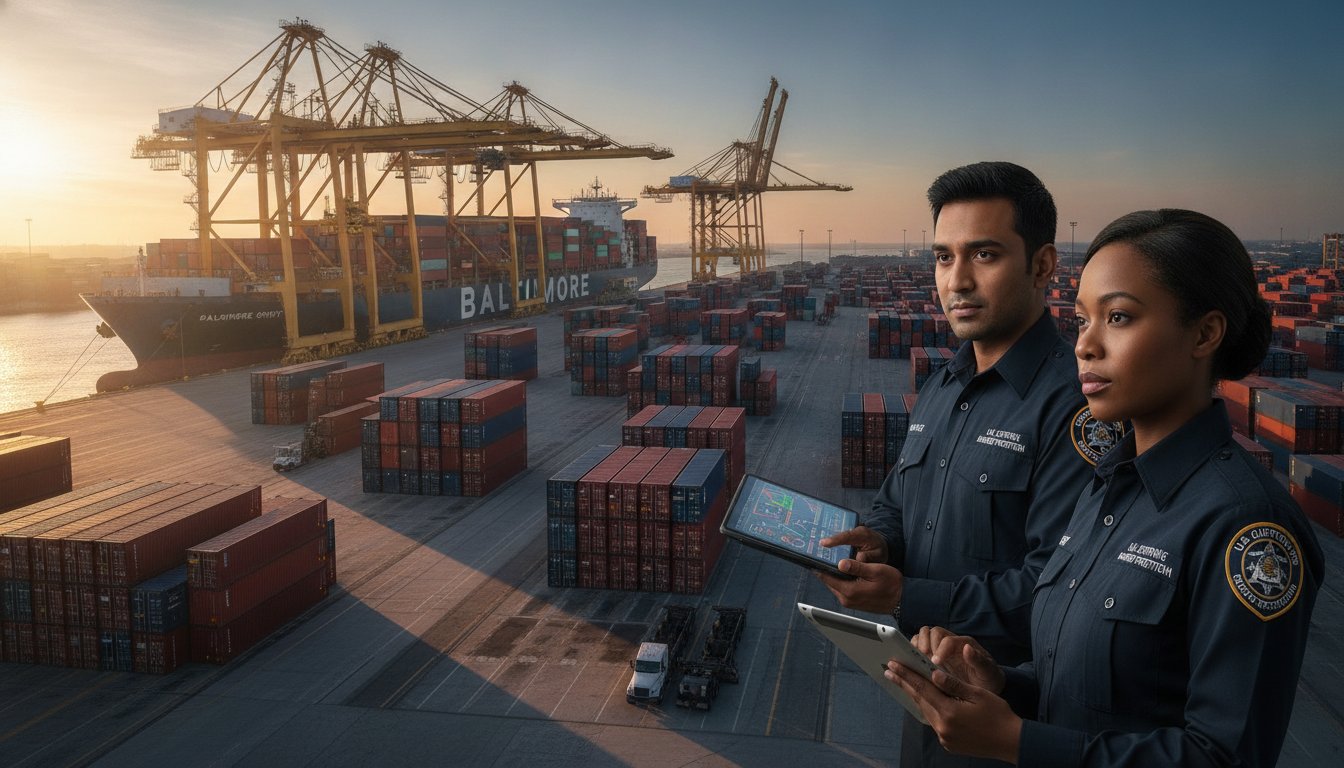
What if the most expensive part of your international shipment isn't the ocean freight, but a single day of unexpected storage fees? With the Port of Baltimore handling over 2,200 vessel visits in 2025, the pace of trade is faster than ever, yet a tiny error in an HTS code can still bring your growth to a standstill. If you've felt the anxiety of shifting federal regulations or the confusion of the new 2026 bonding requirements, you aren't alone. Partnering with a seasoned customs broker Baltimore importers rely on is the first step toward replacing that uncertainty with a sense of total security.
We understand that managing international logistics feels like a heavy administrative burden, especially with the recent June 2026 executive orders tightening enforcement on importers. You deserve a clear path through the red tape and a predictable look at your total landed costs. In this guide, we'll show you how to choose a brokerage partner who acts as a dedicated mentor for your business. You'll learn how to ensure seamless clearance at any US port, master import compliance, and finally achieve the transparency your shipping chain needs to thrive.
Key Takeaways
- Learn how a licensed customs broker acts as your essential bridge to federal agencies, ensuring every shipment meets strict US Customs and Border Protection standards.
- Master the basics of HTS codes and ISF filings to avoid costly "no-load" signals and keep your logistics costs predictable.
- Discover why selecting a family-owned customs broker Baltimore businesses trust provides the advocacy and 30+ years of expertise needed to navigate shifting trade policies.
- See how coordinating documentation from the factory floor to the final doorstep prevents delays before your cargo even leaves the port.
- Understand the long-term benefits of a logistics partner that treats your growth as a priority rather than just another entry in a database.
Defining the Role of a Customs Broker in the Global Supply Chain
Are you feeling overwhelmed by the sheer volume of paperwork required to get your products into the country? It's a common hurdle for growing businesses. A Customs broker acts as the primary liaison between your business and US Customs and Border Protection (CBP). These licensed professionals take the weight of federal regulations off your shoulders by ensuring every shipment meets strict legal standards. A Customs Broker is a licensed intermediary who ensures legal compliance and financial accuracy for importers.
Think of your broker as a protective advocate who provides strategic oversight of the entire international shipping chain. They don't just file forms; they audit your documentation for accuracy to prevent costly penalties. Whether you're working with a customs broker Baltimore experts recommend or a firm with a national reach, their goal is to keep your goods moving without friction. They act as a stabilizing force, translating complex trade laws into actionable steps for your logistics team.
The Difference Between a Broker and a Freight Forwarder
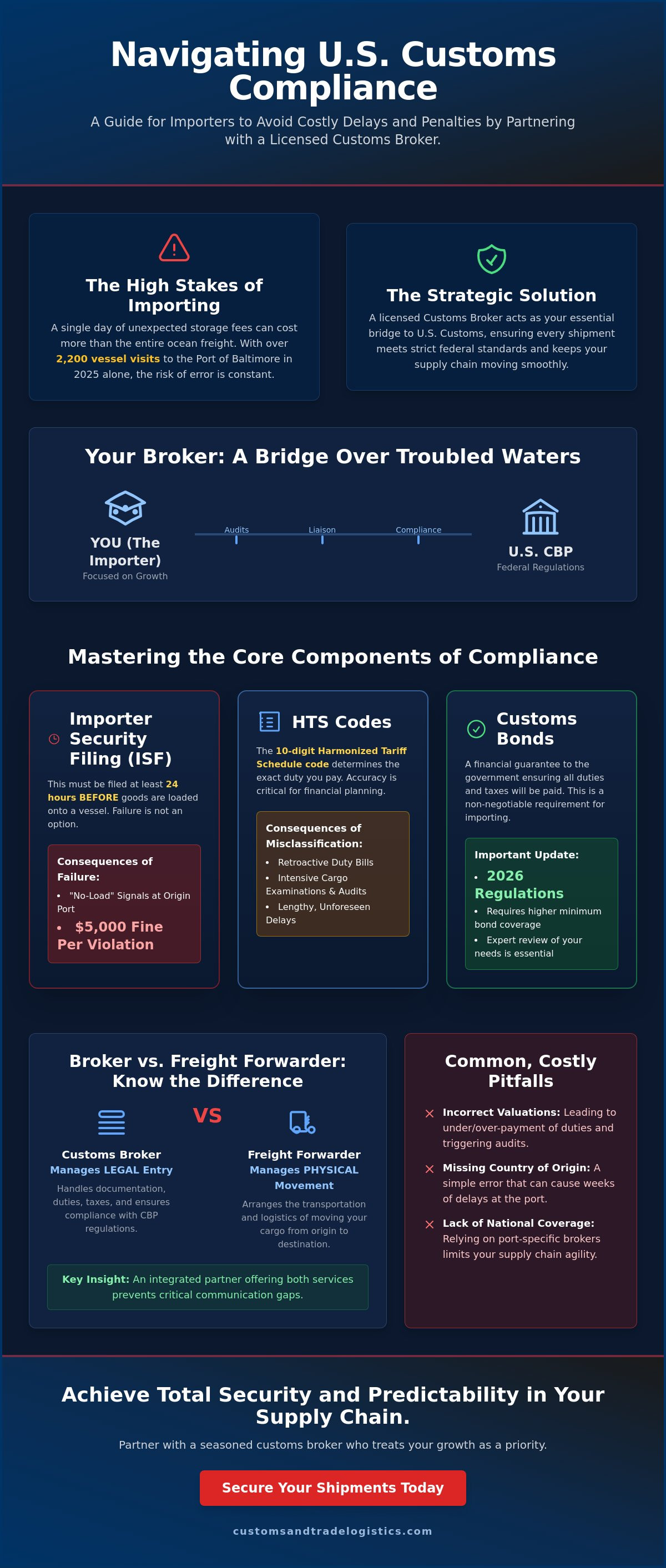
It's easy to get these two roles confused. While a freight forwarder manages the physical movement of your cargo across oceans and borders, the broker manages the legal entry of that cargo into the United States. Why does this matter? If these two roles don't communicate, your goods might arrive at the port with no one ready to pay the duties or clear the entry. Many businesses find that working with a partner who offers both services under one roof provides the smoothest experience. This integrated approach reduces the risk of communication gaps between your overseas supplier and the busy US port.
Why National Port Coverage Matters for Your Business
Does your broker need to be physically standing at the dock to clear your goods? Not anymore. A licensed broker can clear cargo at any US port of entry, regardless of where their main office is located. This national permit system is a game changer for businesses looking to scale. Having a single point of contact for shipments arriving in Baltimore, Los Angeles, or Savannah offers several benefits:
- Consistent data capture: You'll have uniform records for all your imports in one place.
- Uniform classification: Your broker ensures the same HTS codes are applied across different ports to avoid duty discrepancies.
- Simplified billing: You deal with one trusted partner and one set of invoices.
This flexibility allows your supply chain to remain agile. If a strike or weather event closes one port, your customs broker Baltimore team can help you redirect cargo to another entry point without a hitch. This ensures your growth isn't limited by geography or local disruptions.
Mastering Compliance: The Core Components of US Import Regulations
Compliance isn't just about following rules; it's about protecting your business from sudden financial shocks. When you import goods, the U.S. Customs and Border Protection (CBP) expects total accuracy from the moment your cargo leaves the origin port. One of the biggest hurdles is the International Security Filing (ISF). If this isn't filed at least 24 hours before your goods are loaded onto a vessel, you risk "no-load" signals and fines that can reach $5,000 per violation. A seasoned customs broker Baltimore importers trust will manage these high-stakes deadlines, ensuring your supply chain stays moving without expensive interruptions.
Customs bonds are another vital piece of the puzzle. These act as a financial guarantee to the government that all duties and taxes will be paid. With the 2026 regulations requiring higher minimum bond coverage for Importers of Record, having an expert to review your bonding needs is essential. They prevent the simple paperwork errors, like incorrect valuations or missing country-of-origin markings, that often trigger intensive examinations and weeks of delays. Working with a customs broker Baltimore businesses rely on ensures that your documentation is audited before it ever reaches a federal officer's desk.
The Critical Importance of Accurate Product Classification
How much do you really know about your product's Harmonized Tariff Schedule (HTS) code? This ten-digit number determines exactly how much duty you pay. Misclassification is a high-stakes mistake. It can lead to retroactive duty bills, audits, or even the seizure of your products. A professional consultant doesn't just pick a code that looks "close enough." They analyze the material, function, and use of your goods to find the most accurate and legally favorable classification. This oversight directly impacts your bottom line and keeps your business in "good standing" with federal authorities.
Navigating Partner Government Agencies (PGAs)
Did you know that over 40 different government agencies have a say in what enters the country? While CBP is the gatekeeper, agencies like the FDA, EPA, and DOT often require additional permits or certifications. For example, importing electronics requires FCC compliance, while food products need FDA prior notice. Your broker acts as the central coordinator, ensuring all safety and environmental standards are met before your shipment arrives. If you find the regulatory landscape shifting too quickly, you might consider reaching out for expert customs clearance services to simplify the process. This specialized knowledge is what separates a successful import operation from one mired in red tape.
5 Essential Factors for Evaluating a Customs Brokerage Partner
Selecting a partner shouldn't feel like a gamble. When your inventory is at stake, you need a checklist that goes beyond just checking a license. A reliable customs broker Baltimore businesses trust should offer a blend of longevity and personal advocacy. Look for a firm with at least 30+ years of experience. This history means they've seen every trade policy shift, from the 2024 bridge recovery to the 2026 bonding changes. They know how to pivot when the rules change, keeping your shipments on track.
Transparency is your next priority. Do you have a direct line to the person handling your entry? In an industry where a single day of delay can cost thousands, you can't afford to wait in a support queue. Your broker should also specialize in your specific trade lanes. If you're sourcing from East Asia, look for a partner with deep Import From China Consulting expertise. Finally, check for end-to-end capabilities. A partner that offers Delivery and Redistribution Services after clearance ensures your goods don't just clear the port but actually reach your customers. This total management approach lifts the administrative burden from your shoulders.
Experience vs. Automation: Finding the Right Balance
Many "digital-only" brokers promise speed through automation. While tech is helpful, it often fails during a crisis. If your shipment is flagged for an intensive exam, you need a human expert, not a chatbot. A family-oriented mentor with 35+ years of experience knows how to handle "grey area" customs issues that algorithms miss. This personal touch builds trust, especially for first-time importers who feel overwhelmed by the scale of global trade. You deserve a safe pair of hands that values personal connection as much as technical compliance.
Special Considerations for Amazon FBA Sellers
Shipping directly to Amazon fulfillment centers adds a layer of complexity. Your broker must understand FBA labeling, packaging requirements, and strict delivery appointments. Mistakes here lead to rejected shipments and expensive storage fees. Using a partner that provides redistribution services allows you to hold stock and send it to Amazon in smaller, manageable batches. This strategy keeps your inventory flowing and helps you avoid the high costs of long-term storage at FBA warehouses. It's about creating a seamless path from the factory floor to the consumer's doorstep.
From Factory to Doorstep: Managing the International Shipping Chain
How do you ensure your goods don't just sit on a dock once they arrive? Managing the international shipping chain requires a proactive approach that begins long before your cargo reaches the water. A dedicated customs broker Baltimore importers trust will start the process at the factory level. By coordinating directly with your foreign suppliers, they ensure that every Commercial Invoice and Packing List is accurate and ready before the ship even sails. This early oversight prevents the last minute scrambles that often lead to storage fees and missed delivery windows.
Once your goods are in transit, the focus shifts to the ocean or air freight leg. With the Port of Baltimore handling nearly 5 billion dollars in imports as of March 2026, the volume of traffic is immense. Your broker monitors the vessel's progress to execute the customs entry filing within the required legal windows. This "pre-clearance" mindset means your documentation is often reviewed and approved by CBP while the ship is still miles from the coast. After the goods clear the port, your partner should arrange for container transport and redistribution to your specific warehouse or retail locations, providing a truly seamless experience.
Strategies for Importing Goods from China
Importing from China presents a unique set of challenges, particularly regarding shifting trade barriers and Section 301 duties. Navigating these tariffs requires more than just a basic understanding of logistics; it requires a consultant who understands the nuances of sourcing from Chinese manufacturers. A seasoned partner helps you identify potential duty saving opportunities or exemptions that could significantly impact your profit margins. If you're looking to streamline this complex process, it's time to explore professional international freight logistics to protect your interests and ensure your supply chain remains resilient against geopolitical shifts.
Reducing Delays Through Proactive Documentation
Waiting until your ship arrives to start your paperwork is a recipe for disaster. Effective logistics management relies on a digital document management system that speeds up the review process for CBP officers. Your broker will gather and audit three essential documents to ensure a smooth entry:
- Commercial Invoice: Detailing the transaction value, description, and country of origin.
- Packing List: Providing specific details about the weight, dimensions, and contents of each carton.
- Bill of Lading: Acting as the contract of carriage and the title to the goods.
By organizing these files early, you create a transparent shipping chain. This level of preparation reduces the likelihood of intensive physical examinations, which can add days or even weeks to your timeline. It's about moving from a state of reactive anxiety to one of methodical, professional oversight.
Why a Family-Owned Logistics Partner is Your Best Asset for National Growth
Choosing a partner for your international trade shouldn't feel like shouting into a void. Large, automated brokerage firms often treat growing businesses as just another entry in a massive database. In contrast, a family-owned logistics partner offers the personalized advocacy that small and mid-sized companies need to thrive. When you work with a customs broker Baltimore experts recommend, you gain more than a service provider; you gain a mentor who's deeply invested in your success. This relationship ensures that your specific business needs are never overlooked in the rush of global trade. You need a partner who knows your name, understands your product, and anticipates your specific challenges.
Stability is a rare commodity in the modern supply chain. A firm with 35+ years of experience has weathered every economic cycle, from shifting trade wars to global health crises. This longevity creates a "safe pair of hands" that protects your most valuable assets from the volatility of international markets. This dedicated advocacy allows smaller businesses to compete on a global scale. It provides you with the same level of compliance and speed as multinational corporations without the corporate detachment. You don't have to be a giant to have a world-class supply chain; you just need the right mentor to guide you through the red tape.
The Customs and Trade Logistics Difference
We take pride in being a family-owned and operated firm based in the US. Our team doesn't just process paperwork; we offer a 360-degree view of your trade through a blend of brokerage and consulting. This ensures we're looking at your HTS codes and shipping lanes to find every possible efficiency. Learn more about our Customs Clearance Services to see how our oversight transforms your import process into a competitive advantage.
Getting Started: Your Roadmap to Stress-Free Importing
Onboarding with a professional broker starts with a Power of Attorney (POA), a standard document that lets us represent you before CBP. From that moment, we become your stabilizing force. We handle the red tape and manage the deadlines, ensuring your goods move seamlessly. Ready to take the next step toward national import excellence? Contact Customs and Trade Logistics for a personalized consultation and let us lift the administrative burden from your shoulders.
Securing Your Future in Global Trade
Achieving national import excellence doesn't have to be an uphill battle against red tape. By choosing a partner who prioritizes accurate classification and proactive documentation, you ensure your business remains resilient against shifting trade policies. Whether you're managing complex China to US trade lanes or scaling your operations across the country, having a dedicated advocate makes all the difference. When you work with a customs broker Baltimore businesses have trusted for decades, you gain the peace of mind that comes with national coverage for every US port of entry.
As a family owned and operated firm since 1991, we focus on lifting the administrative burden from your shoulders so you can focus on growth. We act as a stabilizing force, providing the expertise needed to navigate the challenges of modern logistics with confidence. Ready to streamline your international supply chain? Let our 35 years of experience guide your next shipment. Your journey toward predictable costs and seamless clearance starts with a single, reliable partnership.
Frequently Asked Questions
What is the difference between a customs broker and a freight forwarder?
A freight forwarder organizes the physical transportation of your cargo, while a customs broker manages the legal requirements for entry into the country. Think of the forwarder as the travel agent for your goods and the broker as the legal advocate who ensures you comply with federal laws. Many businesses choose a partner that handles both to prevent communication gaps during the transition from sea to shore.
How much does a customs broker charge for their services?
Brokerage fees are typically structured around the complexity of the entry and the volume of shipments you process. Factors like the number of HTS classifications, the need for Partner Government Agency (PGA) filings, and the type of customs bond required will influence the final cost. Professional firms provide a transparent quote based on your specific business needs rather than a one-size-fits-all price.
Do I need a customs broker for every international shipment?
While you can technically file your own entries, most businesses use a broker to avoid the high risk of legal errors and costly delays. For formal entries, the process becomes significantly more complex. A professional ensures that your business remains in good standing with federal agencies, which is vital for long-term growth and avoiding intensive audits.
Can a customs broker help me reduce the duties I pay?
Yes, an expert broker identifies the most accurate HTS codes and checks for eligibility under various Free Trade Agreements. They also look for duty drawback opportunities or specific exemptions that non-experts might overlook. This strategic oversight ensures you aren't overpaying while maintaining full legal compliance with all import regulations.
How long does the customs clearance process typically take?
Most shipments clear within 24 to 48 hours after the entry is filed, provided all documentation is accurate and complete. If you utilize a pre-clearance strategy, your goods can often be approved before the vessel even docks. However, this timeline can shift if federal agencies require additional inspections or if there are discrepancies in your paperwork.
What happens if my shipment is flagged for a customs exam?
If CBP flags your cargo, it will be moved to a Centralized Examination Station (CES) for a physical or X-ray inspection. Your broker acts as your eyes and ears during this time, coordinating with the terminal and keeping you informed of the status. While exams are a standard part of enforcement, having an expert manage the communication helps resolve the issue as quickly as possible.
Can you clear my goods if they arrive at a port far from your office?
Yes, a licensed customs broker Baltimore importers rely on can clear cargo at any port of entry across the United States. Through national permits and electronic filing systems, we manage shipments in Los Angeles, New York, or Savannah just as easily as those arriving locally. This allows you to centralize your logistics management with one trusted partner regardless of where your goods land.
What specific documents do I need to provide to my customs broker?
You'll need to provide a Commercial Invoice, a detailed Packing List, and a Bill of Lading for every shipment. Depending on the nature of your goods, you might also need certificates of origin or specific permits for agencies like the FDA or EPA. Providing these documents early allows your broker to audit them for accuracy, which is the best way to prevent unexpected delays at the port.


