

What if a single missing code on your customs paperwork for small business cost you more than the entire shipment was worth? Since the suspension of the de minimis rule in August 2025, every commercial shipment entering the U.S. now requires a formal entry, regardless of its value. It's completely normal to feel a bit of a knot in your stomach when you look at acronyms like HTS, ISF, or MPF. You've worked hard to source your inventory; the last thing you want is for it to sit in a shipping container because of a simple clerical error.
We're here to help you master the essential documentation required to clear US Customs without facing those dreaded $5,000 late filing penalties or costly delays. This guide provides a clear checklist of required documents and explains the exact timeline you need to follow for a smooth arrival. You'll gain the confidence to manage your imports effectively, ensuring your products reach your customers right on time.
Key Takeaways
- Identify the "Big Five" essential documents, including the Commercial Invoice and Bill of Lading, to ensure your cargo moves through the border without friction.
- Learn how to accurately manage customs paperwork for small business to avoid common pitfalls like HTS misclassification that can lead to unexpected duties or audits.
- Master the critical 24-hour Importer Security Filing (ISF) window to protect your shipment from significant late fees and government holds.
- Understand the financial impact of simple clerical errors and how meticulous documentation serves as a strategic asset for your cash flow.
- Discover why partnering with a seasoned customs broker provides the personalized oversight needed to navigate complex US import regulations safely.
Why Customs Paperwork is the Critical Hurdle for Small Business Growth
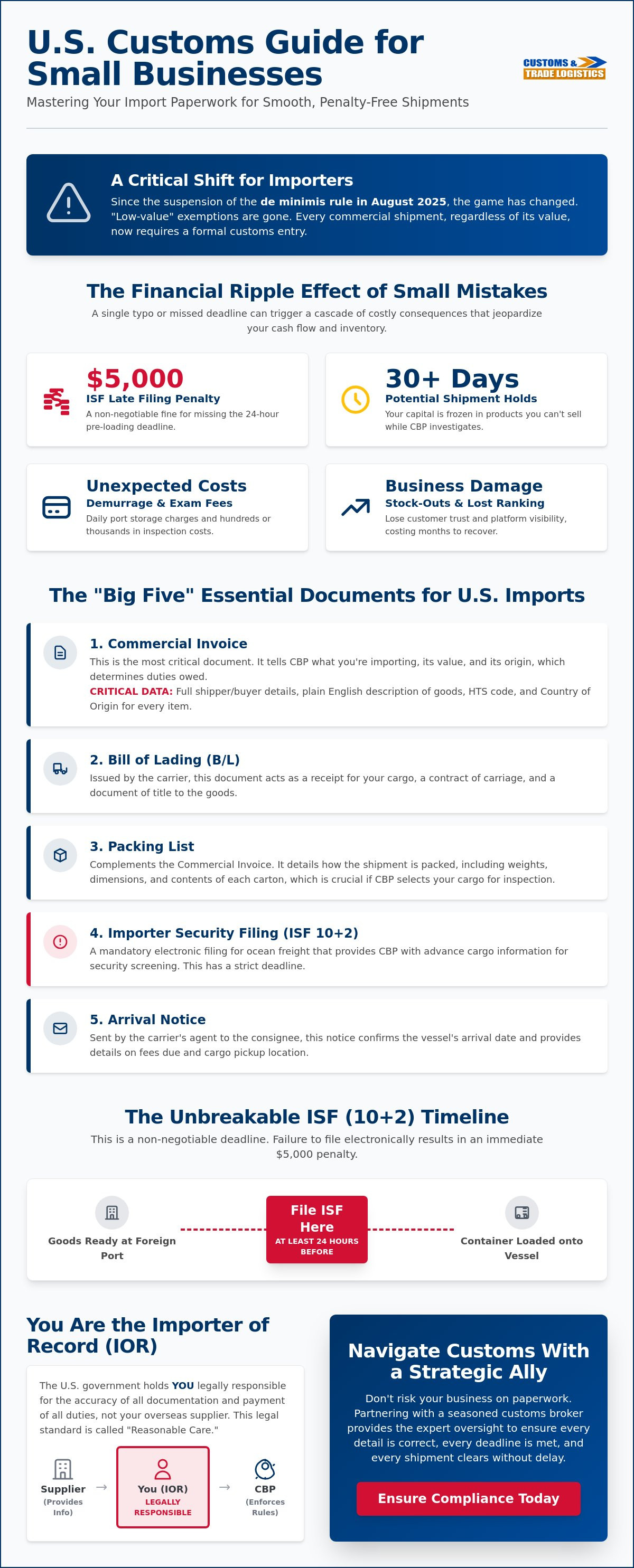
Think of customs paperwork for small business as the digital passport for your products. It isn't just a set of forms; it's a formal Customs declaration that tells U.S. Customs and Border Protection (CBP) exactly what you're bringing into the country, what it's worth, and where it came from. Since the suspension of the de minimis rule on August 29, 2025, this process has become mandatory for every commercial shipment, regardless of its value. You can no longer rely on "low-value" exemptions to skip the red tape. This shift means that small businesses must move from a reactive approach to a proactive compliance strategy to keep their inventory moving.
When paperwork is handled poorly, the consequences are immediate and expensive. You might face demurrage fees, which are daily charges for containers sitting at the pier, or storage fees at a bonded warehouse. In severe cases, CBP can assess liquidated damages, which are essentially fines for failing to follow the rules of your basic import bond. Beyond the money, your reputation with federal agencies is at stake. CBP maintains a history for every importer; if you established a pattern of "simple mistakes," you're much more likely to be flagged for intrusive, time-consuming inspections in the future.
The Financial Ripple Effect of Documentation Errors
A single typo in a Harmonized Tariff Schedule (HTS) code or a missing signature can trigger a 30-day shipment hold. During this time, your capital is tied up in products you can't sell. If CBP decides your cargo needs a physical inspection, you'll be responsible for "Exam Fees." These aren't government fines, but rather the costs charged by the terminal to move your container to an inspection site. For small businesses selling on platforms like Amazon, these delays are devastating. A stock-out doesn't just lose you a sale; it tanks your Inventory Performance Index (IPI) score and can take months of marketing spend to recover your search ranking.
- Demurrage: Port charges that accumulate when a container stays past its "free time."
- Intensive Exams: Physical inspections that can cost hundreds or thousands of dollars per container.
- Stock-out Risks: The loss of customer trust and platform visibility due to empty shelves.
Your Legal Responsibility as the Importer of Record
When you sign off on your entry, you're acting as the Importer of Record (IOR). This is a heavy title. It means you're the party legally responsible for ensuring that the goods are documented correctly and that all duties and fees are paid. You are the one responsible, even if your supplier in China fills out the forms and sends them over. The federal government expects you to exercise "Reasonable Care." This is a legal standard that requires you to take every possible step to ensure your declarations are accurate. If the paperwork is wrong, CBP won't call your supplier; they'll call you. Understanding this responsibility is the first step toward building a secure, reliable supply chain that supports your growth instead of hindering it.
The Essential "Big Five" Documents for Every US Import
While the prospect of managing customs paperwork for small business can feel like a mountain of bureaucracy, it usually boils down to five core documents. These are the tools that prove who you are, what you're buying, and how it's getting here. If you're feeling overwhelmed, looking at these Tips for New Importers and Exporters from CBP can provide a helpful foundation. However, understanding the specific nuances of each form is what prevents your shipment from being sidelined. It's not just about having the forms. It's about the data inside them.
Deep Dive: The Commercial Invoice Requirements
Your commercial invoice is the primary document CBP uses to determine the value of your goods and the duties you owe. It needs to be much more detailed than a standard retail receipt. Mandatory fields include full names and addresses for both the shipper and the buyer, along with a clear, plain-English description of the goods. You must state the "Country of Origin" for every single item in the shipment. Don't fall into the trap of labeling commercial cargo as a "Gift" or "Sample" to avoid duties. Since the 2025 policy changes, CBP scrutinizes these labels heavily, and mislabeling can lead to an immediate audit of your customs paperwork for small business.
Understanding the ISF (10+2) Filing Timeline
The Importer Security Filing, or "10+2," is a non-negotiable electronic submission for ocean freight. It must be filed at least 24 hours before the vessel is even loaded at the foreign port. This means you need to coordinate with your supplier days in advance to get the required data. If you miss this window or submit inaccurate information, the penalty starts at a minimum of $5,000 per violation. This isn't just a threat; it's a standard enforcement tool that can wipe out your profit margins on a single shipment.
Choosing the Right Customs Bond for Your Volume
A Customs Bond is a contract between the importer, the surety, and CBP. It ensures the government gets paid even if you can't fulfill your obligations. You have two main choices. A Single Entry Bond covers one specific shipment and is fine for a one-off import. However, a Continuous Bond is usually the smarter choice for anyone planning more than three shipments a year. It stays on file for twelve months and covers all your entries at every U.S. port, facilitating much faster clearance. If you're unsure which bond fits your current volume, our team can provide customs clearance services to help you choose the most cost-effective path for your growth.
Avoiding the Most Common Paperwork Pitfalls for SMBs
Even the most diligent entrepreneurs can stumble when managing customs paperwork for small business. The complexity isn't just in the volume of forms, but in the precision required for every data point. A single mismatch between your Bill of Lading and your Commercial Invoice can flag your shipment for an "intensive exam," which we previously noted can cost you thousands in terminal fees. Beyond simple typos, there are strategic traps that can lead to long-term audits or permanent seizures of your goods.
One of the most dangerous temptations is "undervaluing" a shipment to save on duties and taxes. While it might seem like a shortcut to better margins, U.S. Customs and Border Protection (CBP) uses sophisticated AI-powered tools to identify shipments priced significantly below market value. If you're caught, you won't just pay the difference; you'll face heavy penalties and lose your status as a low-risk importer. Keeping your records honest is the only way to ensure your inventory arrives without legal friction.
Mastering the Harmonized Tariff Schedule (HTS)
The HTS code is a 10-digit number that serves as the "DNA" of your product. The first six digits are part of a global system, but the final four are specific to the U.S. and determine your exact duty rate. Many small businesses make the mistake of relying solely on the HTS code suggested by their foreign supplier. This is a significant risk. Suppliers often use general codes that don't reflect the specific material or function of your item. If you misclassify a product and underpay duties, CBP can come back years later to collect the balance plus interest. Taking the time to research the 20-plus chapters of the tariff schedule, or consulting with a professional, protects your cash flow from these "hidden" costs.
Managing Partner Government Agencies (PGAs)
Customs isn't the only agency watching the border. Depending on what you're importing, you may need to satisfy Partner Government Agencies (PGAs). If you're bringing in cosmetics or food, the FDA wants to see specific safety registrations. Importing wireless electronics? The FCC requires documentation proving the devices don't interfere with radio frequencies. These PGA holds are often more rigid than standard Customs holds; CBP cannot release your goods until the specific agency gives the "may proceed" signal. Identifying these requirements during the sourcing phase is essential for maintaining a predictable delivery timeline. If you're unsure if your product falls under these rules, we can help you navigate the customs clearance services us landscape to ensure every specialized form is ready before your cargo hits the water.
- HTS Misclassification: Leads to overpaying duties or facing future collection actions.
- Valuation Errors: Triggers audits and damages your reputation with federal agencies.
- Inconsistent Data: Causes manual reviews and expensive shipment holds.
- Missing PGA Forms: Can lead to the permanent refusal of entry for regulated goods.
Step-by-Step Workflow: Organizing Your First Shipment
How do you turn a mountain of bureaucracy into a manageable routine? Organizing customs paperwork for small business works best when you follow a steady, chronological order. The journey of your inventory starts long before the ship leaves the dock, and missing a single milestone can lead to the expensive delays we've already discussed. By breaking the process into five distinct phases, you can replace anxiety with a predictable system that ensures your goods move smoothly from the factory to your warehouse.
- Phase 1: Pre-Shipment: Finalize your HTS classification and confirm any PGA requirements before you even pay your supplier's deposit.
- Phase 2: Booking and ISF: As soon as your cargo is booked, file your ISF. Remember, this must happen at least 24 hours before the vessel is loaded to avoid that $5,000 penalty.
- Phase 3: Transit: While your goods are at sea, review the final Bill of Lading against your Commercial Invoice. If you spot a discrepancy now, you still have time to fix it.
- Phase 4: Arrival and Entry: Upon arrival, your broker files the Entry Summary using the latest CBP Form 7501, which was updated on February 11, 2026. This is when you pay your duties and the Merchandise Processing Fee (MPF). For the 2026 fiscal year, the MPF is set at 0.3464%, with a minimum of $33.58 and a maximum of $651.50.
- Phase 5: Post-Entry: Once the goods are released, the process isn't over. You must ensure all duties are settled and the entry is "liquidated" by CBP, which confirms the transaction is legally closed.
The 72-Hour Pre-Arrival Checklist
Are you ready for the final stretch? Three days before your ship docks, you should perform a final sweep. Verify that your customs broker has every final document, including the packing list and any required safety certificates. Ensure your Customs Bond is active and has sufficient coverage for the duties owed on this specific shipment. Finally, confirm you've received the "Arrival Notice" from the carrier. This document is the trigger for the final entry process and ensures everyone is aligned for the offloading. If you want to ensure your first shipment is handled with expert care, our team provides comprehensive customs clearance services to manage every step of this workflow for you.
Record Keeping: The 5-Year Rule
Why a Professional Customs Broker is Your Best Small Business Ally
You've built your brand from the ground up. Do you really want to spend your evenings deciphering the latest tariff updates or worrying about a container sitting at the port? While some businesses try to manage customs paperwork for small business on their own, the risk of a single error far outweighs the cost of professional help. A licensed customs broker acts as more than just a data entry clerk. They are your dedicated advocate, standing between you and the complex web of federal regulations that can otherwise stall your growth.
If CBP ever flags your shipment for an audit or an inspection, your broker serves as your first line of defense. They communicate directly with federal investigators, providing the necessary documentation and technical explanations to resolve issues quickly. This buffer is invaluable for anyone managing customs paperwork for small business who may feel overwhelmed by the scale of international operations. It allows you to focus on selling your products while your broker manages the administrative weight of the border.
Beyond Filing: Logistics Consulting for Long-Term Savings
Our team brings 35 years of experience to the table, allowing us to identify duty-saving opportunities that others might miss. We don't just file your entry; we look at your entire supply chain to see where you can optimize costs. This includes coordinating the "last mile" delivery to your warehouse or directly to Amazon FBA centers. We ensure that your inventory doesn't just clear customs but arrives at its final destination without a hitch, maintaining your stock levels and protecting your seller reputation.
Getting Started with Customs and Trade Logistics
Ready to take the next step? For your first consultation, have your commercial invoices, packing lists, and any existing HTS codes ready for review. We'll walk you through the transition from the factory floor to your front door, ensuring a seamless journey for your goods. Professional brokerage transforms a complex regulatory burden into a streamlined business process. By partnering with experts who value personal connection as much as technical compliance, you gain the peace of mind needed to scale your operations with total confidence.
Secure Your Global Growth Strategy
Mastering the nuances of customs paperwork for small business is the difference between a thriving enterprise and one stalled by avoidable penalties. You've learned how to identify the "Big Five" essential documents, navigate the strict 24-hour ISF filing window, and avoid common HTS classification traps. By shifting from a reactive mindset to proactive compliance, you protect your cash flow and ensure your products reach your customers without friction. Each document you file accurately is a building block for your company's reputation with federal agencies.
Ready to lift the administrative burden off your shoulders? Let our family-owned team handle your customs paperwork today. With over 35 years of industry expertise and national coverage across all US ports, we are specialists in supporting SMBs and Amazon FBA sellers through every step of the import journey. We provide the personalized oversight and reliable partnership you need to navigate the complexities of global trade with total ease.
Your inventory is in a safe pair of hands. We're here to help you turn international logistics into your brand's greatest competitive advantage.
Frequently Asked Questions
Can I do my own customs paperwork as a small business owner?
You can legally file your own customs paperwork for small business, but it's rarely recommended for those without specialized software. Most small business owners find the learning curve for the Automated Commercial Environment (ACE) portal too steep to manage alongside daily operations. Using a broker ensures your filings are submitted through the Automated Broker Interface (ABI), which speeds up communication with CBP and reduces the likelihood of manual review.
How much does a customs bond typically cost for a new importer?
The cost of a customs bond depends on whether you choose a Single Entry or a Continuous Bond. A Continuous Bond is generally required to be 10% of the total duties, taxes, and fees you expect to pay in a year, with a minimum bond amount of $50,000. While the bond itself is a relatively small annual expense, it acts as a necessary financial guarantee that allows your cargo to move through the port without paying every fee upfront.
What is the most common reason for customs delays for Amazon sellers?
Amazon sellers most frequently face delays due to "Country of Origin" marking errors or missing product safety labels. If your commercial invoice says one thing but the physical packaging says another, CBP will hold the shipment for a marking exam. These holds are particularly painful for FBA sellers because they often lead to missed delivery windows and the inventory stock-outs we discussed earlier in this guide.
How do I find the correct HTS code for my specific product?
You can find the correct code by using the official HTS Search Tool provided by the U.S. International Trade Commission (USITC). It's best to search by the material and primary function of your item rather than just the product name. If your product is complex, like a smart device with multiple functions, you should seek professional advice to avoid the "HTS Code Trap" of overpaying duties or facing future audits.
What happens if my customs paperwork has a mistake after the goods arrive?
If you discover a mistake after your goods have arrived but before the entry has liquidated, you can file a Post-Summary Correction (PSC). This allows you to fix errors in value, classification, or origin without triggering a full audit. It's much better to be proactive and report the error yourself than to wait for CBP to find it, as voluntary disclosure often leads to significantly lower penalties and keeps your importer record clean.
How long does the customs clearance process take once paperwork is filed?
Most shipments clear customs within 24 to 48 hours after the paperwork is electronically filed, provided there are no flags for inspection. For ocean freight, your broker can actually file the entry up to five days before the ship arrives. This "pre-filing" allows CBP to review your data while the goods are still in transit, often resulting in an immediate release the moment the container hits the dock.
Do I need different paperwork for imports from China versus other countries?
The core documentation remains the same for all countries, but imports from China often require additional scrutiny due to Section 301 tariffs. You'll need to be extra careful with your HTS codes to ensure you're paying the correct supplemental duty rates, which can be as high as 25%. While the forms are identical, the financial stakes are higher, making meticulous customs paperwork for small business even more critical for China-based sourcing.
What are the penalties for failing to file an ISF on time?
Failing to file an Importer Security Filing (ISF) on time results in a liquidated damages penalty of $5,000 per violation. CBP is very strict about the 24-hour pre-loading rule for ocean cargo. If your paperwork is late or contains inaccurate data, they can also issue a "Do Not Load" order at the foreign port, which adds thousands of dollars in storage and re-booking fees to your total landed cost.


