
What if the "free pass" your business once relied on just vanished overnight? For many, that's exactly what happened when the $800 de minimis threshold was suspended, turning every small parcel into a formal entry headache. It's exhausting to deal with the fear of seized shipments while Amazon reminds you they won't act as your Importer of Record. You shouldn't have to guess which HTS codes are correct or worry about hidden costs eating your margins.
We're here to help you master customs clearance for Amazon sellers so you can reclaim control over your logistics. This guide provides the expert oversight you need to avoid FBA rejections and secure your legal compliance in a volatile trade environment. We'll walk through the 2026 CPSC eFiling rules, explain how to manage the latest global surcharges, and show you exactly how to build a seamless path from the factory floor to the Amazon warehouse. By the end of this reference, you'll have the confidence to manage your shipments without the stress of border delays.
Key Takeaways
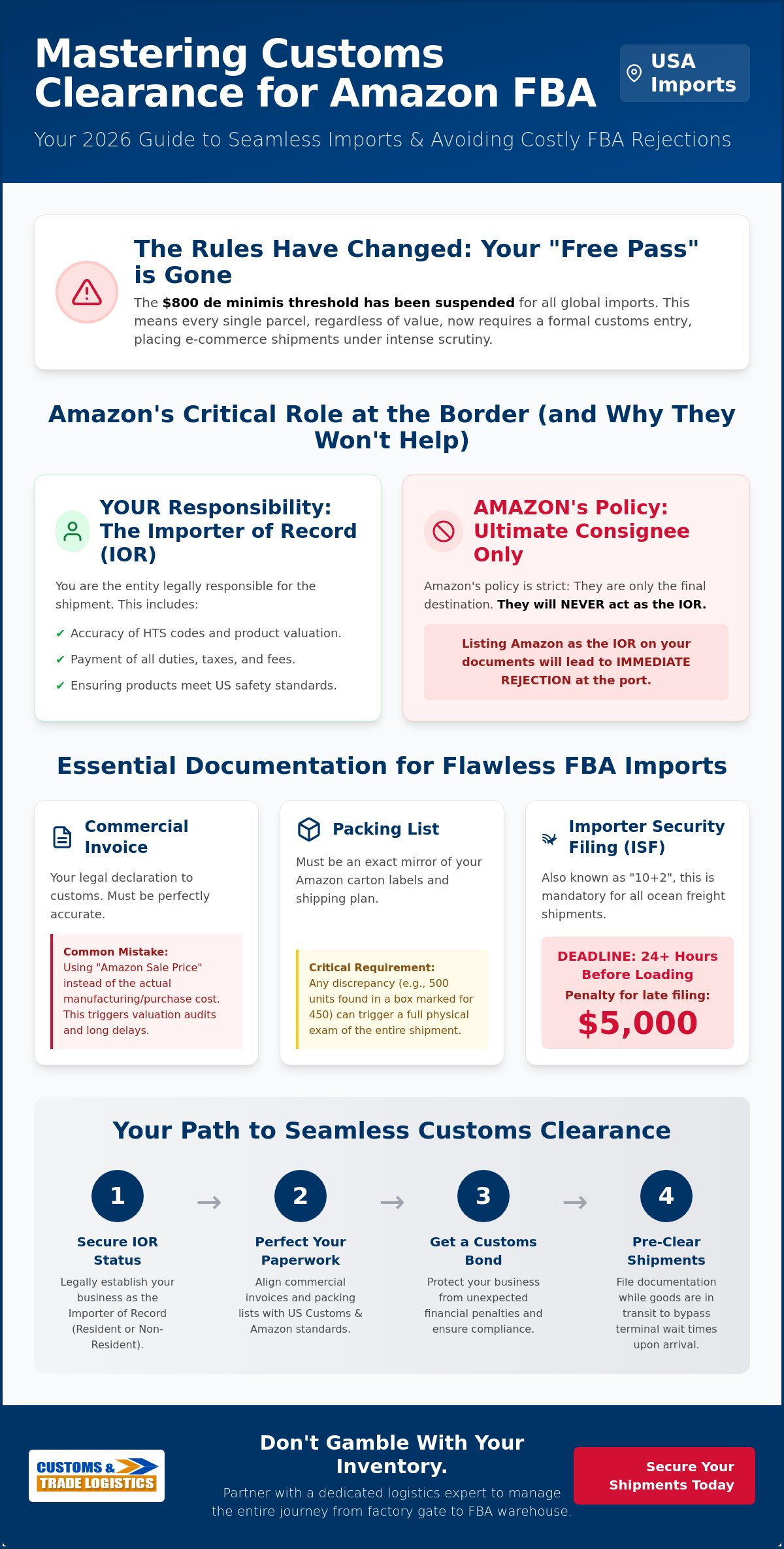
- Understand why Amazon refuses to act as your Importer of Record and how to legally secure this status to prevent your shipments from being seized.
- Learn how to align your commercial invoices and packing lists with both US Customs standards and Amazon’s strict carton requirements for 2026.
- Master the nuances of customs clearance for Amazon sellers by selecting the right customs bond to protect your business from unexpected financial penalties.
- Implement pre-clearance filing strategies to bypass terminal wait times and learn how to identify "false positive" delay notifications in your tracking data.
- Discover how a dedicated logistics partner provides a "safe pair of hands" by managing the entire journey from the factory gate to the FBA warehouse.
Why Customs Clearance is the "Make or Break" Step for Amazon Sellers
Getting your inventory to the United States border is only half the battle. If your paperwork isn't perfect, your business stops at the port. In 2026, the stakes are higher than ever for e-commerce entrepreneurs. Following the suspension of the de minimis threshold for all global imports in late 2025, every single shipment now requires a formal entry. Customs agents are scrutinizing e-commerce cargo with unprecedented intensity; they're looking for any reason to flag a shipment. If you don't have a clear strategy for customs clearance for Amazon sellers, you're essentially gambling with your inventory and your account's future.
The Importer of Record (IOR) Explained
The Importer of Record is the entity legally responsible for the entry documentation and payment of duties. This role is the foundation of any international shipment. Whether you're a US-based business acting as a Resident IOR or an international brand operating as a Non-Resident IOR, you carry the legal burden of compliance. This means you're responsible for the accuracy of HTS codes, the valuation of your goods, and ensuring all products meet safety standards. Understanding what is customs clearance is the first step toward realizing that the government holds you, not your freight forwarder or Amazon, accountable for every item in that container.
Why Amazon Won’t Help You at the Border
Many new sellers assume Amazon will handle the heavy lifting because they're a global giant. They won't. Amazon's policy is crystal clear: they're the "Ultimate Consignee," which is just a fancy way of saying they're the final destination. They'll never act as the importer. If you list Amazon as the IOR on your shipping documents, your shipment will be rejected immediately at the port of entry. This isn't just a minor delay. You'll face mounting storage fees, the high cost of returning the goods to the factory, or even the total destruction of your inventory. Amazon's refusal to participate in the border process is a protective measure for their business, leaving you to manage the legalities on your own.
Relying on "ghost importing," or shipping without a valid US tax ID, is a dangerous shortcut that no longer works in 2026. With the new CPSC eFiling requirements that went into effect in July 2026, electronic certificates of compliance must be filed at the time of entry for regulated goods. Missing these details doesn't just stall your shipment; it damages your Amazon Seller Central health metrics. Frequent logistics failures signal to Amazon that your supply chain is unreliable. This can lead to suppressed listings, inbound shipment blocks, or even total account suspension. Managing customs clearance for Amazon sellers correctly is about more than just avoiding taxes; it's about protecting the long-term viability of your brand.
Essential Documentation for FBA Imports: A 2026 Reference
Documentation is the digital fingerprint of your shipment. In 2026, with the total suspension of de minimis exemptions, your paperwork must be flawless to clear the border. Customs officials no longer overlook minor discrepancies in small-parcel imports. Every commercial invoice and packing list acts as a legal declaration. If the data on these forms doesn't match your Amazon shipping plan, you risk both a customs hold and an FBA warehouse rejection. Accurate paperwork is the only way to maintain a smooth Essential FBA Import Documentation process and keep your inventory moving.
Commercial Invoice and Packing List Requirements
Your commercial invoice is the most critical document for customs clearance for Amazon sellers. It must clearly state the transaction value, the country of origin, and a detailed description of the goods. A common mistake is using "Amazon sale price" instead of the actual manufacturing cost or purchase price. This triggers valuation audits that can stall your shipment for weeks. Your packing list must be equally precise. It needs to mirror your Amazon carton labels exactly. If Customs finds 500 units in a box marked for 450, they may flag the entire shipment for a physical exam, which adds significant costs and delays.
For those importing via ocean freight, the Importer Security Filing (ISF), also known as 10+2, is a mandatory step. You must file this electronically at least 24 hours before your cargo is loaded onto the vessel at the origin port. Failure to meet this deadline often results in a $5,000 fine from US Customs. If you're struggling to coordinate these moving parts, our team offers specialized customs clearance services to ensure every filing is submitted on time and without errors.
HTS Codes: Classifying Your Amazon Products
Classification is where many sellers lose their profit margins. HTS codes determine the duty rate for every imported product. Using the wrong ten-digit code can lead to overpayment or, worse, underpayment that results in heavy penalties. In 2026, specific tariffs are particularly steep. For example, Section 301 tariffs on Chinese imports can range from 7.5% to 100%, while Section 232 tariffs on steel and aluminum have risen to 50%. A simple classification error could accidentally land your product in a high-tariff category.
High-volume sellers should consider requesting a "binding ruling" from US Customs. This is a formal letter that confirms the correct HTS code for your specific product, providing a legal "safe harbor" against future audits. It's a proactive step that protects your bottom line and ensures your customs clearance for Amazon sellers remains predictable. By verifying your codes early, you avoid the sting of the 10% global surcharge implemented in early 2026 and ensure your landed cost calculations stay accurate.
Navigating FBA-Specific Customs Requirements
Once you've organized your documentation, the next step is establishing your legal standing with US Customs. This involves more than just filling out forms; it requires setting up a framework that allows your goods to move without constant manual intervention. If you're looking for a "safe pair of hands" to manage this, utilizing specialized customs clearance services us based can bridge the gap between your overseas factory and the FBA warehouse. To start, you'll need to sign a Power of Attorney (POA). This document doesn't give away control of your company; it simply grants your broker the legal authority to file entries on your behalf.
Securing the Right Customs Bond
Every formal entry requires a customs bond, which acts as a financial guarantee to the US government that all duties and fees will be paid. In 2026, choosing the right bond is a strategic financial decision. You have two primary options: a Single Entry Bond or a Continuous Bond. If you plan to ship more than three times in a calendar year, a Continuous Bond is almost always the more cost-effective choice. It covers all your imports for a full 12 months, regardless of how many shipments you send or which ports you use. With the 2026 landscape requiring formal entries for even the smallest parcels, the efficiency of a Continuous Bond helps you avoid the repetitive paperwork and higher cumulative costs of single-entry filings.
The Ultimate Consignee Distinction
Confusion between the Importer of Record (IOR) and the Ultimate Consignee is a leading cause of customs clearance for Amazon sellers being delayed. As we established earlier, Amazon will never act as your IOR. However, they must be listed as the "Ultimate Consignee" on your customs entry. This tells the government that while you are the owner responsible for the taxes, the goods are physically headed to an Amazon fulfillment center. For international sellers, this requires linking your foreign entity to a US-assigned tax ID or a Customs Assigned Importer Number (CAIN) to ensure the bond is valid.
Managing deliveries to multiple FBA warehouses adds another layer of complexity. Since Amazon often splits your inventory across different states, your customs entry must reflect the primary destination while acknowledging the ultimate delivery points. Ensuring your bond and tax ID are correctly linked prevents the "shipment rejected" notifications that haunt so many Seller Central accounts. By clearly defining these roles before your cargo leaves the factory, you create a transparent logistics chain that satisfies both US Customs and Amazon’s strict receiving protocols. This clarity is essential for maintaining your account health and ensuring your products are available for customers without a hitch.
Strategies to Prevent "Customs Clearance Delay" Notifications
Few things trigger panic like seeing a "Customs Clearance Delay" status on your Amazon shipping queue. You've done the hard work of sourcing and shipping, only to feel like your inventory is stuck in a black hole. In many cases, these notifications are actually false positives caused by data sync issues between carrier APIs and Amazon’s internal system. Understanding the mechanics of customs clearance for Amazon sellers means knowing when to worry and when to simply wait for the systems to catch up. By implementing a proactive strategy, you can minimize these alerts and keep your supply chain moving toward the FBA warehouse without unnecessary friction.
The Amazon Tracking Glitch: Fact vs. Fiction
Have you ever received an "additional documentation required" alert even after your broker confirmed the shipment was cleared? This often happens during the handoff between the international carrier and the domestic delivery leg. Amazon’s API sometimes misinterprets a standard customs processing scan as a permanent hold. This glitch can lead to anxious customers and negative feedback if you're using Seller Fulfilled Prime or shipping directly to buyers. To manage this, don't rely solely on the Seller Central dashboard. Your broker can verify the actual status of the entry through the Automated Commercial Environment (ACE) portal, giving you the peace of mind that your goods are actually on the move.
Proactive Pre-Clearance Techniques
The best way to avoid a terminal wait is to finish the customs process before your cargo even touches US soil. For ocean freight, your broker can often file the entry up to five days before the vessel arrives at the port. For air shipments, we aim for a "wheels up" clearance, filing as soon as the plane is in the air. This is particularly vital in 2026, as new regulations like the CPSC eFiling requirement (effective July 8, 2026) demand that certificates of compliance be filed at the time of entry. Resolving these requirements or handling Partner Government Agency (PGA) holds like the FDA while the goods are in transit ensures that your shipment is "cleared on arrival," bypassing the congested exam sites.
Even after clearing the border, the "last mile" can still present challenges. Utilizing a strategy for import delivery and redistribution allows you to move goods from the port to a central hub before they are split into smaller FBA shipments. This extra step prevents the common tracking errors that occur when a single large import is broken down into dozens of individual UPS or FedEx boxes. If you're tired of guessing where your inventory is, you can partner with our logistics experts to ensure your data and your cargo stay perfectly in sync. Taking these proactive steps doesn't just prevent delays; it protects your Amazon account health from the sting of inbound defect fees, which can now reach as high as $5.72 per unit for standard-sized items.
Partnering with a Customs Broker for FBA Growth
Why do some brands scale effortlessly while others get trapped in a cycle of port delays and unexpected fees? The difference is often found in the quality of the partnership behind the scenes. While modern software can automate a form, it can't advocate for your business when a customs official decides to pull your container for a manual exam. Choosing a family-owned partner provides you with a "safe pair of hands" that values your growth as much as you do. We've spent over 35 years navigating the complexities of global trade, and we use that experience to ensure customs clearance for Amazon sellers is a bridge to success rather than a barrier.
Beyond the Entry: Logistics Consulting
Managing a successful Amazon business in 2026 requires a deep understanding of your total landed cost. With the 10% global surcharge implemented earlier this year and the permanent suspension of de minimis exemptions, your margins are under constant pressure. Our team provides specialized import from China consulting to help you navigate these shifting waters. We look past the immediate shipment to help you evaluate how duty rates and FBA fee increases impact your bottom line. As your SKU count grows, our seasoned mentors help you scale your logistics chain, ensuring your redistribution strategy remains efficient even as your operations become more complex.
The Customs and Trade Logistics Advantage
Our commitment is to demystify the intimidating world of international trade, replacing your anxiety with a sense of security. We provide national coverage, allowing us to clear your goods at any US port, whether they arrive by air in Chicago or by sea in Long Beach. You won't be left talking to a chatbot or waiting days for a ticket response. Instead, you get direct access to experts who understand the nuances of the 2026 regulatory landscape, from the latest CPSC eFiling requirements to the complexities of Section 301 tariffs. We act as your dedicated advocate, managing the entire journey from the factory gate to the FBA warehouse so you can focus on what you do best: growing your brand.
Are you ready to stop worrying about the border and start focusing on your customers? Our end-to-end management approach ensures your shipments are compliant, your costs are transparent, and your inventory is always where it needs to be. Let us take the administrative burden off your shoulders and provide the professional assurance you need to succeed in the global marketplace.
Secure Your FBA Logistics for 2026 and Beyond
Mastering the border is no longer optional for your brand's survival. By securing your status as the Importer of Record and perfecting your HTS classifications, you protect your margins from the 2026 surcharge and avoid the trap of FBA shipment rejections. You've learned how to bypass automated tracking glitches and why pre-clearance is the secret to a fast logistics chain. These steps ensure that customs clearance for Amazon sellers becomes a predictable part of your business growth rather than a source of constant stress.
You don't have to face these regulatory hurdles alone. With over 35 years of industry expertise, our family-owned team acts as your dedicated mentor in China-to-US FBA logistics. We provide the personalized oversight needed to demystify complex trade laws and keep your inventory moving smoothly. Let our experts handle your Amazon customs clearance. Contact Customs and Trade Logistics today. We're ready to be the safe pair of hands your business deserves. Your global marketplace expansion is within reach, and we're here to help you cross every border with confidence.
Frequently Asked Questions
Will Amazon act as my Importer of Record?
No, Amazon will never act as your Importer of Record. Their policy is very strict on this point because they don't want the legal or financial liability associated with your imports. If you list Amazon as the IOR on your shipping documents, the shipment will be rejected at the border. You must take responsibility for the entry yourself or use a dedicated service to manage the process correctly.
What is the difference between an IOR and an Ultimate Consignee for FBA?
The Importer of Record (IOR) is the entity legally responsible for the accuracy of documentation and the payment of all duties. The Ultimate Consignee is simply the final delivery address where the goods are headed. For your shipments, you are the IOR, and the specific Amazon fulfillment center is the Ultimate Consignee. Distinguishing these roles is a fundamental part of customs clearance for Amazon sellers.
Do I need a customs bond for every Amazon shipment?
Yes, you need a bond for every formal entry. Since the $800 de minimis threshold was suspended for all global imports in August 2025, almost every shipment now requires a bond. You can use a Single Entry Bond for an individual shipment, but most growing sellers find that a Continuous Bond is more efficient. This yearly bond covers all your imports and simplifies the paperwork for your entire supply chain.
How long does customs clearance typically take for FBA inventory?
Standard clearance usually takes between 24 and 48 hours if your broker files the entry before the cargo arrives. However, this timeline can change quickly if US Customs selects your shipment for a physical exam. These inspections can add anywhere from a few days to several weeks to your lead time. Filing early and ensuring your documentation is perfect are the best ways to keep your inventory moving.
Can I import to Amazon FBA as a foreign seller without a US office?
You can absolutely import as a foreign entity by acting as a Non-Resident Importer (NRI). You don't need a physical US presence, but you will need a US Customs bond and a Customs Assigned Importer Number. This allows you to manage customs clearance for Amazon sellers from your home country. It is a very common practice for international brands looking to tap into the massive US customer base.
What are the most common reasons for Amazon customs delays?
Delays are usually caused by missing paperwork or incorrect product classifications. In 2026, many sellers are facing holds because they haven't complied with the new CPSC eFiling requirement that started on July 8, 2026. Other frequent issues include HTS code errors that trigger valuation audits and Partner Government Agency (PGA) holds, such as those from the FDA. Having a knowledgeable broker helps you spot these red flags before they stop your shipment.
How much are customs brokerage fees for Amazon sellers?
Industry fees for a standard formal entry typically fall between $150 and $400 depending on how complex your shipment is. You should also account for mandatory government fees like the Merchandise Processing Fee, which is currently 0.3464% of the value of your goods. While these costs are an investment, they're much lower than the storage fees or Amazon inbound defect fees you would pay if your shipment was stuck or rejected.
What happens if my shipment is rejected by Amazon at the warehouse?
If Amazon refuses a delivery, the carrier will typically move the goods to a local terminal or return them to the port. This often happens due to labeling errors or damage during transit. To avoid the high cost of shipping items back to an overseas factory, many sellers use a redistribution service to inspect and fix the inventory locally. This ensures your products can be successfully redelivered to FBA without further account health issues.


