

Did you know that since the suspension of the $800 de minimis rule in late 2025, every single commercial shipment now requires a formal customs entry regardless of its value? This policy shift has made the process of calculating landed cost for imports much more demanding for small businesses. It's completely normal to feel a bit of anxiety when you see vague shipping quotes or struggle with the dense logic of HTS code classifications. You want to grow your brand, not spend your nights worrying about whether a hidden port fee will wipe out your entire quarterly profit.
We understand that the logistics industry can feel intimidating, but we're here to act as a safe pair of hands for your operations. This guide will help you master the math behind your margins and discover how to identify the specific fees that generic calculators often overlook. We'll walk through the current 2026 fee structures, including the latest Merchandise Processing Fee (MPF) adjustments and the reality of rising truckload costs. By the end of this article, you'll have a clear, step-by-step framework to protect your bottom line and ensure your international operations remain a source of strength rather than stress.
In This Guide:
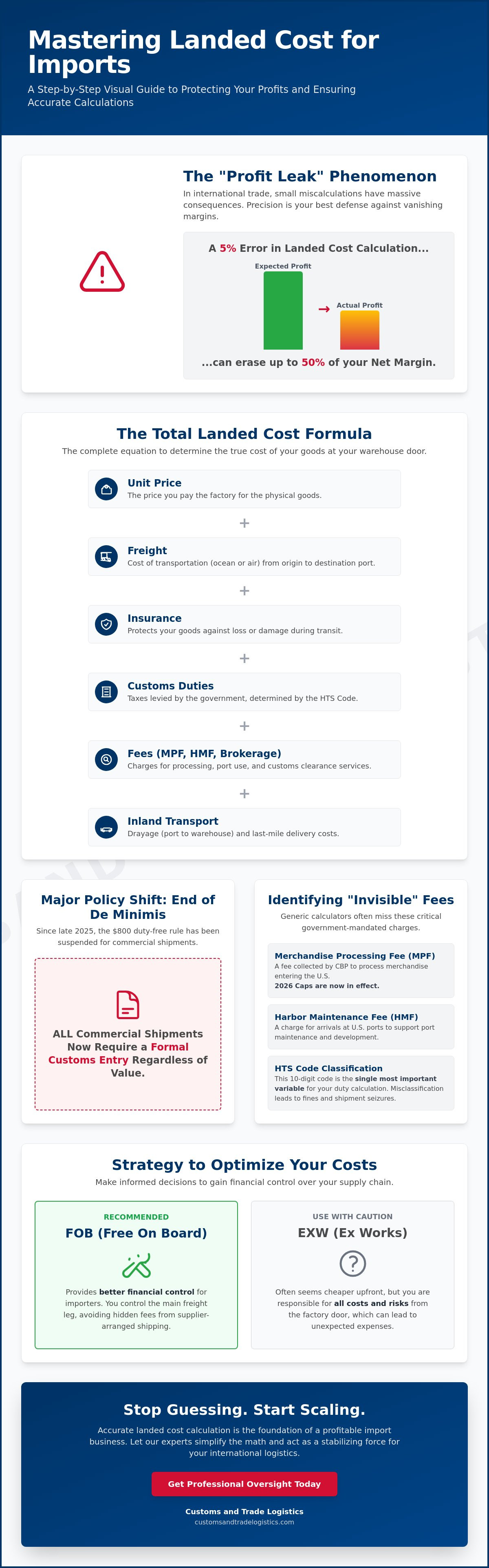
- Understand the "Profit Leak" phenomenon and how a 5% error in your math can erase up to 50% of your net margin.
- Master the full formula for calculating landed cost for imports, including unit price, freight, insurance, and duties.
- Identify "invisible" fees like the Harbor Maintenance Fee (HMF) and the latest 2026 Merchandise Processing Fee (MPF) caps.
- Discover cost-saving strategies, such as why choosing FOB over EXW often provides better financial control for small businesses.
- Learn how professional oversight can simplify HTS code classification and act as a stabilizing force for your international logistics.
What is Landed Cost and Why Does Precision Matter for Importers?
To put it simply, Landed Cost represents the total price of a product once it has safely arrived at your warehouse door. It's the sum of every penny spent to get an item from the factory floor to your inventory shelf. While it sounds straightforward, many small business owners fall into the trap of only looking at the supplier's invoice. In reality, the invoice is just the beginning of the story.
Precision is your best defense against the "Profit Leak" phenomenon. In the world of international trade, a tiny 5% error in your initial math can easily erase 50% of your net margin. This happens because margins for Amazon and e-commerce sellers are often tighter than they appear. If you don't account for a specific port fee or a sudden shift in trucking rates, that expected profit quickly evaporates. Accurate calculating landed cost for imports allows you to set retail prices that are both competitive and sustainable, ensuring you aren't accidentally selling at a loss.
The Difference Between Unit Cost and Landed Cost
Unit cost is what you pay the factory for the physical goods. Landed cost is what the global market requires you to pay to actually possess those goods. It's easy to get excited when a supplier offers "Free Shipping," but experienced importers know this is a psychological trap. That cost is either baked into a higher unit price or it ignores the inevitable customs duties and port handling fees that wait for you at the border. Focusing only on the invoice price creates a false sense of security that can derail your financial planning.
Why Accurate Calculations Protect Your Business Standing
Beyond your bank account, precision protects your reputation with regulatory bodies. Underestimating your costs often leads to the underpayment of duties, which can trigger a US Customs audit. These audits are stressful, time-consuming, and expensive. By being diligent with your math, you ensure your business remains in good standing while keeping your cash flow healthy. You'll know exactly when to expect port and brokerage fees, which allows you to build a reliable financial roadmap for every new product launch. This level of oversight turns a complex, intimidating process into a predictable sequence of events that supports your long-term growth.
Mastering the art of calculating landed cost for imports is the first step toward moving from a reactive business model to a proactive one. It replaces guesswork with certainty, giving you the confidence to scale your operations without fear of hidden financial traps.
The Total Landed Cost Formula: Breaking Down the Components
To move from a rough estimate to a precise financial roadmap, you need a formula that captures every dollar spent. The process of calculating landed cost for imports involves summing six primary components: Unit Price, Freight, Insurance, Customs Duties, Fees, and Inland Transport. While the unit price is fixed by your supplier, the other variables can shift based on your choices. For instance, choosing air freight provides speed but significantly increases your freight line item, whereas ocean freight is more economical but introduces additional port handling complexities.
The final leg of the journey is often where small businesses find the most surprises. You must factor in "drayage," which is the short-haul trucking required to move a container from a port to a warehouse, as well as the last-mile delivery to your facility or an Amazon FBA center. Missing these small links in the chain can lead to unexpected invoices that eat into your margins at the very last second.
HTS Codes: The Foundation of Duty Calculation
The Harmonized Tariff Schedule (HTS) code is the single most important variable in your customs duty calculation. This ten-digit number determines exactly how much tax you owe the government. Finding the right code can feel like searching for a needle in a haystack, but precision is non-negotiable. If you misclassify your goods, you risk more than just a wrong calculation. You could face heavy fines, shipment seizures, and even retroactive duty payments that go back years. Because tariff laws change frequently, it's helpful to seek to stay ahead of regulatory shifts.
If you feel overwhelmed by the technical density of these codes, you aren't alone. Many successful importers rely on professional customs clearance services to verify code accuracy and ensure they aren't overpaying or inviting a costly audit.
Insurance and Valuation: Protecting Your Investment
Insurance isn't just a "nice to have" addition; it's a critical component of your total valuation. Most insurance premiums are calculated based on the CIF (Cost, Insurance, and Freight) value. It's a common mistake to rely solely on "Carrier Liability," which often only covers a fraction of your shipment's actual worth. By securing comprehensive cargo insurance, you protect your investment from damage or loss while also establishing the correct valuation for tax purposes. This valuation directly affects your total tax liability at the port of entry, so keeping your records clear and your coverage adequate ensures a smoother transition through customs.
Identifying the 'Invisible' Fees: MPF, HMF, and Brokerage
While freight rates and customs duties take up the most space on your spreadsheet, the "invisible" fees often cause the most stress for small businesses. These are the secondary regulatory costs that many generic online calculators simply ignore. Because the $800 de minimis exemption was suspended in August 2025, almost every commercial shipment now requires a formal entry. This means calculating landed cost for imports must now include specific US Customs user fees that you might have previously avoided.
Beyond government fees, you also need to account for potential penalties like demurrage and detention. Demurrage occurs when your cargo stays at the port longer than the allotted "free time," while detention is charged for the late return of the equipment itself. These daily costs can escalate quickly, turning a profitable shipment into a financial burden if your paperwork isn't processed with speed and precision.
Navigating MPF and HMF Calculations
The Merchandise Processing Fee (MPF) is an ad valorem fee charged by US Customs to cover the administrative costs of processing your shipment. For formal entries, this is calculated at a rate of 0.3464% of your cargo's value. For the 2026 fiscal year, the Merchandise Processing Fee features a minimum of $33.58 and a maximum of $651.50 per formal entry. If you're bringing goods in via ocean freight, you'll also encounter the Harbor Maintenance Fee (HMF). This is a flat 0.125% of the cargo value with no minimum or maximum cap. It's important to remember that HMF only applies to sea shipments; if you've switched to air freight to save time, you can leave this specific line item out of your budget.
The Value of Professional Brokerage Fees
It's tempting to view a customs broker's fee as just another expense, but it's actually one of the most effective ways to protect your margins. A broker doesn't just file paperwork; they act as your advocate. They look for duty drawback opportunities or trade preference programs that could significantly lower your overall tax bill. By ensuring every document is prepared correctly the first time, an expert broker reduces the risk of your goods being pulled for a costly physical exam or held at the port. This proactive oversight keeps your supply chain moving and prevents the "hidden" penalties mentioned earlier from ever appearing on your invoice. When calculating landed cost for imports, including a professional service fee is a small price to pay for the security of a "safe pair of hands" managing your compliance.
Strategies to Optimize and Reduce Your Landed Cost
Once you've mastered the mechanics of calculating landed cost for imports, the next step is moving from observation to optimization. You don't have to accept every fee as a fixed cost. By strategically adjusting how you buy and move your goods, you can uncover significant savings that go straight to your net margin. This proactive approach is what separates a scaling brand from one that is merely surviving. It turns your logistics from a line item into a genuine competitive advantage.
Consolidation is another powerful tool for small businesses. By grouping smaller shipments into a single larger container, you can slash your per-unit freight cost and minimize the impact of flat fees. Since the suspension of the de minimis rule in August 2025, every shipment now incurs formal entry costs. Consolidating goods helps you hit the Merchandise Processing Fee (MPF) maximum more efficiently rather than paying the minimum fee multiple times on smaller, separate parcels.
Choosing the Right Incoterms for Your Business
Choosing the right Incoterm is perhaps the most powerful lever at your disposal. Many newcomers start with Ex Works (EXW) because it seems simple, but it often leaves you vulnerable to "invisible" local fees in the origin country that are difficult to audit from thousands of miles away. Switching to Free On Board (FOB) is usually a smarter move for small businesses. With FOB, the supplier is responsible for all costs until the goods are loaded onto the vessel. This gives you cleaner oversight and more control over the international freight and insurance components.
Be cautious of Delivered Duty Paid (DDP) agreements. While they promise a "hands-off" experience, suppliers often bake in high buffers to cover their own risks. This means you likely end up overpaying for the convenience. Taking control of the process yourself ensures you only pay the actual costs required to move your goods.
Leveraging Trade Expertise for Duty Reduction
Tariff environments are incredibly volatile. In 2025, tariff policies changed on average every 1.5 weeks, making it nearly impossible for a solo entrepreneur to stay current. This is particularly true for the "China Factor." While Mexico has surpassed China as the United States' top trade partner as of June 2026, many businesses still rely on Chinese manufacturing and must navigate complex Section 301 duties. Identifying specific exclusions can slash your tax liability overnight.
A thorough supply chain audit can reveal hidden opportunities for duty reduction. By ensuring your "Country of Origin" markings are accurate and exploring trade preference programs, you can avoid punitive tariffs that your competitors might still be paying. If you're feeling overwhelmed by these variables, our Import From China Consulting services can help you navigate these negotiations with confidence, ensuring you never pay more than is legally required to bring your products home.
Partnering for Profit: How Customs and Trade Logistics Simplifies the Math
How do you turn a sea of complex variables into a predictable business plan? It starts with having a partner who has seen every shift in the industry over the last three decades. With over 35 years of experience, we specialize in demystifying the importation process for small businesses. We don't just provide you with a static formula; we act as a stabilizing force that lifts the heavy administrative burden from your shoulders. Our family-owned approach ensures you receive personalized care that large, impersonal aggregators simply can't match. You aren't just a shipment number to us; you're a partner we're deeply invested in seeing grow.
Our team provides end-to-end oversight that begins at the factory floor in China and continues until your goods reach their final US destination. By offering a single, reliable point of contact for all US Customs ports, we replace the anxiety of logistics with a sense of security. You won't have to chase down different vendors or wonder which stage of the journey your cargo is in. We manage the movement, oversight, and facilitation of your goods with the diligent care of a seasoned mentor, acting as your knowledgeable bridge to the global marketplace.
Our End-to-End Import Management Process
We coordinate your international freight logistics to ensure every shipment arrives on time and within budget. Our team handles the professional preparation of all US Customs entry documentation, which is the most effective way to prevent the "holds" or exams that lead to unexpected costs. We also provide specialized consulting for Amazon sellers and e-commerce brands, helping you protect your margins in a high-growth environment. This comprehensive management ensures that every detail, from HTS classification to final delivery, is handled with technical precision.
Ready to Calculate Your Real Margins?
Investing in a "safe pair of hands" is the best way to protect your growing brand from the volatility of global trade. When calculating landed cost for imports, having an expert eye to spot potential errors or duty-saving opportunities can save you thousands of dollars over the life of a product line. We help you navigate the specific complexities of imports from China, ensuring your business remains compliant even as regulations shift. This proactive care allows you to focus on building your business while we handle the logistical heavy lifting.
Don't let hidden fees or technical jargon hold your business back from reaching its full potential. Get a professional landed cost analysis from our experts today and start calculating landed cost for imports with total peace of mind. We are ready to help you move forward with confidence and clarity.
Secure Your Margins with Professional Precision
Mastering the technical details of your supply chain is the most effective way to replace anxiety with a sense of security. By identifying those "invisible" fees and choosing the right Incoterms, you've already taken the first steps toward protecting your business from the profit leaks that derail so many importers. Accurately calculating landed cost for imports isn't just a math problem; it's a strategic shield that ensures your retail pricing remains both competitive and profitable.
You don't have to navigate these global complexities alone. Our family-owned team brings over 35 years of industry expertise to your side, offering specialized support for China-to-US logistics that large aggregators can't match. We act as a safe pair of hands, providing the diligent oversight needed to keep your operations moving smoothly. Ready to move forward with total clarity? Request a Professional Customs Consultation today. Your brand's growth deserves the stability of a seasoned partner, and we're here to help you succeed every step of the way.
Frequently Asked Questions
What is the most common mistake when calculating landed cost for imports?
Focusing solely on the supplier's invoice price is the most common error importers make. This oversight ignores the significant impact of port fees, inland trucking, and regulatory costs that accrue after the goods leave the factory. When you're calculating landed cost for imports, you must account for the entire journey. Missing even a small handling fee can quickly turn a projected profit into an unexpected loss for your small business.
How do I find the correct HTS code for my product?
You can find your HTS code by using the official U.S. International Trade Commission search tool or by consulting a licensed professional. While the online database is a good starting point, many products fall into "grey areas" that require expert interpretation. Misclassification can lead to heavy fines or shipment seizures, so having a mentor guide you through the 10-digit coding process ensures both your compliance and your financial accuracy.
What are the current US Customs Merchandise Processing Fee (MPF) rates for 2026?
For the 2026 fiscal year, the Merchandise Processing Fee for formal entries is set at an ad valorem rate of 0.3464%. This fee is subject to specific limits; the current minimum is $33.58 and the maximum is $651.50 per entry. These rates took effect on October 1, 2025, and are a vital part of your budget now that the $800 de minimis exemption has been suspended for all commercial shipments.
Does landed cost include the shipping from the port to my warehouse?
Yes, a true landed cost calculation must include every expense required to move goods from the port of entry to your final door. This includes "drayage" fees for moving containers out of the terminal and the final "last-mile" delivery to your facility or an Amazon FBA center. If you stop your math at the port, you aren't seeing the full picture of your product's actual profitability or your true cash flow needs.
Why is my landed cost higher when importing from China compared to other countries?
Higher costs for Chinese imports are primarily driven by Section 301 tariffs and the recent removal of de minimis treatment for China-origin parcels. These additional duties can range from 7.5% to 25% or more depending on the specific HTS classification. Managing these specific tariffs requires a strategic approach and expert oversight to ensure your margins remain healthy despite the increased regulatory pressure on goods originating from China.
Can a customs broker help me reduce my total landed cost?
A customs broker can absolutely help reduce your total costs by identifying duty drawback opportunities and trade preference programs you might otherwise miss. They act as your advocate, ensuring you don't overpay on duties or trigger expensive port exams due to paperwork errors. Their expertise often pays for itself by preventing the daily penalties associated with shipment delays or incorrect HTS classifications, making them a "safe pair of hands" for your brand.
What happens if I underestimate my landed cost and can't pay the duties?
If you cannot pay the required duties, US Customs will hold your shipment at the port of entry. This situation often triggers daily storage fees, known as demurrage, which can escalate your debt rapidly and eat into your remaining capital. Eventually, the government may consider the goods abandoned, leading to a total loss of your investment. It's much safer to have a reliable financial roadmap in place before your cargo ever reaches the border.
Is insurance mandatory for calculating landed cost?
While cargo insurance isn't legally mandated by US Customs, it's an essential component of a responsible risk management strategy. It protects your capital from damage or loss during the long international journey and helps establish the correct valuation for tax purposes. Relying on basic carrier liability is often a mistake, as it rarely covers the full replacement value of your goods, leaving your small business vulnerable to a total financial loss.


